
Simanaitis Says
On cars, old, new and future; science & technology; vintage airplanes, computer flight simulation of them; Sherlockiana; our English language; travel; and other stuff
ON ENVIRONMENTAL PHILOSOPHY
THE AMERICAN ASSOCIATION FOR THE ADVANCEMENT OF SCIENCE maintains a lively Member Community, one of its active members being Ronnie Hawkins, whose PhD in Philosophy and MD combine in her speciality of environmental philosophy. Ronnie (she seems to eschew “Dr. Hawkins” in her AAAS Profile) has a focus on “the continuing anthropocentric impoverishment of the biosphere.”

With this in mind, Ronnie comments at the Member Community about “human evolution, the feedback loops that have generated the unsustainable Anthropocene that we’re currently living enmeshed in, and our capacity for ‘evolvability’ as a species that we hope just might allow us to get back on a path to global sustainability in the future.”

Ronnie Hawkings, MD, PhD, Department of Philosophy, University of Central Florida.
Heady stuff, this. But it’s essential that philosophers offer intelligent thought about our helter-skelter proclivities. In particular, Ronnie cites two papers on this subject: Evolution of the Polycrisis: Anthropocene Traps that Challenge Global Sustainability, by Jorgensen et al. (www.ncbi.nlm.nih.gov/pmc/articles/PMC10645130), and Our Fragile Future under the Cumulative Cultural Evolution of two technologies, by Charles Efferson et al. (pubmed.ncbi.nlm.nih.gov/37952623).
The Jorgensen paper discusses “evolutionary traps.” The Efferson paper is a mathematical modeling study of “human populations size and our investment in technologies for producing and consuming resources.” Tidbits follow gleaned from Ronnie’s cogent comments.

Evolutionary Traps. Such traps can affect any species: Ronnie cites “seabirds ingesting floating plastic waste because it resembles normal food sources in the marine environment that they have evolved to consume.”
Humans too are subject to evolutionary traps: Ronnie describes “… practice that may have initially promoted human well-being… but that become maladaptive and yet seem to have us behaviorally and institutionally ‘trapped’ on a clearly unsustainable trajectory.”
A Human Example. Jorgensen et al. offer a long-term example in which “selection for higher levels of social organization leads to specialization, which leads to increased efficiency and growth, which leads to ever-expanding resource needs” (which may well be unsustainable).
What’s more, Ronnie notes, the researchers “speculate about how we might intentionally evolve culturally to break out of these traps.”
Mathematical Modeling. Using mathematical techniques to model environmental activities has been discussed here at SimanaitisSays. Thus I had special interest in Efferson et al. Ronnie writes, “Their model comes up with ‘a wide range of dynamical regimes,’ but the system overall is said to exhibit ‘a basic fragility in the sense that human activities often lead to the endogenous extinction of the human species,’ which can either ‘happen gently’ or follow ‘periods of explosive human activity with super-exponential growth that ends in collapse.’ ”
Yep, so it is with dynamical systems that are “structurally unstable,” in which subtle changes in initial conditions can lead to wildly different outcomes. In particular, one path of evolution may lead to cyclic sustainability; a nearby one, to extinction.
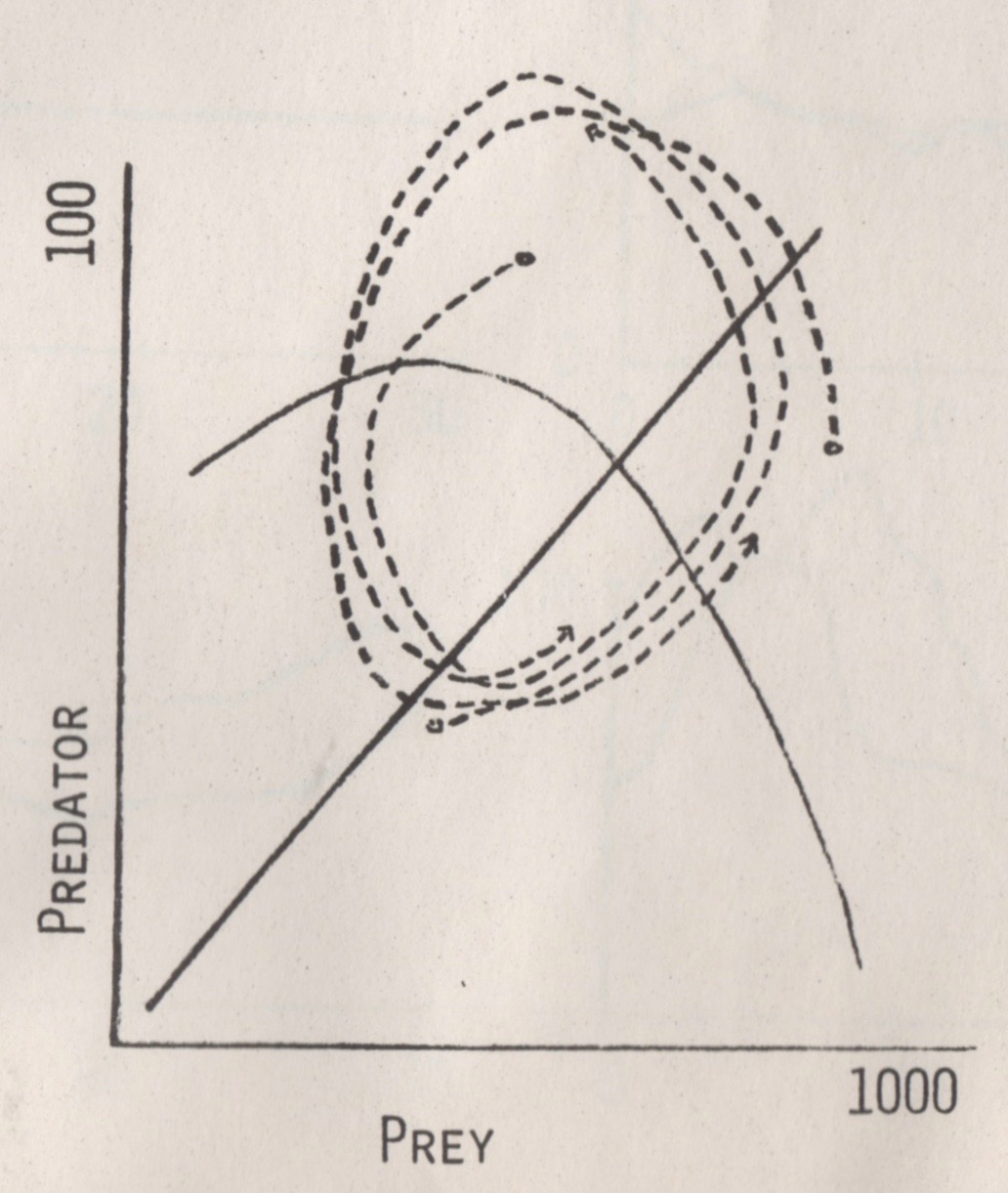
A periodic outcome with specific age distributions of predator and prey. Illustration from Predator/Prey Dynamics with Age Distributions; Preliminary Report, D.J. Simanaitis and William P. MacLean, Ninth Annual Symposium on Some Mathematical Questions in Biology, 1975.
Ronnie’s Conclusions. “Though they do not state this, their modeling seems to yield results that exemplify the ‘trap’ of pursuing the ‘growth-for-growth’ strategy identified by Jorgensen et al, where what’s happening now is that ‘institutional lock-ins drive pursuit of growth at the cost of well-being.’ ”
She says, “Inviting us to see ourselves in global, ecological and evolutionary context and consider not only what we have ‘accomplished’ so far but where we might be headed in the not-too-distant future makes this collection good preparation for ushering in 2024. Happy New Year, everybody!”
And thanks, Ronnie, for this philosophical perspective. ds
© Dennis Simanaitis, SimanaitisSays.com, 2024
 Simanaitis Says
Thank you for the thought-provoking commentary (as usual!). We need more reflections like this that help us look at the bigger picture. It reflects a perspective similar to Coco Krumme’s “Optimal Illusions.” Optimization may not lead to the best results in the long run.
I second Paul above and thank you for a beautiful and vital article which those blessed with pulpits and communication skills need to trumpet. The second paper Ronnie cites, authored by Charles Efferson, et al, includes “human population.” Because addressing symptoms alone akin to Band Aids on a patient hemorrhaging in the ER, and attacking i.c. cars in favor of resource gobbling EVs–which are no panacea– are just more rounding up of the usual suspects, are why every poll of scientists shows them agreeing our biggest by far problem, their words, “bigger than climate,” remains overpopulation.
T h i s is the juggernaut, the 800-lb gorilla we need to confront with all the ingenuity we can muster.
Despite the consumer-driven media’s blackout on the subject, last year 60 Minutes managed a segment on how human overpopulation is causing mass species extinction, and the New York Times ran articles on overpopulation fostering pandemics.