
Simanaitis Says
On cars, old, new and future; science & technology; vintage airplanes, computer flight simulation of them; Sherlockiana; our English language; travel; and other stuff
EARLY FLIGHT AND THE FEAR THEREOF
BACK WHEN I WAS ACCUMULATING aviation books (I can’t call this hodgepodge a “collection”), I tended to limit my acquisitions to pre-1914 civilian. Imagine my excitement upon adding Pioneer Aircraft Early Aviation to 1914.

Putnam’s History of Aircraft: Pioneer Aircraft Early Aviation to 1914, Philip Jarrett series editor, Putnam Aeronautical Books, 2002.
“Of all human achievements,” Jarrett writes in his Introduction, “flight took the longest to accomplish and posed the greatest challenges. Down through the ages, some of the world’s greatest thinkers, scientists, and inventors invested time and effort in the search for the solution to a problem that most lesser mortals thought insoluble—though the dream of flight was a continual fascination, featuring in mythologies, literature and art around the globe.”
Here are tidbits about the earliest of these, gleaned from this fascinating book and with my usual Internet sleuthing. There’s even a moral message as well.
Alexander the Great’s Flying Machine. Professor Clive Hart, University of Essex, is one of eight contributors. He writes, “After Alexander the Great had conquered all known countries on land he tried to extend his dominion over the sea and the air.”
Hart continues, “To show he was lord of the air he invented an airborne chariot: to a wicker basket he attached two—some accounts say four—hungry griffins. He put a dead carcase on a pole or spear, holding the pole so that the carcase was raised above the griffins’ heads. When they attempted to fly up to the meat they carried the basket and Alexander aloft. When he satisfied his curiosity about the regions of the air, he held the carcase below the griffins, which obligingly flew him down to earth again.”
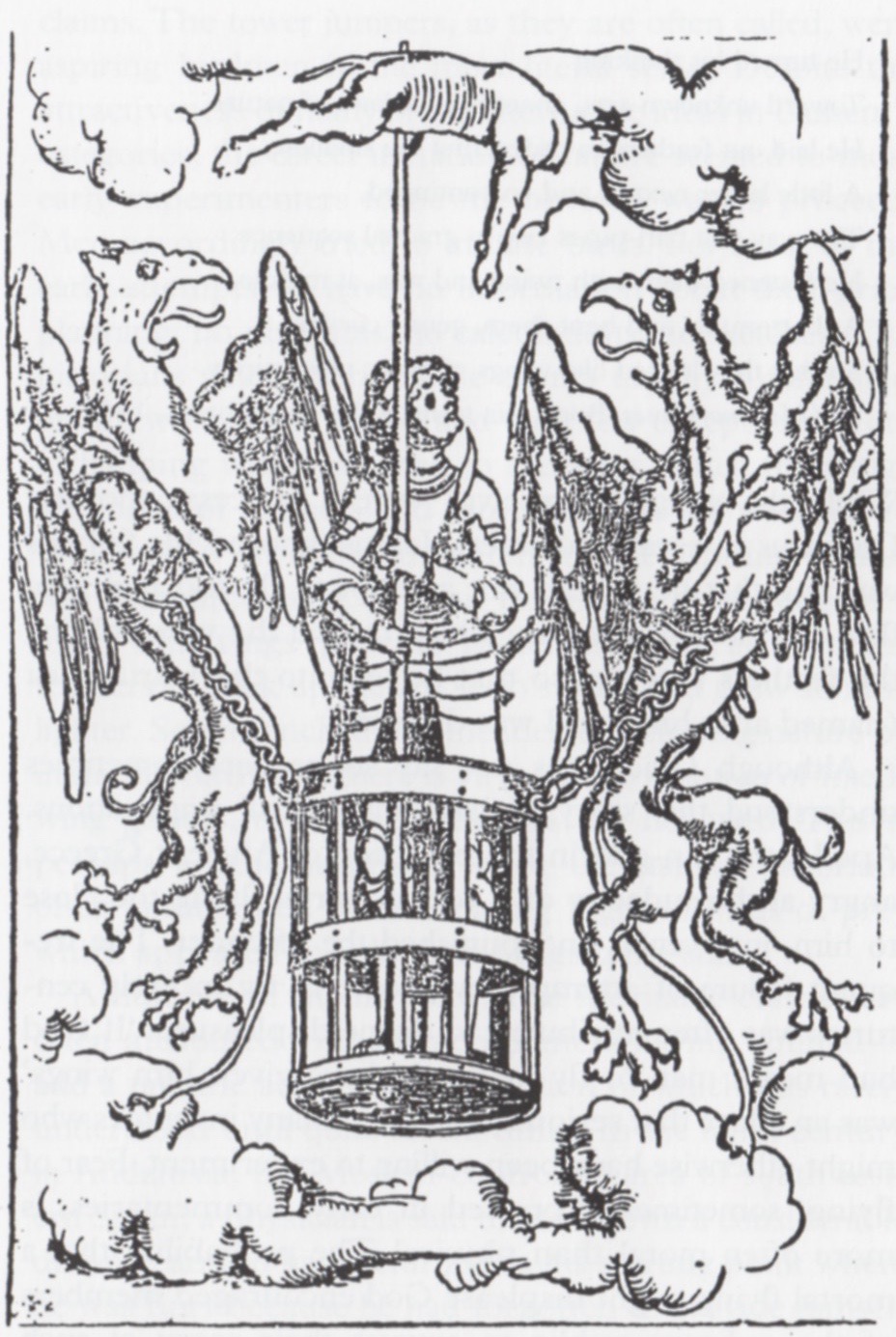
Alexander the Great carried aloft by griffins. This and following image from Pioneer Aircraft.
“This legend, immensely popular during the Middle Ages,” notes Hart, “was one of many revealing the enduring strength of the human desire to fly. Ridiculous and impractical though it may be, and of course griffins are mythological beasts, it is nevertheless more or less rational in design.”
Early Conceptualizations. Hart cites Jules Duhem, who wrote Histoire des Idées Aéronatiques Avant Montgolfier, 1943. Duhem arranged early concepts of flight into five groups: “Appeals to supernatural forces; Harnessing the forces of the natural world; Attempts to modify the natural world by use of technology; Attempts to use nonexistent or impossible natural forces; and Successful combinations of technology and natural forces.”
Alexander’s control of the carcase stick nudges his attempt into the third group; griffins, into the fourth.
Daedalus and Icarus. Imprisoned in the great maze of Crete, Daedalus made wings for himself and his son to escape. Hart recounts, “In his Metamorphoses [8 A.D.] Ovid wrote a version of the story which influenced generations of writers and proved suggestive to many inventors: “… He laid out feathers in order, first the smallest,/ A little larger next it, and so continued,/ The way that pan-pipes rise in gradual sequence./ He fastened them with twine and wax, at middle,/ At bottom, so, and bent them, gently curving,/ So that they looked like wings of birds, most surely.” This, from a 1955 translation by Rolfe Humphreys.
Icarus’ Fate: a Theological View. “While the wings themselves were a success,” Hart notes, “Icarus ignored his father’s warning that he should not attempt to fly too high. He flew too close to the sun, which melted the wax holding the feathers together so that he fell into the Icarian Sea (named after him) and was drowned.”

Spiegel der waren Rhetoric, 1483, by Friedrich Reidrer. The diving birds, by contrast, have a natural affinity with their environment.
“Although Ovid does not say so,” Hart observes, “readers sometimes understood this story to have theological implications. Apollo, the sun-god in the pantheon of Ancient Greece, angry at the audacity of a young mortal flying too close to him, intervened and punished the offender.”
If God had meant man to fly, the adage goes, He would have given him wings. Hart says, “Fear of flying, sometimes expressed in early commentaries, is more often moral than physical.”
An interesting conceptualization of fear, and not only with regard to aviation. ds
© Dennis Simanaitis, SimanaitisSays.com, 2023
 Simanaitis Says
Based on your description, I got the notion that Alexander the Great may have invented the “Collective” helicopter control…
https://en.wikipedia.org/wiki/Helicopter_flight_controls
Yea, sorta. It’s the griffin part that likely kept him grounded.
Is this how Rolls-Royce came up with their “Griffon” engine name?
Yes, Frank, Wikipedia says that the British were especially enamoured of the Griffin/Griffon.