
Simanaitis Says
On cars, old, new and future; science & technology; vintage airplanes, computer flight simulation of them; Sherlockiana; our English language; travel; and other stuff
KEEP ON DANCIN’
THE WORD “CHOREOMANIA” IS MORE THAN a song by Florence + the Machine. It’s a recognized phenomenon of dancing, something that’s been going on for millennia and yet as timely as today’s headlines. Here are tidbits about choreomania, more or less in chronological order.
Dancing Mania, Dancing Plague. Wikipedia says, “The earliest known outbreaks of dancing mania occurred in the 7th century, and it reappeared many times across Europe until about the 17th century, when it stopped abruptly.”
Until recently.

“One of the earliest-known incidents,” Wikipedia described, “occurred sometime in the 1020s in Bernburg, Germany, where 18 peasants began singing and dancing around a church, disturbing a Christmas Eve service.”
Pied Piper of Hamlin? Wikipedia cites, “Further outbreaks occurred during the 13th century, including one in 1237 in which a large group of children travelled from Erfurt to Arnstadt (about 20 km (12 mi)), jumping and dancing all the way, in marked similarity to the legend of the Pied Piper of Hamelin, a legend that originated at around the same time.”
Hmm… I wonder which came first?

Dancing mania on a pilgrimage to the church at Sint-Jans-Molenbeek, a 1642 engraving by Hendrick Hondius after a 1564 drawing by Pieter Brueghel the Elder. Image from Wikipedia.
Significant outbreaks also took place in Aachen, now Germany, then the Holy Roman Empire, in 1374; another in Strasbourg, Alsace, now France, then also HRE, in 1518.
Meanwhile in Italy…. Wikipedia also describes tarantism, allegedly caused by bites of the tarantula or scorpion: “As with dancing mania, people would suddenly begin to dance, sometimes affected by a perceived bite or sting and were joined by others, who believed the venom from their own old bites was reactivated by the heat or the music. Dancers would perform a tarantella, accompanied by music which would eventually ‘cure’ the victim, at least temporarily.”
“As with dancing mania,” Wikipedia continues, “participants apparently did not like the color black, and women were reported to be most affected. Unlike dancing mania, tarantism was confined to Italy and Southern Europe. It was common until the 17th century, but ended suddenly, with only very small outbreaks in Italy until as late as 1959…. A study of the phenomenon in 1959 by religious history professor Ernesto de Martino revealed that most cases of tarantism were probably unrelated to spider bites.”
A Study from The Lancet. “A Forgotten Plague: Making Sense of Dancing Mania” is a study of this phenomenon by John Waller, published in The Lancet, February 21, 2009. Waller cites an 11th-century tale: “On Christmas Eve in 1021, 18 people gathered outside a church in the German town of Kölbigk and danced with wild abandon. The priest, unable to perform Mass because of the irreverent din from outside, ordered them to stop. Ignoring him, they held hands and danced a “ring dance of sin”, clapping, leaping, and chanting in unison. The enraged priest, recorded a local chronicler, cursed them to dance for an entire year as a punishment for their outrageous levity. It worked. Not until the following Christmas did the dancers regain control of their limbs. Exhausted and repentant, they fell into a deep sleep. Some of them never awoke.”
“It might seem improbable to us,” Waller writes, “but there was nothing in this story that medieval people found hard to believe.”
Positive Aspects As Well. Waller’s analyses are rather dour, but dance, spontaneous and less manic, can also have positive aspects. I’m reminded of Pussy Riot, the Russian feminist punk band protesting against Putin in Moscow’s Cathedral of Christ the Savior on February 21, 2012. More recently, they won the 2023 Woody Guthrie Prize. (Curiously, the group has one of the larger Wikipedia entries with more than 300 references.)
Viral Iranian Dances. Back in March 14, 2023, RadioFreeEurope/Radio Liberty recounted, “Five Tehran girls were reported to have voiced contrition [possibly faked] after posting a dance video that went viral among Iranian social media users. It’s illegal for women to dance in public in Iran, but the video has inspired others across the country to post similar videos with the same song, in a potentially dangerous act of open defiance toward the regime.”
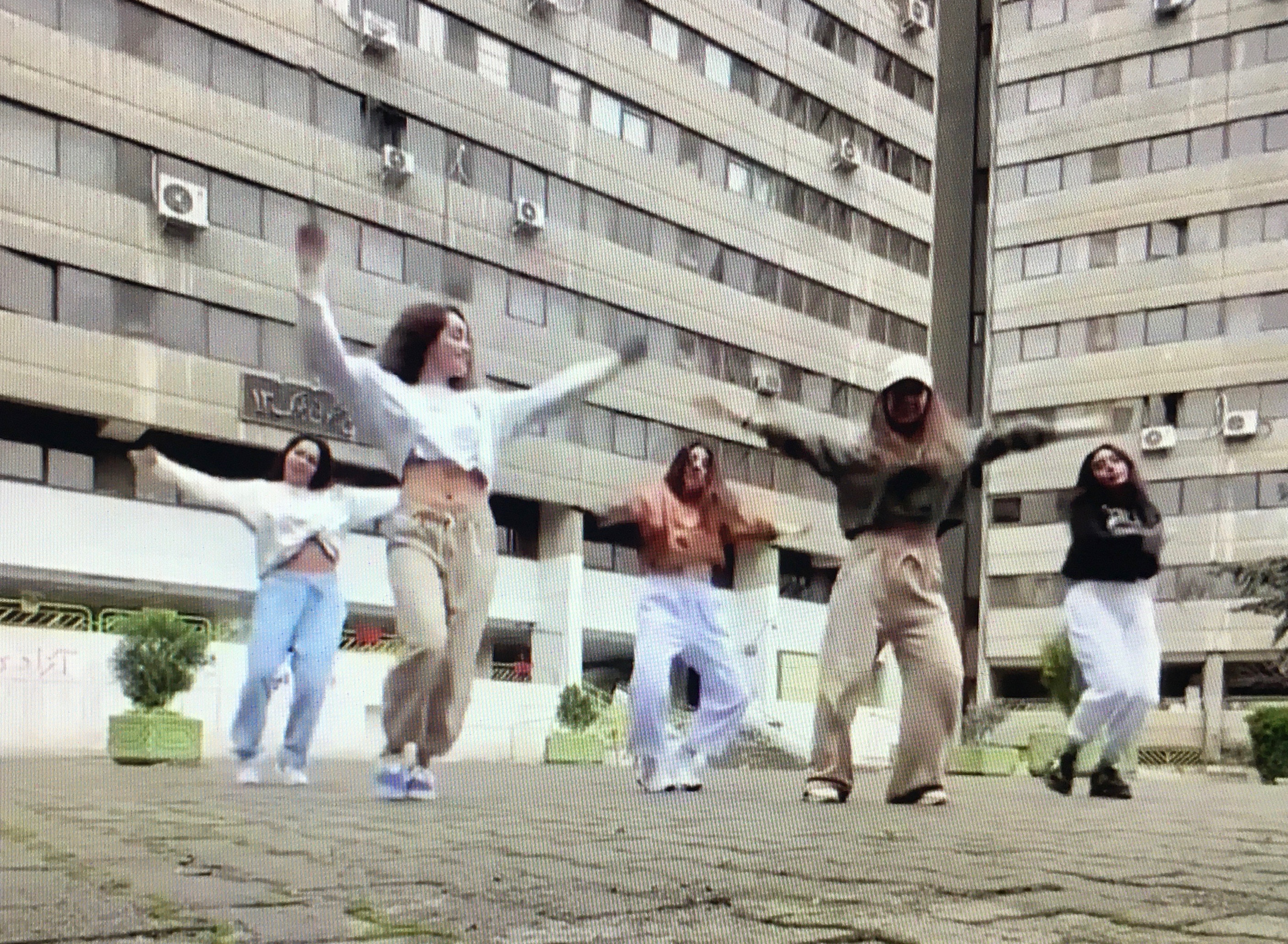
Image from rferl.org
And more recently, December 12, 2023, RadioFreeEurope/RadioLiberty reports “Dancing Iranian Pensioner Spawns Imitators, Riles Regime.”

Image from rferl.org.
“Uncle Sadeghe,” as he’s known, had his Instagram page temporarily shut down. Now its popularity had doubled to some 400,000 followers.
Those who experience suppression and injustice have shown the courage to keep on dancin’! ds
© Dennis Simanaitis, SimanaitisSays.com, 2023
 Simanaitis Says