
Simanaitis Says
On cars, old, new and future; science & technology; vintage airplanes, computer flight simulation of them; Sherlockiana; our English language; travel; and other stuff
ETYMOLOGY: EIGENGRAU—AND OTHER STUFF HERE AND THERE
I LEARNED AN OPTICAL TERM from the WordDaily website that jogged my memory in other ways: The word “eigengrau” defines “the dark gray color seen by the eyes in perfect darkness as a result of signals from the optic nerves.”

Etymology. With my modest knowledge of German (“Noch ein, bitte” means “another round, please”) and rather more math, I could figure out etymology of eigengrau: Grau is German for “gray.” And an eigenvalue is a “characteristic value” in several different mathematical realms. For instance, in linear algebra it’s any number such that a given matrix minus that number times the identity matrix has zero determinant.
Thus, I think of eigengrau as a “characteristic gray.”
But How Come? Wikipedia says, “Common scientific terms for the phenomenon include ‘visual noise’ or ‘background adaptation.’ These terms arise due to the perception of an ever-changing field of tiny black and white dots seen in the phenomenon.” And hence the resulting gray.
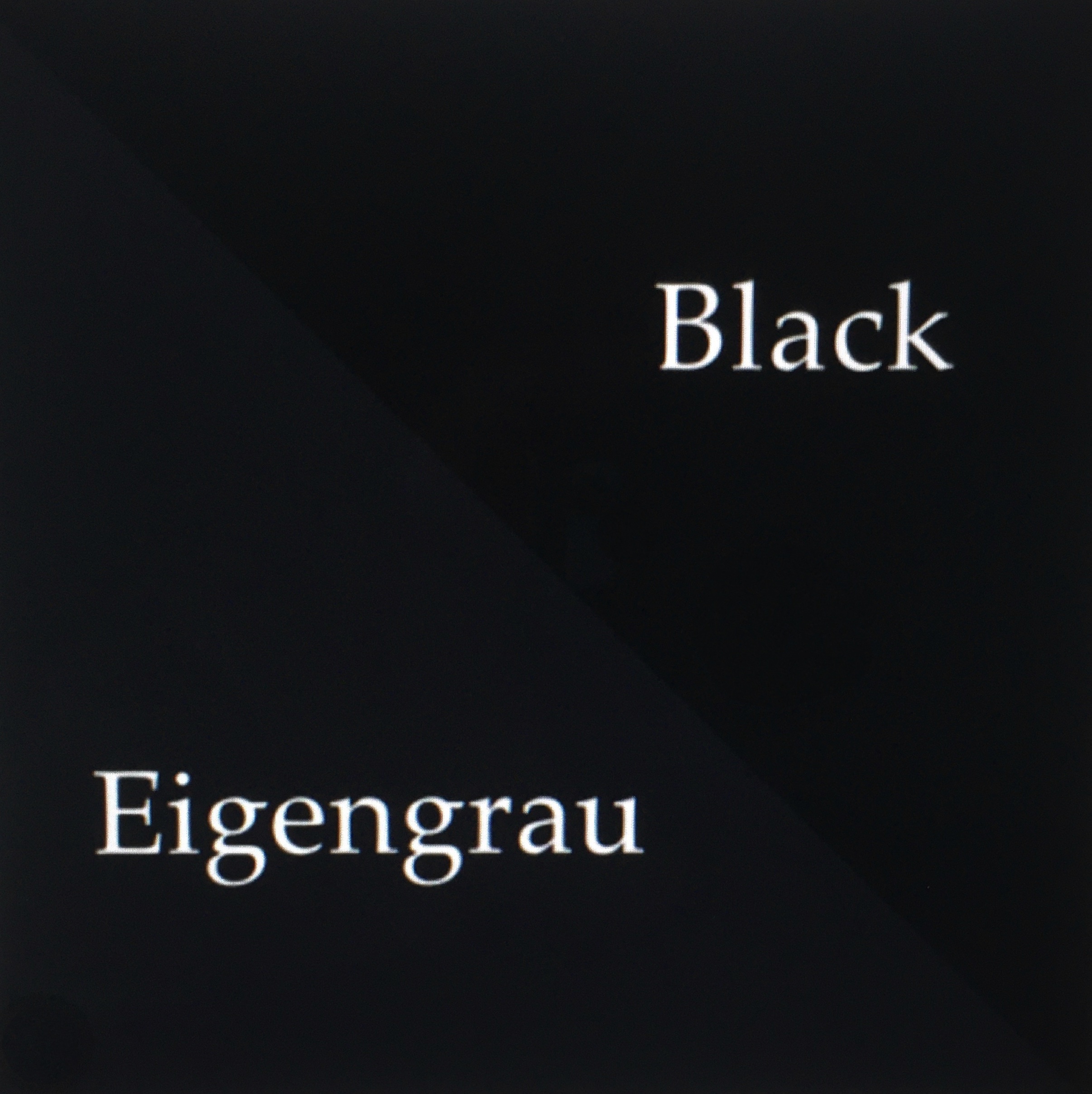
Wikipedia adds, “Eigengrau is perceived as lighter than a black object in normal lighting conditions, because contrast is more important to the visual system than absolute brightness. For example, the night sky looks darker than Eigengrau because of the contrast provided by the stars.”
Note, by the way, Wikipedia acknowledges the word’s German origin by retaining its noun capitalization. WordDaily accepts its English importation as eigengrau.
German-English, English-German. Both languages reside on the same European Germanic branch of the Indo-European language tree.

Image by Minna Sundberg from “25 Maps That Explain the English Language.”
Thus it’s no surprise that the two languages share more than a few cognates, words of common origin. (Apple/Apfel, Blue/Blau, Green/Grün, New/Neu, School/Schule, Water/Wasser, ….)
My Lousy Memory Aid. In learning German, I often confused the two words jeder (“each”) and jener (“that one”). So I thought of the English word “yonder,” meaning “over there.”
It’s a lousy memory aid: Yonder’s “n” reminds me of jener; its “d” reminds me of jeder. Its “r” doesn’t help.

Which Reminds Me of Mnemonics. Oxford Languages defines a mnemonic as “a device such as a pattern of letters, ideas, or associations that assists in remembering something, for example Richard Of York Gave Battle In Vain for the colors of the spectrum (red, orange, yellow, green, blue, indigo, violet).” Regardless of one’s view on War of the Roses, this mnemonic is a helluva lot more PC than the one ending “Violet Gives Willingly” (adding gray and white in the color coding of resistors).

John Rentoul offers “The Top 10: Mnemonics,” in The Independent, September 1, 2018. Here are my three favorites.
∏. “How I wish I could calculate pi” gives its first seven digits, though we all know that π is an infinite non-repeating decimal, and thus the wish is inherently in vain.
Henry, Serial Nuptualist. “Able Bodied Seamen Catch Hairy Pirates” suggests the surnames of Henry VIII’s wives: Aragon, Boleyn, Seymour, Cleves, Howard, and Parr.
Taxonomy in Biology (the Polite Version). “Dear Kate, Please Come Over For Great Spaghetti” helps memory of the taxonomic orders: Domain, Kingdom, Phylum, Class, Order, Family, Genus, and Species.

And One from Wikipedia: “The memorable sentence ‘There’s a fork in Ma’s leg’ helps the learner remember that the Hebrew word for fork is mazleg (מזלג).”
I don’t know that I’ll ever need the Hebrew word מזלג, but I may never forget this mnemonic. ds
© Dennis Simanaitis, SimanaitisSays.com, 2023
 Simanaitis Says
Then there are the 12 cranial nerves listed here https://www.kenhub.com/en/library/anatomy/the-12-cranial-nerves#
Many mnemonics to help remember the twelve…
E.g., https://www.mnemonic-device.com/medical/cranial-nerves/on-old-olympus-towering-top-a-fin-a-german-viewed-a-hop/#google_vignette
I recall a conversation with my dentist of yore where she asked me were I made some comment about not annoying my trigeminal nerve and I started rattling off “on old Olympus towering tops…” and she interrupted to iterate through the bawdy version of that list! Fun, but too bad I can’t remember that version…
>