
Simanaitis Says
On cars, old, new and future; science & technology; vintage airplanes, computer flight simulation of them; Sherlockiana; our English language; travel; and other stuff
GRACE HOPPER FORCED COMPUTERS TO SPEAK ENGLISH, SORTA PART 2
YESTERDAY NICE NEWS INTRODUCED US TO mathematician Grace Hopper. Today in Part 2, we follow her career in the pioneer days of computers and at the nexus of academe and the U.S. Navy.

Rear Admiral Grace Hopper. This and other images from “60 Minutes Rewind” of March 6, 1983.
COBOL. Wikipedia recounts, “In the spring of 1959, computer experts from industry and government were brought together in a two-day conference known as the Conference on Data Systems Languages (CODASYL). Hopper served as a technical consultant to the committee, and many of her former employees served on the short-term committee that defined the new language COBOL (an acronym for COmmon Business-Oriented Language).”
“The new language,” Wikipedia notes, “extended Hopper’s Flow-Matic language with some ideas from the IBM equivalent, COMTRAN. Hopper’s belief that programs should be written in a language that was close to English (rather than in machine code or in languages close to machine code, such as assembly languages) was captured in the new business language, and COBOL went on to be the most ubiquitous business language to date.”

Hopper has her COBAL manual in hand as she examines part of early computer tape-drive memory.
Retired, Recalled, Commander, Captain, Commodore, Rear Admiral. Hopper’s military career continued to advance. Not without discontinuities as cited by Wikipedia: “In accordance with Navy attrition regulations, Hopper retired from the Naval Reserve with the rank of commander at age 60 at the end of 1966. She was recalled to active duty in August 1967 for a six-month period that turned into an indefinite assignment. She again retired in 1971 but was again asked to return to active duty in 1972. She was promoted to captain in 1973.”
Hopper was promoted to commodore by President Reagan in 1983. Then, Wikipedia continues, “Effective November 8, 1985, the rank of commodore was renamed rear admiral (lower half) and Hopper became one of the Navy’s few female admirals.” This last, a most appropriate rank as her great-grandfather Alexander Wilson Russell was a rear admiral in the U.S. Navy at the Battle of Mobile Bay during the Civil War.
Quite a Career. YaleNews says, “At the age of 79, Hopper retired as a rear admiral. She was the oldest serving officer in the U.S. Armed Forces. That same year she went to work as a senior consultant in public relations at the Digital Equipment Corporation, where she worked up until a year before her death in 1992. Hopper was buried with full military honors in Arlington National Cemetery.”
In 2016, Obama awarded Hopper a posthumous Presidential Medal of Freedom, the nation’s highest civilian honor, in recognition of her remarkable contributions to the field of computer science.
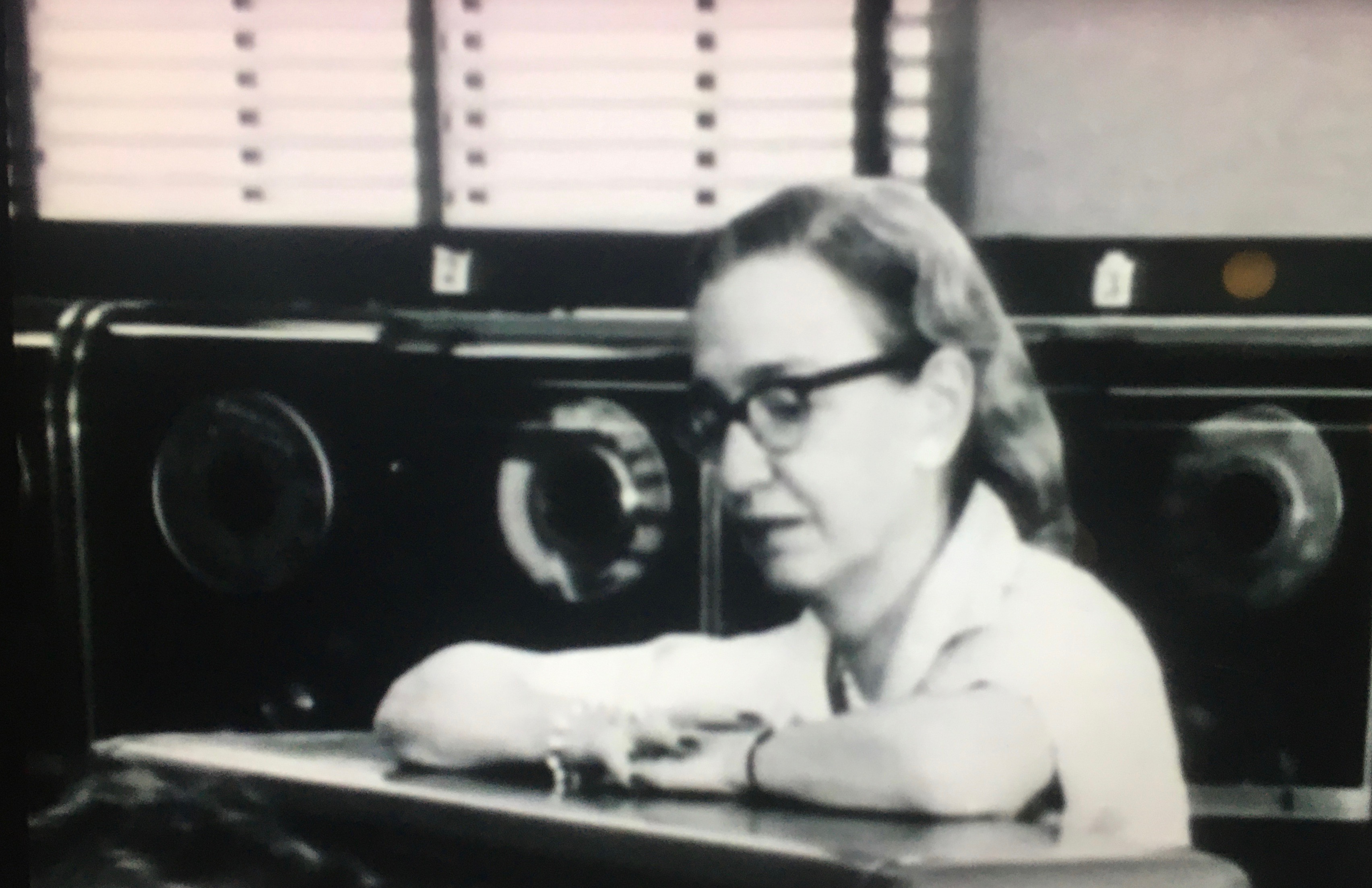
YaleNews recounts, “Hopper was not only a brilliant mathematician and computer scientist; she was also a gifted teacher and communicator.”
I especially appreciate her interview on “60 Minutes,” March 6, 1983; a “60 Minutes Rewind” exists. (Alas, the link works ok on my desktop, but is pesky on my smart phone. Sorry. Smart phone folks: Try Googling it.)
To put its concepts in perspective, remember that this broadcast originated more than 50 years ago.
It would have been illuminating indeed having Grace Hopper as a math teacher. ds
© Dennis Simanaitis, SimanaitisSays.com, 2023
 Simanaitis Says