
Simanaitis Says
On cars, old, new and future; science & technology; vintage airplanes, computer flight simulation of them; Sherlockiana; our English language; travel; and other stuff
NSU SPIDER—A MATTER OF WANKEL SHELF LIFE
IN 1965, R&T’S RON WAKEFIELD (hi, Ron!) wrote, “Eleven years ago Felix Wankel devised his first rotary-combustion engine, which incorporated the normal gasoline engine (Otto) cycle in an epitrochoidal combustion chamber with a 3-pointed rotor…. The NSU Motorenwerke Aktiengesellschaft of Neckarsulm, West Germany, recognized the potential in Wankel’s design, and they collaborated with him on the building of his first working model in 1957.”
Here it was December 1965 and R&T got to test the first production car powered by this innovative powerplant, the NSU Wankel Spider. Tidbits follow gleaned from this road test (and also with crystal ball observations from future issues).
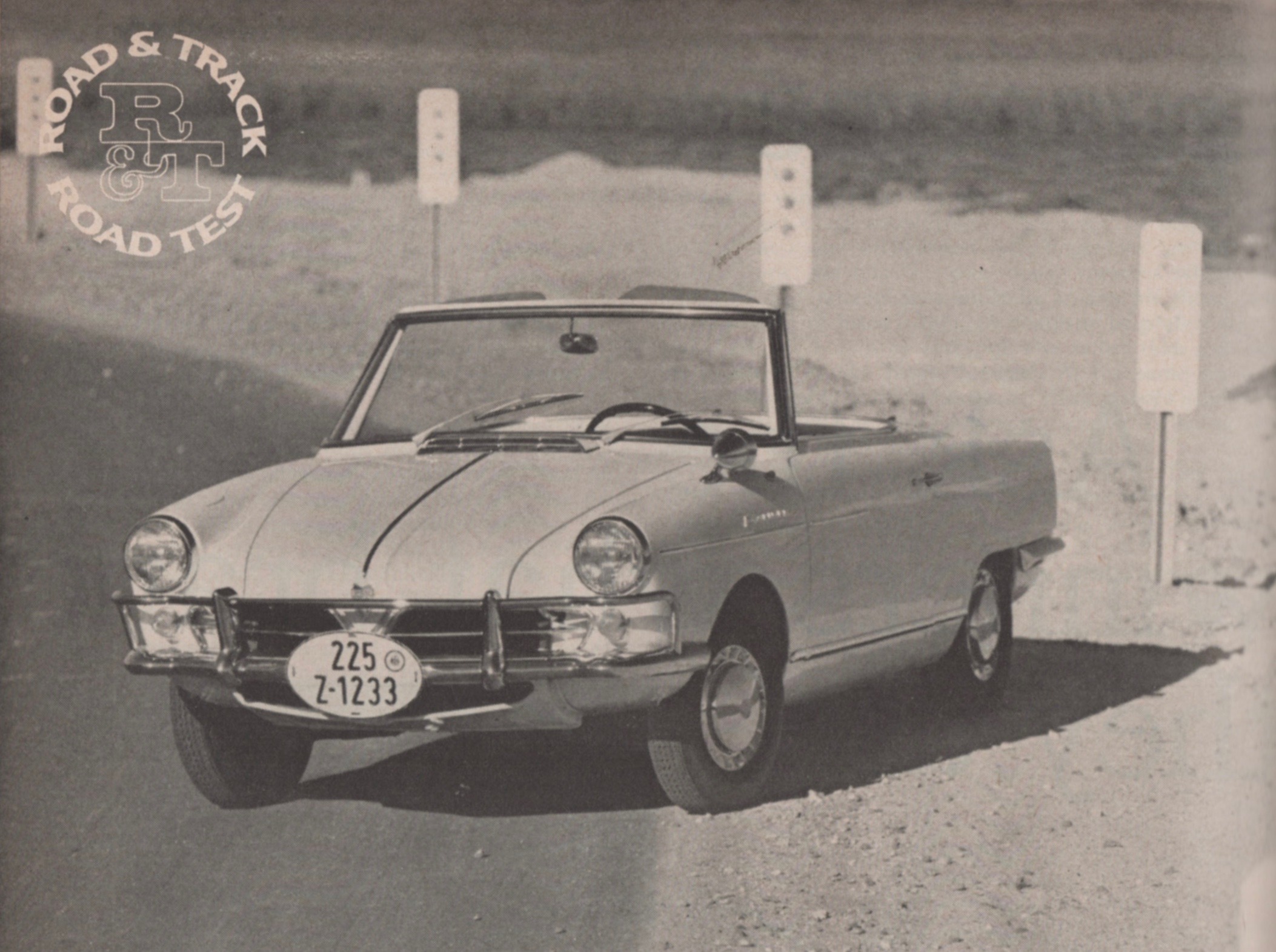
This and other images from R&T, December 1965.
A Prophetic Comment. “The Spider, we think,” R&T said, “was not put on the market by NSU with any hope of its becoming a big seller. Rather, it seems that its main purposes are to give the builders production experience with Wankels and to get enough of them into the hands of the public to get a good cross-section of opinions from owners—and also to discover problem areas that even extensive controlled testing doesn’t bring out, but for which the general public has great talent.”
Crystal ball: “The Wankel engine got off to a tough start. An early R&T citation quipped ‘Winkle winkle, little Wankel,/ How I wonder if your crank’ll/ Wind up all around itself/ And you’ll end up on the shelf.’ Hardly encouraging, German automaker NSU introduced its Wankel-powered Spider in 1964, only to find itself the butt of automotive humor: Instead of waving to fellow Wankel owners, drivers would hold up finger counts of their replacement engines.”
R&T’s 1965 Road Test: “Once the technique of keeping revs up is mastered—above 3000—the Spider becomes a peppy little machine. One learns to stomp on the throttle a little more vigorously than usual on moving off from rest, and to shift gears as we did in the days of the TDs.” Which, by the way, had comparable performance: The NSU Spider’s 0-60 time was 17.4 seconds; a 1953 TD’s, 19.4 sec.

Smooth Revs. “The odd thing about the Wankel is that it gets progressively smoother as its speed builds up, with no vibration periods, valve bounce or the like to impose limits on it. As everyone must know by now, the [6000-rpm] rev limit is imposed by the makers to keep wear on the rotor seals within reason—this factor being the main ‘bug’ remaining in the design.”

I include this image from Ron’s article to show an extreme of Wankel development: Curtiss-Wright’s RC-19, a 1920-cu.-in. version created simply by scaling up all dimensions of a 61-cu.-in. (1-liter) unit.
Perhaps a Bit Thirsty. R&T admitted, “As for fuel economy we can’t really be conclusive, but for the one tank of gasoline we used our average was 26.5 mpg; this figure includes the performance testing.”
Crystal ball again: Even the fully developed twin-rotor Mazda RX-7 recorded only 22.0 mpg in 1978.

A tidy top and even vestigial fins.
Pretty Good Handling. “The Spider,” R&T said, “is a pretty good-handling little car; its rear weight bias, about normal for a rear-engine car, doesn’t make it a violent oversteerer like some of its rear-powered countrymen. This virtue is probably the result of having semi-trailing arms at the rear rather than the cheaper swing axles. Anyway, it’s a car that can be driven very briskly on winding roads.”
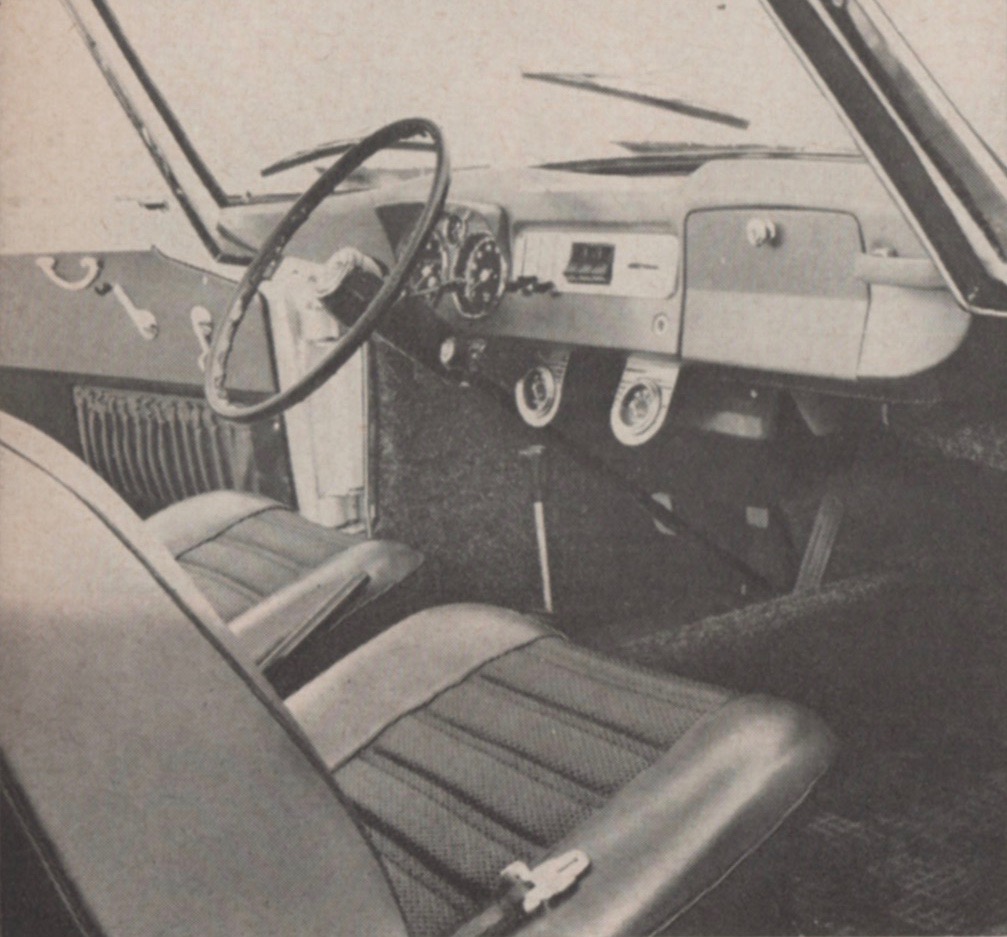
Provided You Fit. R&T reported, “No doubt about it, this is a small car—we found it to be one of the most difficult we’ve seen for getting into and out of. Once inside, our average- to small-size testers found it was a snug but comfortable fit, but our large-size staffers found it was just about impossible.”
Not naming names, but one of them was 6 ft. 4 with size 14 hoofers.

A Tidy Engine, a Big Exhaust. “Looking under the floor of the rear luggage compartment into the engine room,” R&T noted, “one is first impressed by the compactness of the engine. True, the engine itself is very, very small; but the compactness hasn’t been fully realized, for a very bulky exhaust system was found to be necessary to achieve a low noise level and not impose too much restriction on the engine (the Wankel is very sensitive to exhaust back pressure).”

Summary. R&T said, “The big question about the Wankel Spider then would be, what does it tell us about the future of the Wankel engine in cars?”
There was no crystal ball in 1965 to tell R&T that Mazda’s Kenichi Yamamoto had already been developing a Wankel for five years. Even so, wrote R&T, “… though it may not be fully acceptable today it certainly shows great promise for tomorrow.”
Or, for that matter, neither NSU nor Yamamoto could predict implications of emissions and fuel economy on the Wankel future. To cite early R&T, for the moment at least it’s ending up on the shelf. ds
© Dennis Simanaitis, SimanaitisSays.com, 2023
 Simanaitis Says
I remember when I was in college in Montreal being in a parking lot and a group of guys were standing around a NSU Wankle.It would not start.Taught power technology from 1971 to 1999. Use a Kawaski Wankle lawn mower engine as a teaching aid. Thought it was the future.John