
Simanaitis Says
On cars, old, new and future; science & technology; vintage airplanes, computer flight simulation of them; Sherlockiana; our English language; travel; and other stuff
THE ORIGINAL 911
IN MARCH 1965, R&T was thinking “timeless” when it wrote, “If we exclude the special racing models, the new Porsche 911, née 901, is the first entirely new Porsche in 16 years.”
Ha! Only 16 years? Here it is 58 1/2 years later, and the 911 is still very much with us. Sure, there have been significant changes (some would say upgrades; others, refinements), but a familiar shape embodying a rear-mounted flat-six has changed remarkably little in almost six decades.
Here are tidbits gleaned from R&T’s initial impressions of this replacement for the Porsche 356.
901? Mais Non, 911. R&T wrote what has become an oft-told tale: “When this car was first shown at Frankfurt in 1963, it was christened the Type 901 because it happened to be the design identified by this number. Since then, because Peugeot has some sort of registered priority on type designations with three figures and a zero in the middle, the 901 became the 911.”
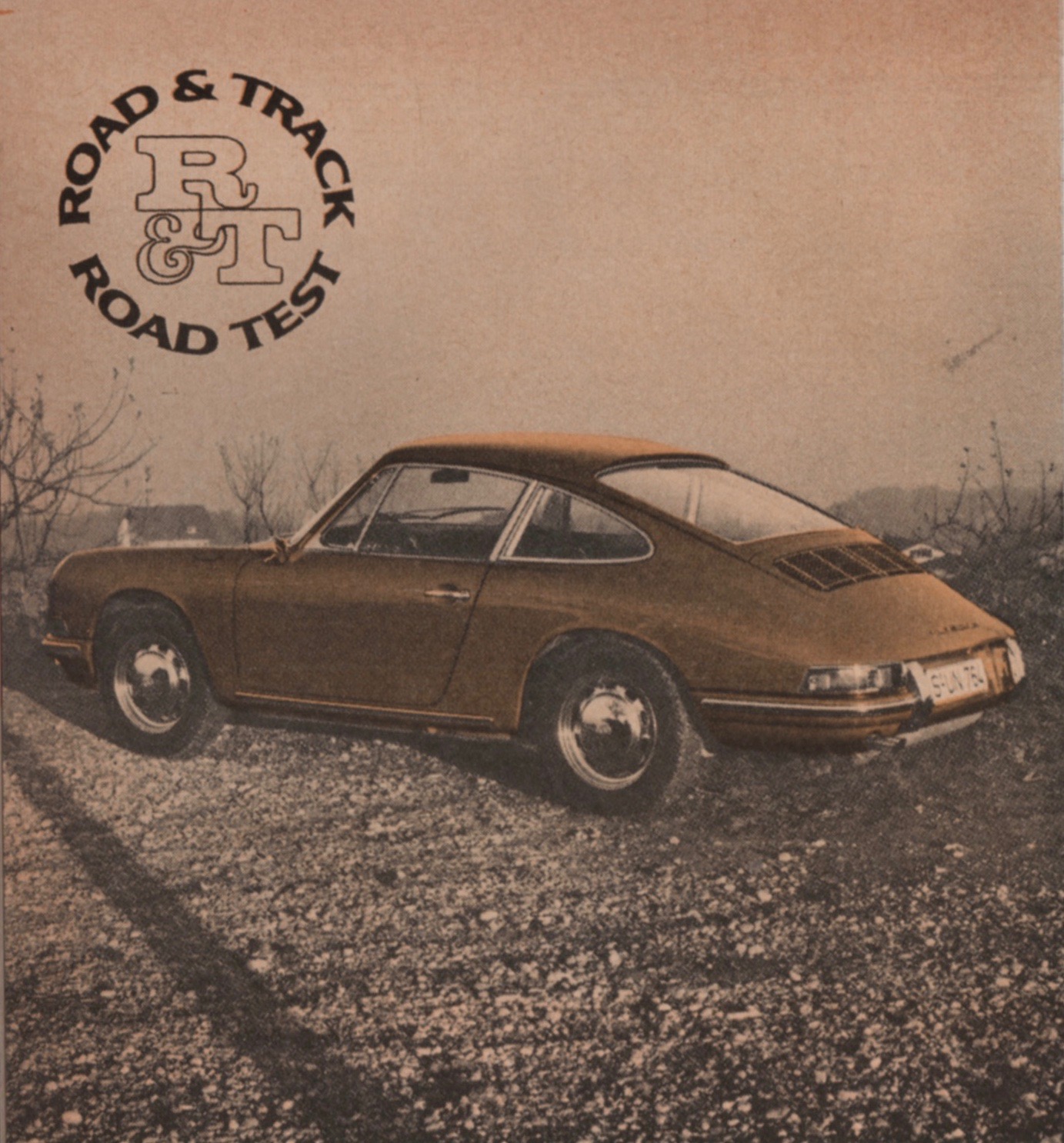
This and other images from R&T, March 1965.
More Glass, Even a Better Trunk. “The body of the 911 is completely new,” R&T observed, “with more glass, crisper lines and functional styling. At the same time, it remains unmistakably Porsche. In front, the luggage compartment lid is almost flat and plunges down sharply in the interest of forward visibility. The elimination of the VW-type torsion car cross-structure made it possible to deepen the luggage compartment considerably and one of our fattest, most awkward shaped test cases was swallowed without protest.” R&T noted as well that this was the first Porsche sans VW ancestry.
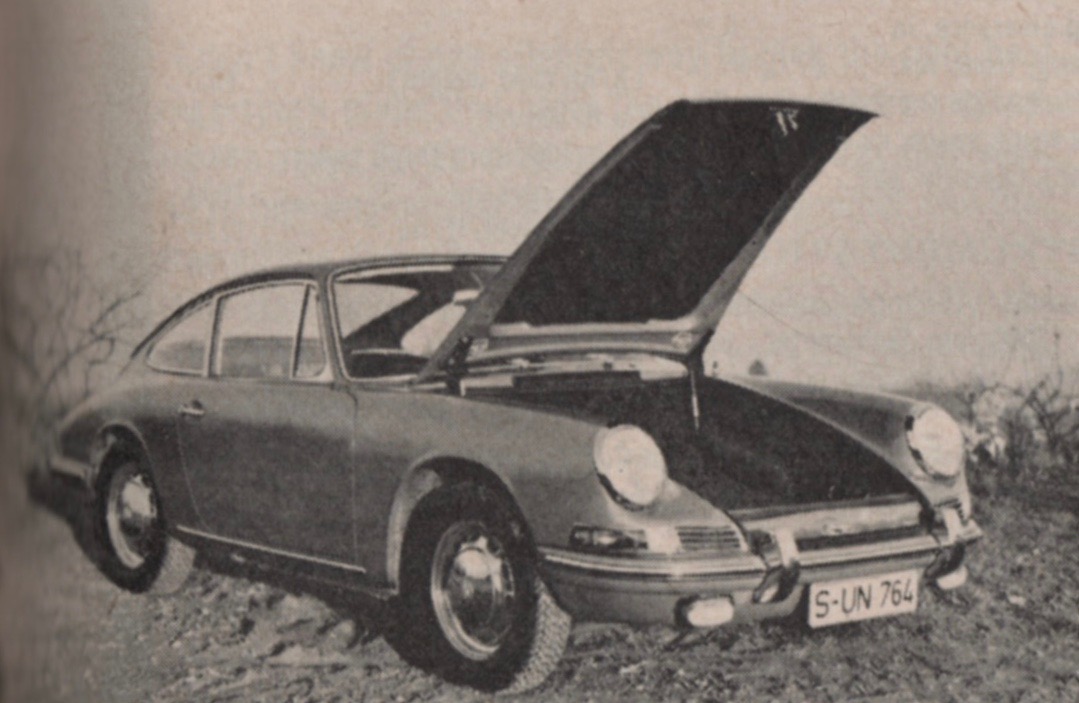
Fast Motoring. “The overall impression,” R&T said, “is that this car was built by men who know something about fast motoring and that it is destined for owners who feel the same.” Sidestepped by R&T staffers of the era was whether there were any women at Zuffenhausen doing anything but taking memos and fetching coffee.
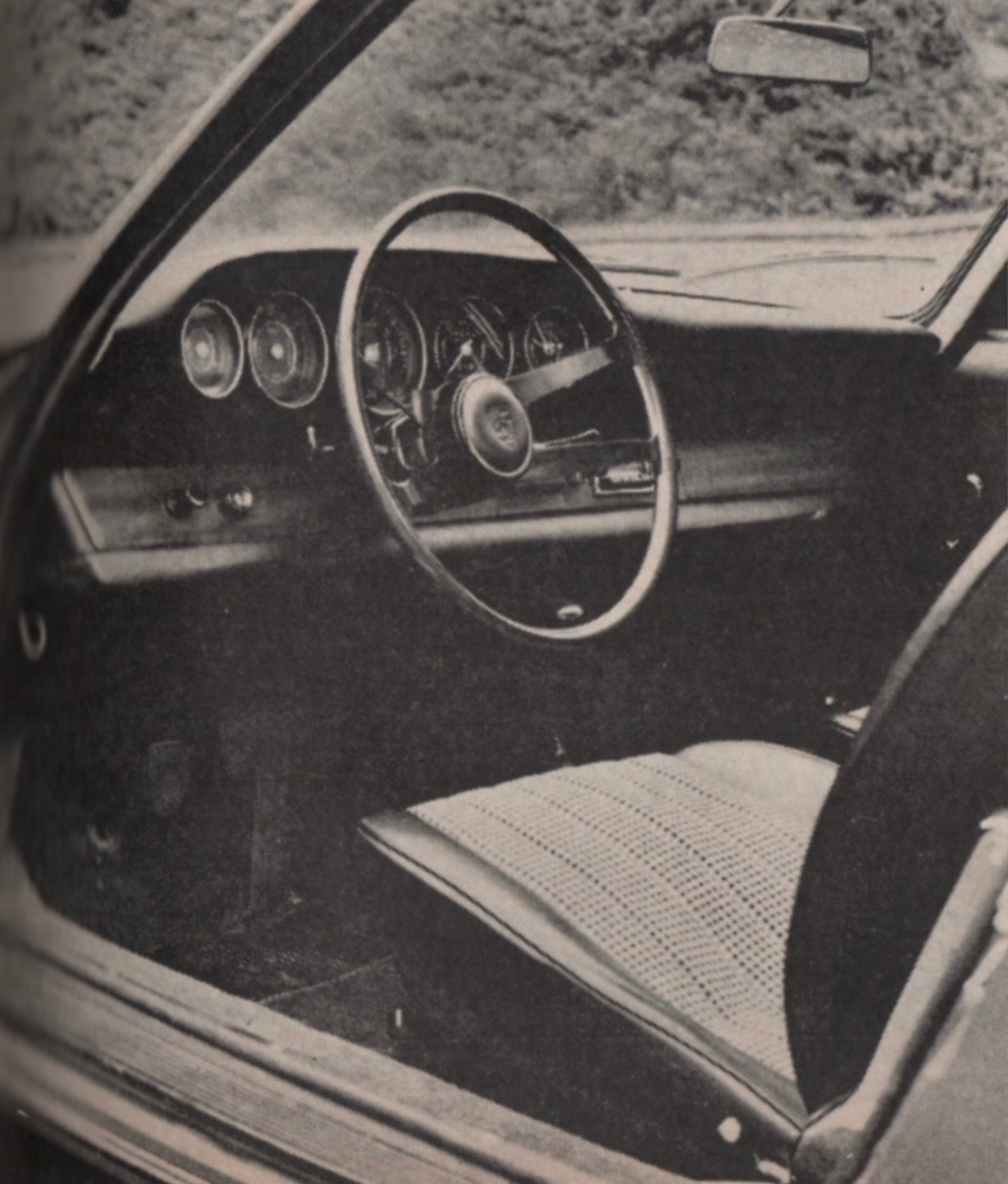
“There is a full set of instruments, including gauges for fuel and oil tank (the engine has dry sump lubrication; there is no dipstick so you check the tank gauge after about half a minute of idling with the engine fully warmed up.…”
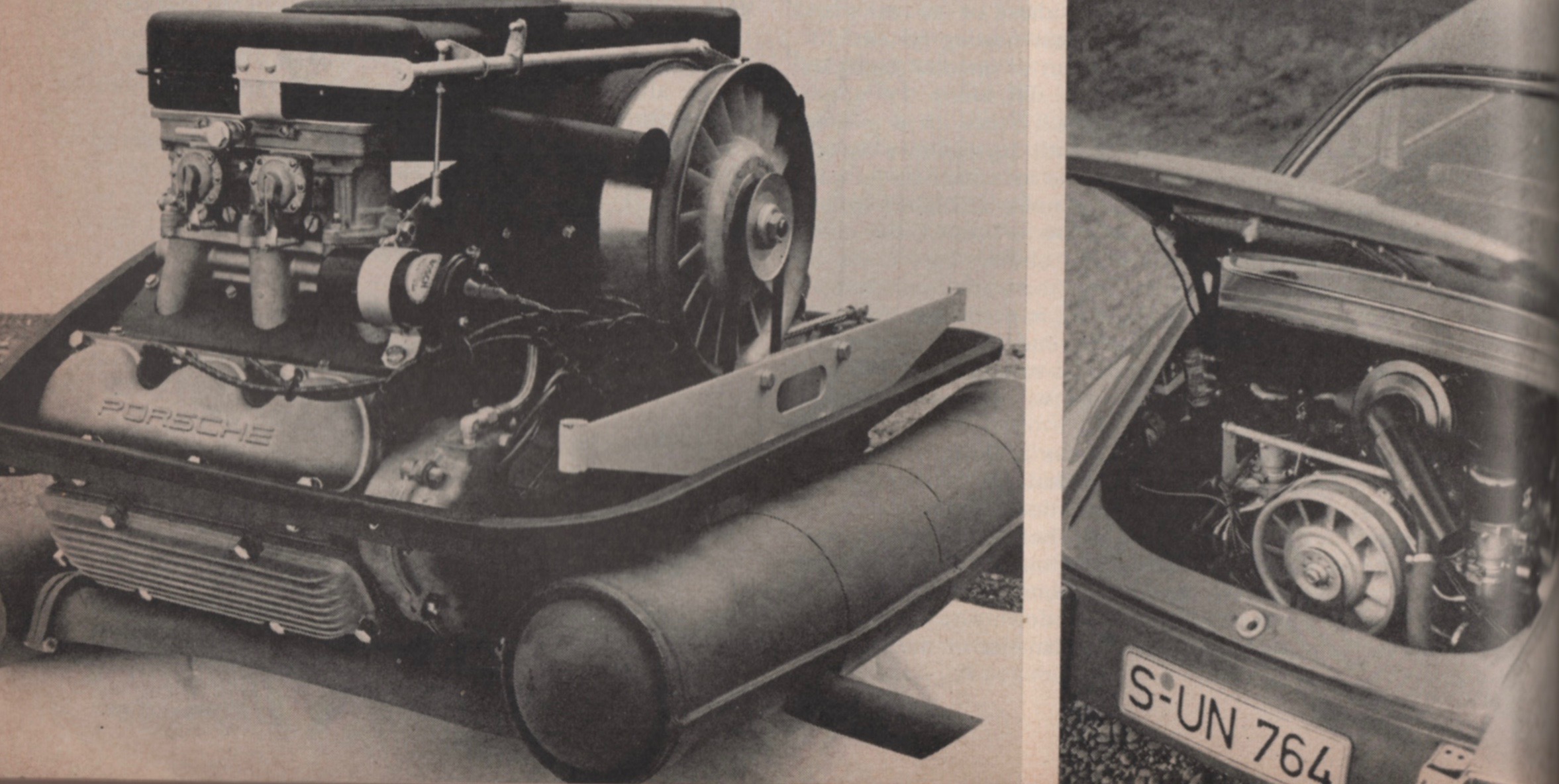
A Noisy Environment, and Not Just the Engine. “Even with all windows closed,” R&T recounted, “wind noise at higher speeds is considerable. As soon as any window is opened, the noise is definitely objectionable. In spite of obvious care taken to insulate passengers from engine noise (there are even silencers in the warm air ducts!), the engine and, in particular, the cooling fan remain much too audible. At the end of a day’s driving, it takes some time before the hum in the ears subsides and one can only hope that development work will proceed to further improve soundproofing.”
It would be another 32 years before Porsche swapped an air-cooled engine for a water-cooled one. Diehards still complain about conceptual purity, but thermal efficiencies played a greater role than simply reducing fan noise.
Company Synchros, But.… “Gears,” R&T noted, “are changed by a shift lever, looking and feeling traditionally Porsche and, as expected, are very quick, with the help of unbeatable synchromesh.” On the other hand, R&T disliked the basic H of the car 5-speed containing reverse and 1, 2, 3: It devoted a lengthy paragraph summarized by “the box itself is superb, the present shifting mechanism is far from perfect.”
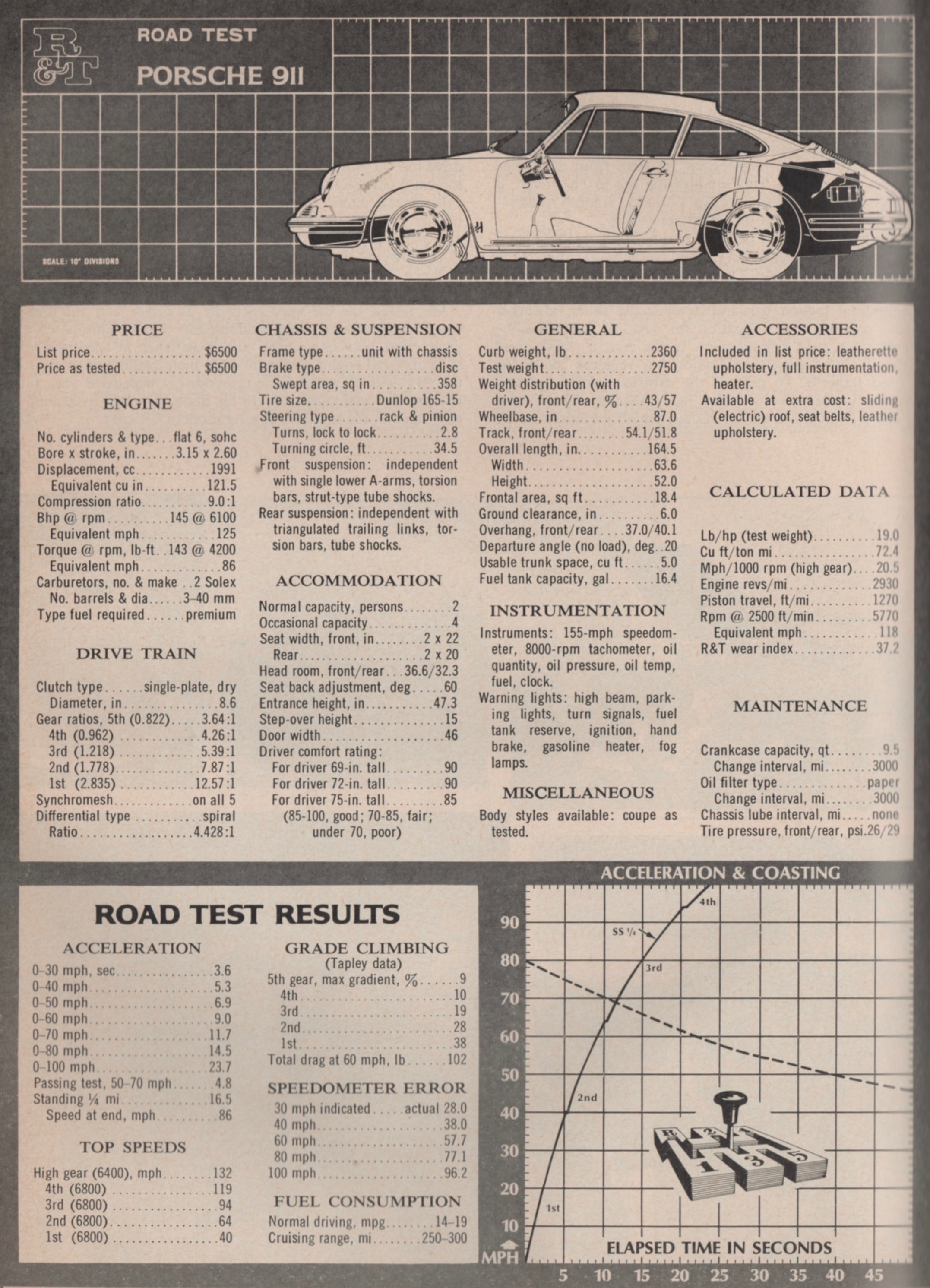
Not Entirely Without Fault. “The timed acceleration and top speed figures are excellent for a 2-liter car,” said R&T. “This engine is not entirely without fault, however. On our test car, it was jerky when running at about 2800 rpm on a trailing throttle, and part-throttle after full-power acceleration was sometimes accepted with some hesitation.”
What’s more, R&T observed, “Fuel consumption is on the high side (14–19 mpg)… and results in a driving range of just over 250 mi. When fuel stations are far apart this is a definite nuisance on a GT car that otherwise would be ideal for long, high-speed, non-stop runs.”
I’m reminded of the cordial PR agent of a popular English sports car who once told me “Do you think it’s easy to shove all that fuel through that itty-bitty engine?”
“Animal Oversteer?” “On all swing-axle Porsches,” R&T wrote in 1965, “in spite of a very high degree of taming, the ‘animal oversteer’ could still be sensed. On the 911, the beast is out, and the car is neutral in behavior and perfectly controllable throughout the whole speed range and even on atrocious surfaces.”
In the evolving decades, 1965 to present, I believe there might be some 911 drivers who would beg to differ. On the other hand, my favorite variant is the legendary 930, the turbocharged 911 built between 1975 and 1989. ds
© Dennis Simanaitis, SimanaitisSays.com, 2023
 Simanaitis Says
This 53-year owner of a ’65 912 suggests that a similar article would be worthwhile. Die-hard 356 guys just didn’t cotton up to that overhead-cam six, hence the 912 actually out-sold the 911 for some time.