
Simanaitis Says
On cars, old, new and future; science & technology; vintage airplanes, computer flight simulation of them; Sherlockiana; our English language; travel; and other stuff
WHO’S COOKING?
“WORLDWIDE, WOMEN COOK TWICE AS MUCH as Men: One Country Bucks the Trend.” This, from NPR reporting on an annual survey by Gallup and Cookpad. What’s more, this survey organization makes its entire 82-page study “A Global Analysis of Cooking Around the World” available as a pdf download.

“The latest edition,” Gallup Cookpad describes, “explores emerging themes, including the widening of the cooking gender gap in 2022 and how various factors—including gender, age and household size—influence cooking habits and enjoyment across the globe. The report also unravels the world’s typical cooking profiles, defining five distinct categories of home cooks such as ‘Joyful Chefs,’ who relish any opportunity to cook a meal at home, or ‘Reluctant Cooks,’ who cook the least.”
Talk about tasty tidbits! Here let’s focus on just one aspect.
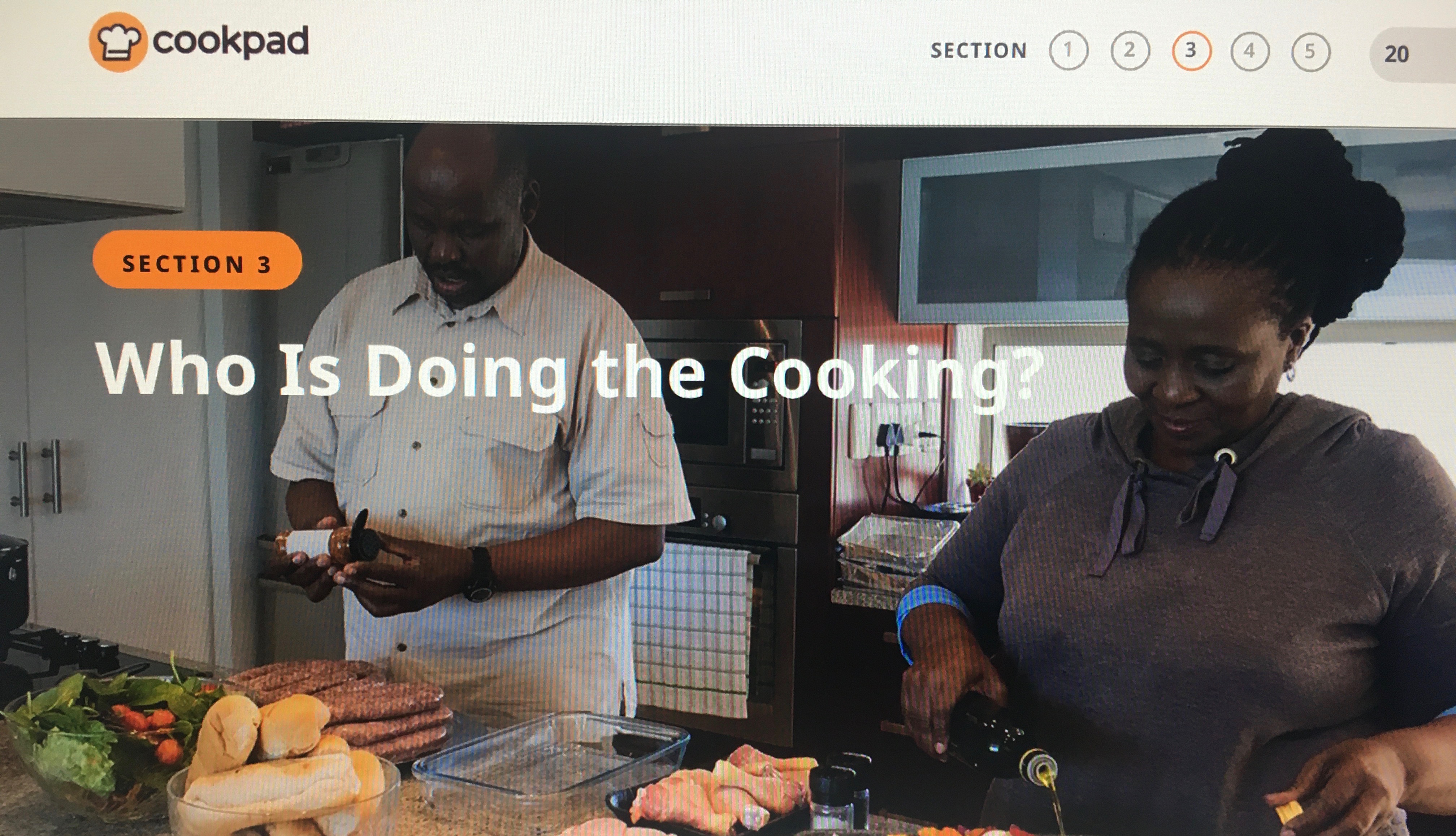
Who Does the Cooking? NPR writes, “Women cooked just under nine meals per week, on average, in 2022. Men cooked about four per week…. When the survey began in 2018, traditional gender roles were well established, but during the pandemic years the survey results showed that men were cooking more. This narrowed the gender gap, explains Andrew Dugan, a research director at Gallup, who has worked on the survey since it began. ‘Every year since the study started, the gap narrowed,’ he says. Until now.”

Frequency of cooking meals at home per week, by gender. This and other images from Gallup Cookpad.
Country Differences. “In the United States,” NPR cites, “women cook about two more meals per week on average, than men. The survey report graphs the countries with the largest gender gaps, including Ethiopia, Tajikistan, Egypt, Nepal and Yemen, where women are making about eight more meals per week than men.”
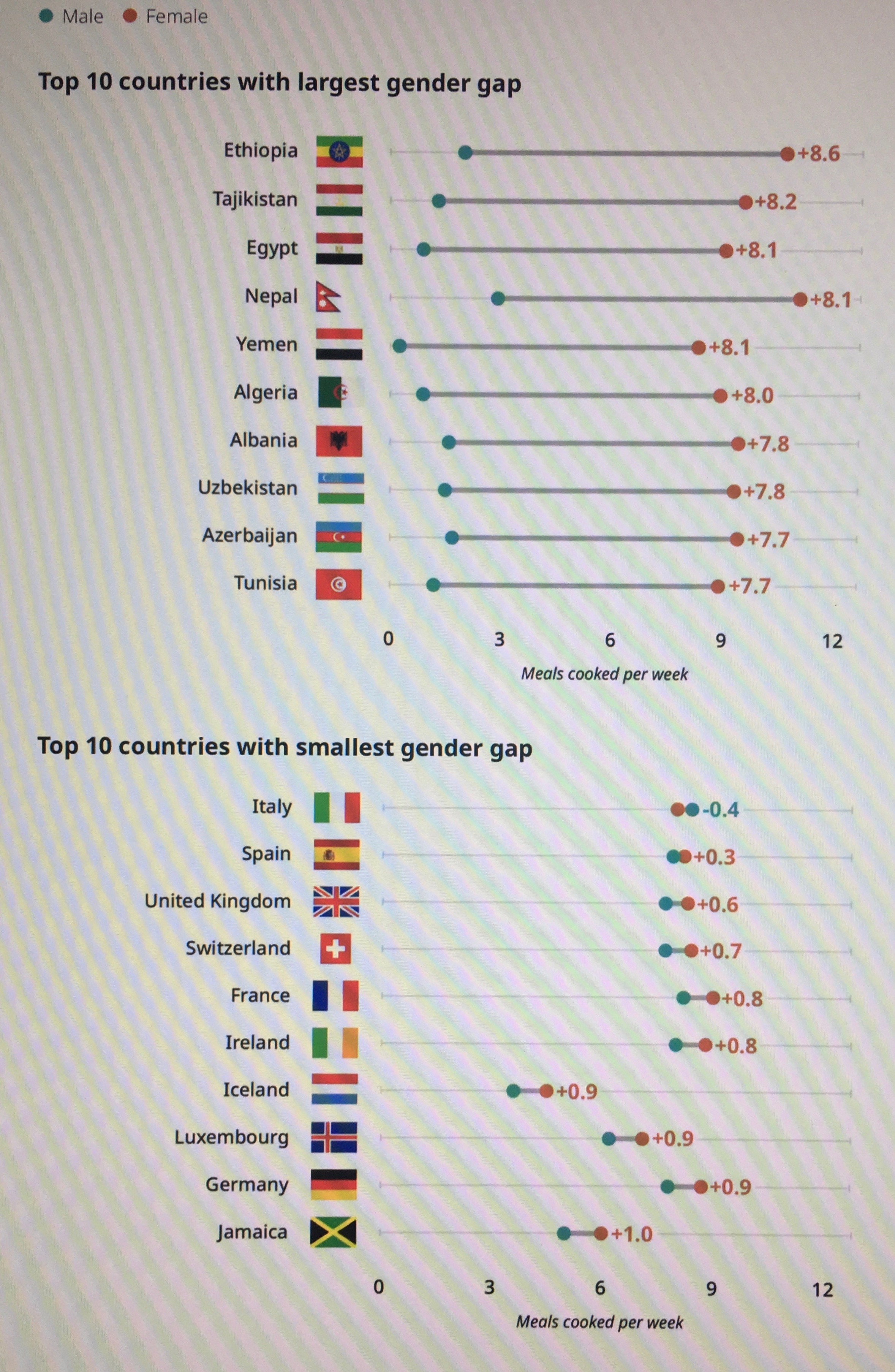
NPR continues, “The countries with the smallest gender differences in cooking are clustered in Europe, including Spain, the UK, Switzerland, France, and Ireland. There’s only one country where men actually cook more than women. Wait for it…. Italy.”
“Buon Appetito!” He Said. “Italy’s exception is notable,” says Gallup Cookpad. “As recently as 2020, women in Italy cooked an average of 5.1 more meals per week than men. Like other countries in its region, however, Italy saw the gender gap shrink in 2021, as men cooked more and women less. This trend accelerated in 2022, leading to this interesting, if unexpected, result.”
Tables Turned. Gallup Cookpad observes, “In 2021, Jamaica was the only country where men cooked at higher levels than women—though the most recent survey finds that the tables have turned, with women cooking on average 1.0 more meals per week than men.”
Joys and Otherwise. “Cooking enjoyment,” the survey indicates, “differed significantly by global region and demographic factors, including education level, age, income, household size and employment. But the biggest determinant was gender. Seventy-six percent of women reported enjoying cooking, while only 40% of men said the same.”
It continues, “Across world regions, people in Northern America expressed the highest rate of cooking enjoyment (74%), followed closely by individuals in Northern, Southern and Western Europe (73%). In the Arab States (50%), Central and Western Asia (50%), Southern Asia (49%), Northern Africa (48%) and Eastern Asia (47%), roughly half of people indicated they enjoyed cooking.”
The Five Types of Home Cooks. Gallup Cookpad recounts, “Clustering respondents into distinct groups helps increase understanding of the inherent organization of these groups of people, thus providing insights for further analysis. This analysis identified five types of home cooks.”

By the survey’s definition, the Joyful cohort’s home cooking is not complicated by full-time employment. Gallup Cookpad says, “Notably, three in four Joyful Chefs are women, and they tend to belong to younger age brackets—64% are age 34 or younger. People in this group do not tend to work full time for an employer, but they may be employed part time, self-employed or unemployed. Group members live in medium-sized households with three other members in all regions of the world, with the largest concentration (35%) residing in Southern Asia.”
Home Cooking Professionals work full time for an employer (of course not as chefs necessarily). They comprise 18 percent of those worldwide, quite close to the 17 and 16 percent, respectively, of those in North America and Northern, Southern, and Western Europe. This group uniformly (100 percent) enjoys cooking.
Seasoned Culinarians are those who cook the most, an average of 9.6 meals per week. Almost all (99 percent) enjoy cooking. They constitute the third largest categories in North America (11 percent) and Northern, Southern, and Western Europe (18 percent).”

I encourage you to dig into the Gallup and Cookpad survey. It’s good food for thought. ds
Dennis Simanaitis, SimanaitisSays.com, 2023
 Simanaitis Says
Pingback: WHO’S COOKING? – DIGITALNEWSLINK
In the above case, make this Brit-ancestried mongrel both a Kuklapolitan a n d Italian.
While I have cooked since graduating from University, it was sporadic, with far too many meals out, and especially of the fast food variety (I’m paying the price for that now with Type 2 diabetes). In my last few years of work I was cooking a little more, and once retired I actually started cooking quite a bit, doing as much as 75%-100% some weeks, and as little as 25%-30% other weeks. I do enjoy trying new recipes, and also doing many of my classic recipes, learned from my mother.
My father started cooking, and even tried his hand at baking (not one of my skills), at age 83 after my mother passed away. Before that making eggs for breakfast was about the limit of his skills.