
Simanaitis Says
On cars, old, new and future; science & technology; vintage airplanes, computer flight simulation of them; Sherlockiana; our English language; travel; and other stuff
HAVE YOU GOT THE TIME?
TOM JOHNSON TAKES ON the subject of time—and even the ending thereof—in “Take That, Astrolabe,” London Review of Books, October 19, 2023. It’s his review of Alle Thyng Hath Tyme: Time and Medieval Life.

Medieval people, IndieBound writes, experienced time “as continuous, discontinuous, linear, and cyclical—from creation through judgement and into eternity.” Though ours is certainly more precisely measured, I’m not sure that it’s any more encompassing of life. Here are tidbits gleaned from Johnson’s review of Adler and Strohm’s book.

Medieval Time. Johnson cites that “The Cloud of Unknowing, a 14th-century devotional treatise, put the matter starkly: ‘All time is goven to thee, and it schal be askid of thee how thou hast dispended it.’ Johnson says, “The smallest unit of time, as The Cloud of Unknowing explained, was the atom, ‘so litil that, for the littilnes of it, it is undepartable’. According to a 13th-century encyclopedia, there were 47 atoms to the ounce, 12 ounces to the moment and 40 moments to the hour. At the other end of the spectrum, in Chaucer’s translation of Boethius, was ‘the endles space of eternite’. Life was lived somewhere in-between.”
Unknowing, But Knowing. “The Northamptonshire landowner Richard Hotot,” Johnson recounts, “gives a sense of time’s fractured geometry, dating a book to ‘the 33rd year of King Henry [III] son of King John, which is 5448 years from the beginning of the world, 1249 from the birth of Christ, 1216 from Christ’s death, 544 from the building of Peterborough, 184 from the Norman Conquest, 79 from the martyrdom of Becket and 34 from the lifting of the interdict.’ ”
Even today, various cultures define dates as “in the yth reign of xxxx.”
Liturgical Time. Johnson cites the importance of Church Time: “The seven and later eight liturgical hours of each day began with Matins at around 2 a.m.—for Dante the time of ‘resplendent lights before the dawn’—and ended with Compline around 8 p.m. The intervals changed with the available daylight over the year, devotional time wrapped inside natural time. Monks and hermits were advised to pay careful attention to the lengthening or shortening days: better to recite the service too early than too late, according to a 13th-century anchoritic rule.”
Forgive Me This Time Break: Which reminds me of the monk being admonished by his abbot for confusing Compline at Matins: “Someone chanted ‘evening.’”
Ouch.
The Ringing of Bells. “Each hour,” Johnson notes, “was marked by the ringing of church bells: everywhere, the time of day was experienced as a disturbance of sound.” Or, to some, a joyous recognition of it.
I recall growing up in a Cleveland neighborhood within easy range of church bells. Church bells may still resound somewhere each hour here in SoCal, but not within earshot.
How about where you live?
My Bells Are Bigger Than Yours. In medieval times, Johnson says, “Local governments suffered from timepiece envy…. The still-extant clock of Wells Cathedral, constructed about 1390, is a carnival of time. A face of three concentric circles shows the 24 hours, the position of the sun and the phases of the moon, all decorated with stars, angels and depictions of the four cardinal winds. Every fifteen minutes, four knights come out to joust. Above the clock an automaton (‘Jack Blandifer’) kicks his heels on bells every quarter hour. In the 15th century an exterior clock was geared onto it: two axe-men stand and strike two more bells on the hour. Nequid pereat, runs the inscription – let nothing perish, no matter how whimsical.”
Personal Time Observances. Munich’s Neues Rathaus, New Town Hall, in Marienplatz is far from medieval: It replaced this Bavarian city’s Old Town Hall in 1874; it has been refurbished as recently as the 1990s.

The Neues Rathaus, Marienplatz, Munich, with Frauenkirche’s twin towers in the background.
As described in Wikipedia, “The 85 m high Rathausturm is crowned by the Münchner Kindl, created by Anton Schmid, with his son Wiggerl (Ludwig Schmid-Wildy) as model. At the top of the tower is the fifth-largest clockwork in Europe, which was first heard in 1908. The 43 bells of the mechanical clock play successively four different melodies, to which a total of 32 figures represent the Schäfflertanz and a knights’ tournament at the wedding of the Bavarian Duke William V and Renata of Lorraine in 1568.”
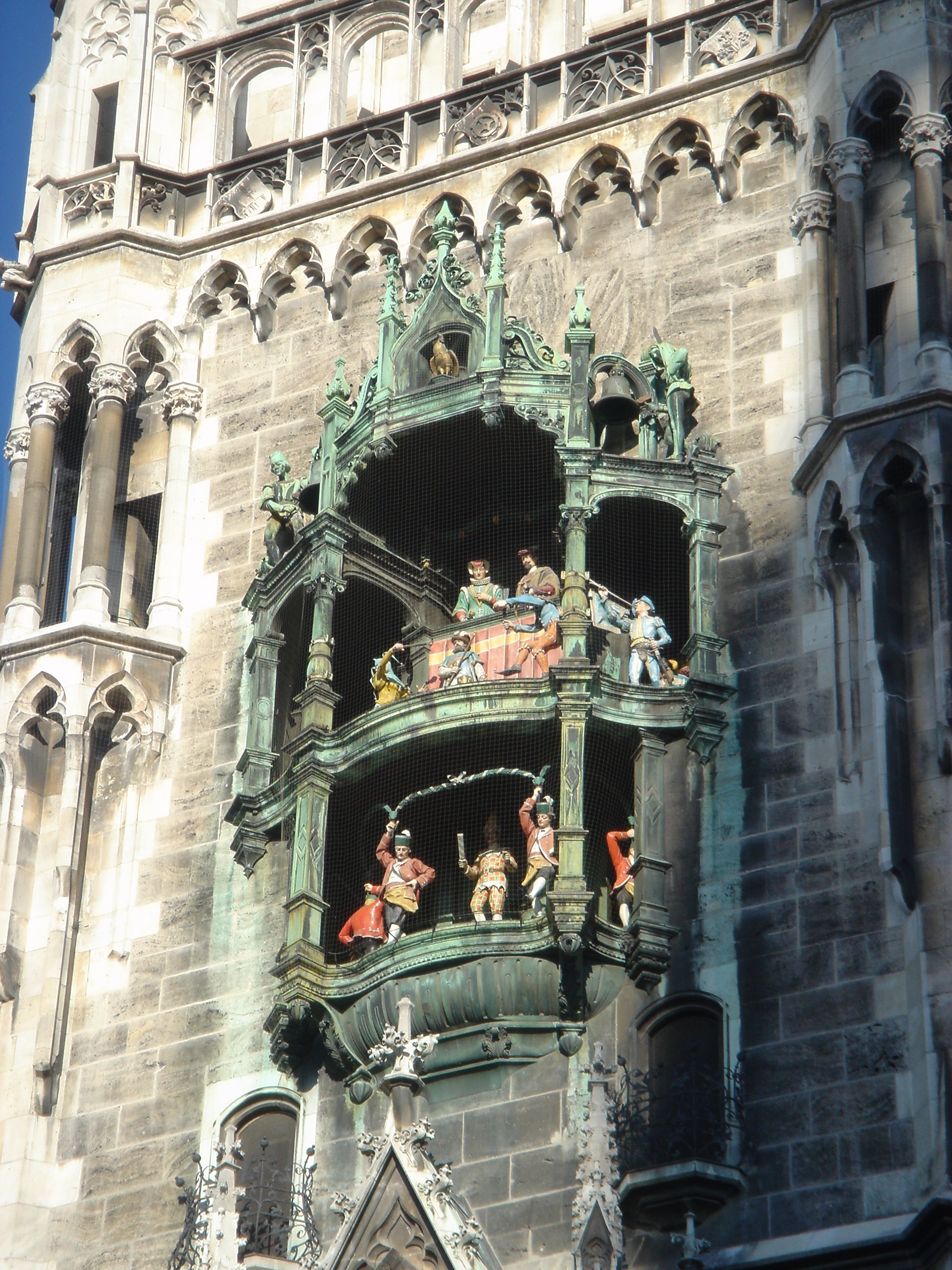
“The melodies are changed over the course of the year,” Wikipedia recounts, “six different combinations of four songs are used. In the windows of the seventh tower a Munich night watchman appears blowing on his horn, as well as an angel blessing the Münchner Kindl.”
Medieval, no; but it marks memorable times I’ve had in Munich. ds
© Dennis Simanaitis, SimanaitisSays.com, 2023
 Simanaitis Says
Thanks for the fascinating post on time. Another favorite — the Prague Astronomical Clock (“Orloj”), which goes back to 1410. Here is part of Wikipedia’s description, better than what I would produce:
“The Orloj is mounted on the southern wall of Old Town Hall in the Old Town Square. The clock mechanism has three main components – the astronomical dial, representing the position of the Sun and Moon in the sky and displaying various astronomical details; statues of various Catholic saints stand on either side of the clock; “The Walk of the Apostles”, an hourly show of moving Apostle figures and other sculptures, notably a figure of a skeleton that represents Death, striking the time; and a calendar dial with medallions representing the months.”