
Simanaitis Says
On cars, old, new and future; science & technology; vintage airplanes, computer flight simulation of them; Sherlockiana; our English language; travel; and other stuff
TESTING THE GULLWING TWICE PART 1
IF YOU’RE GONNA TEST THE SAME CAR TWICE, why not one of the most memorable: the Mercedes-Benz 300SL Gullwing. Here, in Parts 1 and 2 today and tomorrow, are tidbits gleaned from a pair of R&T road tests more than 13 years apart: April 1955 and October 1968.
From the first road test: “Few cars have been so long anticipated or so long awaited as the first genuine sports car from Mercedes-Benz in over 20 years.” From the second evaluation: “Over the years few cars have become so legendary, so sought after, as the Mercedes-Benz 300SL coupe and even fewer postwar cars have become the center of legends.”
Origins. “The first 300 SLs (S for Super, L for Leicht or light),” R&T wrote in its October 1968 Classic Test, “were racing cars, appearing in 1952 with a great splash.” They placed 1-2 in the Carrera Panamericana, at Le Mans, and at the Nürburgring; 1-3 at the Bern Grand Prix and 2nd and 4th at the Mille Miglia.

Thanks to Max Hoffman. Mercedes had no initial plans of selling a production version of the race car, but, as R&T noted, “… at some point in 1953 the American distributor, Max Hoffman, prodded the factory into putting the 300SL into production by guaranteeing purchase of 1000 of them. Thus the 300SL was one of the earlier examples of a European car built primarily for America.”
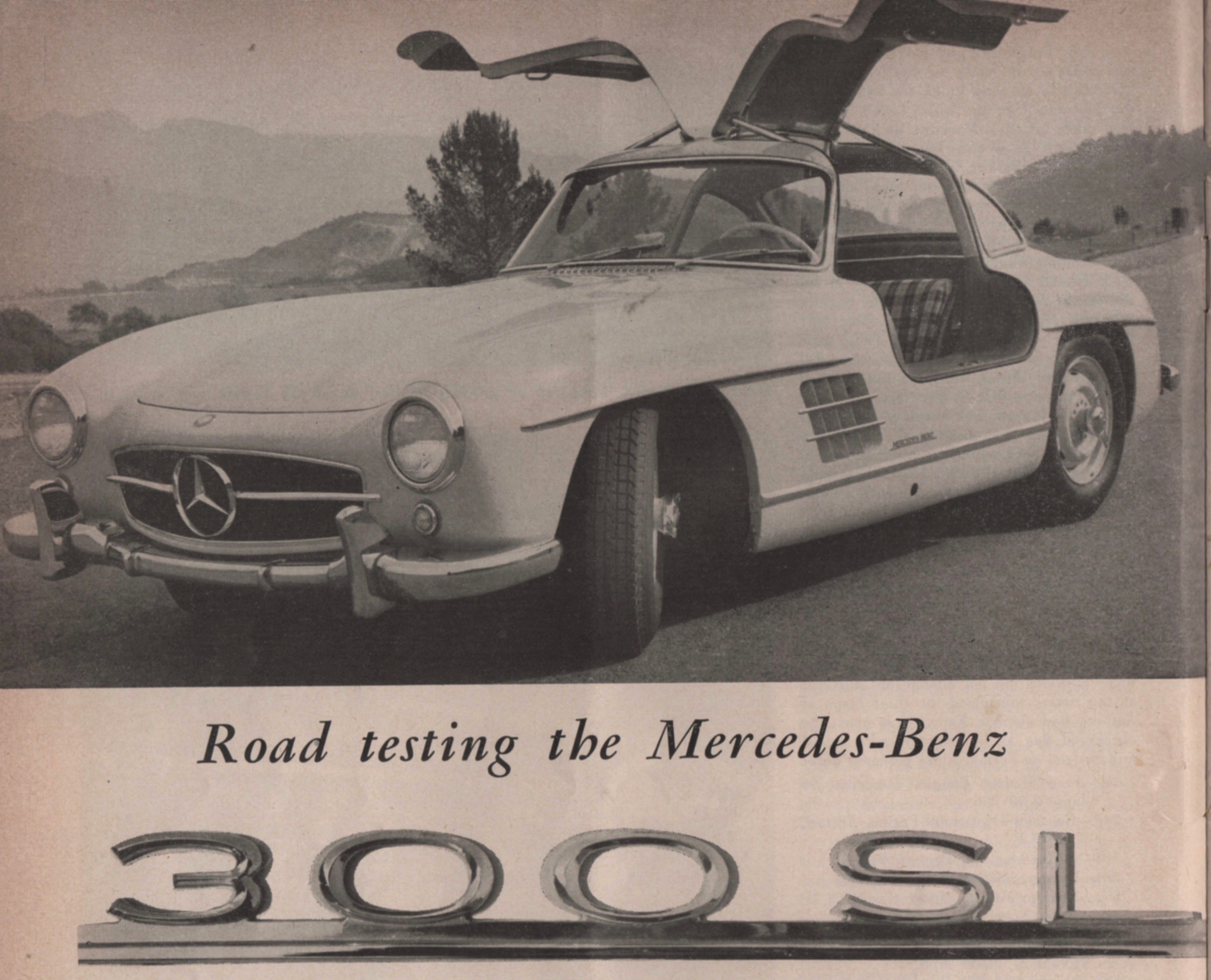
R&T continued in 1968, “Though mid-1957, when production of the coupe—which had come to be called Gullwing because of its lift-up doors—ceased, 1400 of them had been built, of which only 29 had full aluminum bodies. The remaining 1371 had steel panels with aluminum hood and deck.”
“The original price of the Gullwing,” R&T noted, “was $6820, and by the end of its production run that had worked its way up to $8905—Mercedes had priced it too low to break even, and the price crept up in several steps.”

The F-3-55 nomenclature identifies this as the third foreign car tested in 1955. The Data Panel makes an interesting contrast to the 1968 version in Part 2.
R&T’s Initial 300SL Road Test. In April 1955, R&T called the 300SL “the ultimate in all-round sports car. It combines more desirable features in one streamlined package than we ever imagined or hoped would be possible.”
“Performance?,” R&T noted. “It accelerates from a dead stop to 100 mph in just over 17 seconds. Top speed? With standard axle ratio it can approach 140 mph in under 2 miles from a standing start.”

Dealers had no 300SL demos, but R&T met “enthusiast supreme, Mr. Vivian A. Corradini.” He consented to the magazine testing his new car—on a deserted desert road.
“Dual purpose?,” R&T said. “A production model 300SL can make a very acceptable showing in any type of sports car competition. Yet the car is extremely tractable and easy to drive in traffic. Comfort? The fully enclosed 300SL is the most comfortable (and safe) high-speed ‘cross-country’ car built today.”
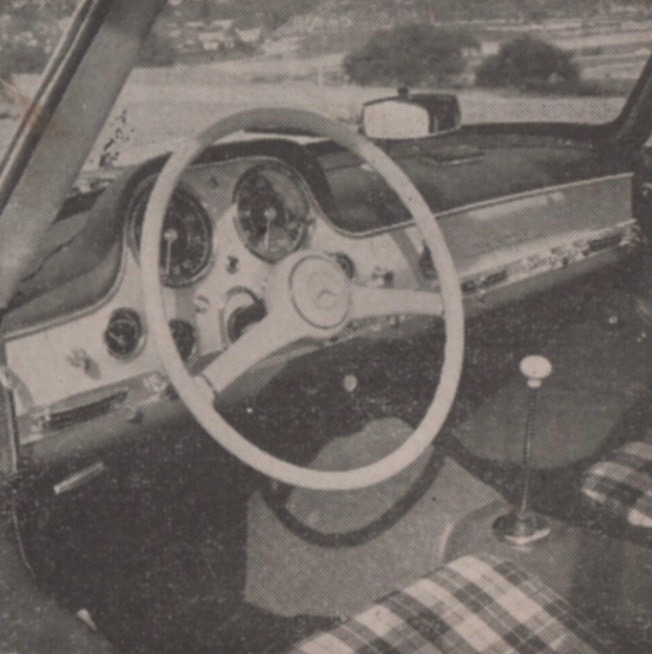
“… steering effort is quite light yet remarkably enough does not feel overly sensitive or too quick for a sports car owner.” No mention is made of Gullwing entry traceable to its high-silled chassis.
“First cost?,” R&T said. “After careful, detailed examination of this car and its performance data, the only question is—‘how do they do it for less than $8000?’ ”
To put that 1955 price of $7463 in perspective, a newly introduced Jaguar XK-140 Super Sports Convertible or Hard Top Coupe went for $3795. And $7463 equates to $86,031 in today’s dollar.
Tomorrow in Part 2, R&T takes a second look at the Gullwing 13 years later. ds
© Dennis Simanaitis, SimanaitisSays.com, 2023
 Simanaitis Says