
Simanaitis Says
On cars, old, new and future; science & technology; vintage airplanes, computer flight simulation of them; Sherlockiana; our English language; travel; and other stuff
VINTAGE DIGITAL
WE LOVE VINTAGE CARS, VINTAGE WATCHES, vintage wines. Why not vintage digital? Moore’s Law predicted quite accurately a two-year obsolescence of almost anything digital, but what of the discarded stuff?
Granted, a 1983 Olivetti M10 isn’t nearly as versatile as my Dell Inspiron 16. And floppy discs aren’t anywhere as convenient as 1tb thumb drives. But then again Bugatti Brescias aren’t as utile as modern transportation, are they?
Evan Moffitt touches on this in “The Future of the Past, The New York Times Style Magazine, October 22, 2023. Indeed, his focus is on curating and conserving “art made with aging hardware,” but its image of CTL Electronoics’ Chi-Tien Lui surrounded by vintage digital piqued my interest. Here are tidbits gleaned from Moffitt’s piece, together with a personal reflection as near as my desk top (as opposed to “desktop”).

Chi-Tien Lui at CTL Electronics. This and following images by Daniel Terna from The New York Times Style Magazine.
Technician/Artisan Chi-Tien Lui. Moffitt describes, “At CTL, which he opened in 1968, Lui initially sold closed-circuit TV systems and video equipment, but for the past couple of decades, his business has had a unique focus: repairing video artworks that, since the onset of the digital age, are increasingly likely to malfunction and decay. ”

A diagram and circuit board in Lui’s workspace.
Museums are interested in CTL: “New technologies are only ever new for so long,” Moffitt notes. “When the phaseout of the incandescent light bulb, a go-to material for artists from Robert Rauschenberg to Felix Gonzalez-Torres, began in 2012, museums either amassed stockpiles of the old bulbs or found a reliable supplier. Dan Flavin, who spent his entire career working with fluorescent light, always had his preferred manufacturers.”

I especially like the cat atop this vintage Sony.
Old Art—Or Updated Art. Moffitt observes that “Not all artists are so precious about their materials, however: In 2012, when Diana Thater presented her 1992 video installation ‘Oo Fifi, Five Days in Claude Monet’s Garden’ at the Los Angeles gallery 1301PE, where it had first been shown 20 years earlier, she updated its clunky CRT projectors to digital ones. She digitized the video, a collage of film footage from Monet’s garden in Giverny, France—itself a technological update of the Impressionist painter’s vistas in oil—because, she said, ‘I don’t want my work to look fake old.’ ”
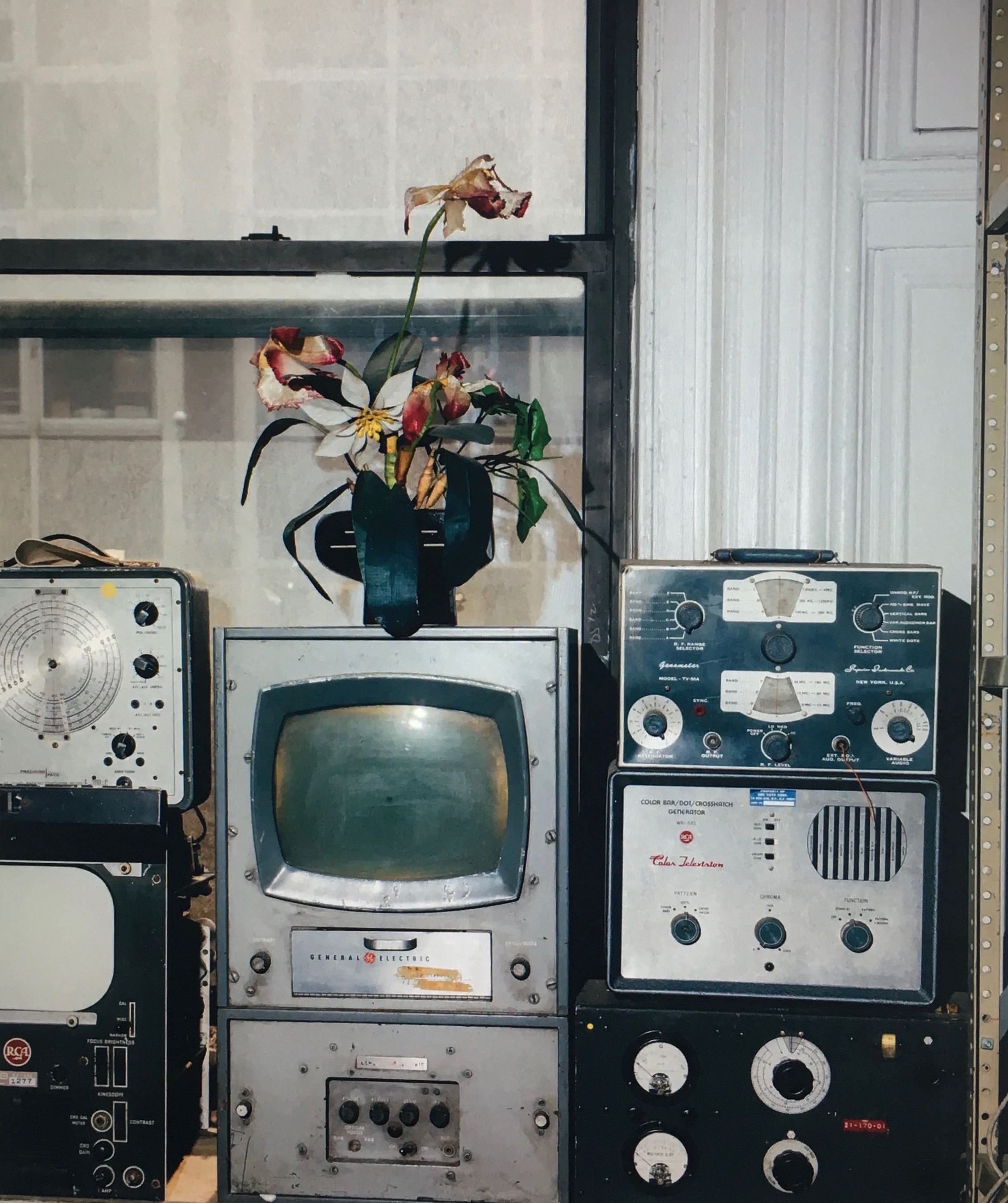
More of Lui’s vintage hardware.
What About Conserving the Old? Moffitt introduces Glenn Wharton, who “was hired in 2007 as MoMA’s first conservator of time-based media, or works that often depend on commercial technology that can have a limited shelf life. ‘I saw the writing on the wall that it was hard to even buy videotapes anymore,’ Wharton said. In the early days, he was making decisions ‘about changing the works of art’ that were the equivalent of a painting conservator using acrylic instead of oil paint.”
Moffitt describes a change of thought: “ ‘We were swapping out CRTs and sometimes moving toward flat-screen technology, or changing projectors or even digitizing.’ Ultimately, Wharton decided, ‘defining the authentic state of a work of art is central to what conservators do.’ So when the museum acquired a work dependent on a specific technology from a living artist, he’d ask how they wanted it to be conserved and displayed.”
One Tool: Emulation. Moffitt says, “For works dependent on old hardware, conservators sometimes rely on a method known as emulation: ‘You’re fooling a current computer into thinking that it’s running on an older system, meaning I can turn my MacBook Pro into a virtual machine where I can run a net art piece in a Netscape 1.1 browser,’ said Christiane Paul, the curator of digital art at the Whitney Museum of American Art.”
Or Just Fire Up the Old Machine. My approach is rather more like driving an original Brescia: On an Italian press junket years ago, Wife Dottie was gifted with an Olivetti M10, a state-of-the-art laptop at the time.
As described at old-computers.com, “The Olivetti M10 is basically the same computer as the Tandy 100 or the NEC PC-8201. All these machines were in fact conceived by Kyocera Corporation (Japan)…. Compared to the Tandy 100 or NEC PC-8201, the M10 is quite beautiful. The main physical difference is the LCD screen which can be tilted for user’s comfort.”
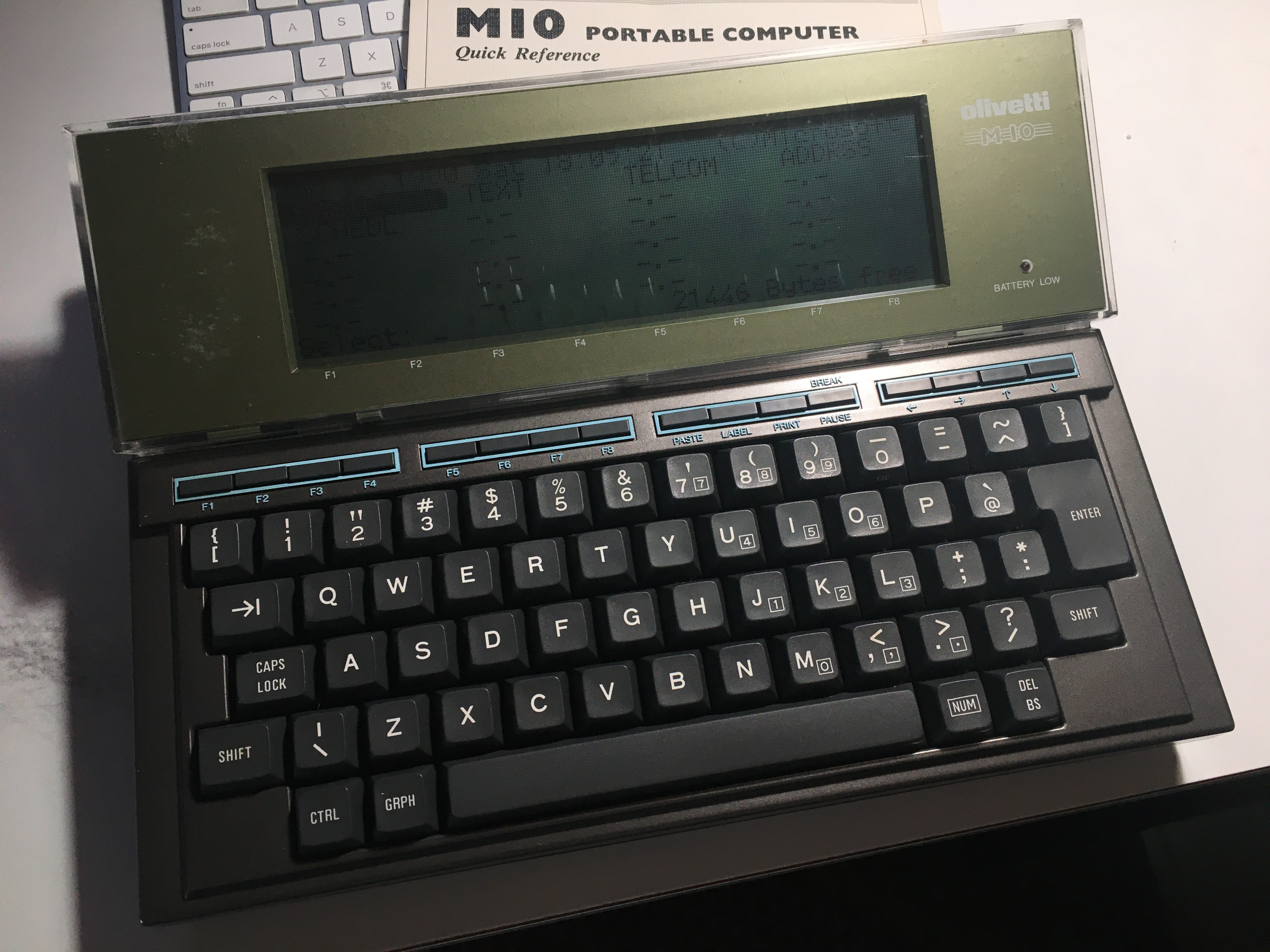
“Just like its brothers,” Old-Computers says, “the M10 was used a lot by reporters all around the world. This success was mainly due to its excellent keyboard and large battery autonomy.”
The M10’s built-in software includes a interpreter for Microsoft Basic 1.0 (the last code developed personally by Bill Gates), a word processor (its display, eight lines of 40 characters, with copy/paste functionalities), a small spreadsheet (for address files), as well as scheduling and telcom capabilities. All this is supported by four AA batteries.
The Olivetti is 11.75 x 8.5 x 2.4 in. and weighs 4.2 lbs, with 32k of ROM. Some 40 years later, my Dell Inspiron 16 2-in-1 laptop is 14.05 x 9.91 x 0.64–0.75 in. and weighs 4.4 lbs, with 16GB of memory.
Yes, but the specifications of my Honda Crosstour are also strikingly in contrast to a Bugatti Brescia’s. ds
© Dennis Simanaitis, SimanaitisaSays.com, 2023
 Simanaitis Says
The Radio Shack TRS-80 Model 100 (to use the complete name as sold) had a socket in the bottom that could hold extension ROMs. Mine had (actually, has, though the machine is not presently operable) one, that added a text formatter (the built-in tool otherwise was a very basic text editor, which was fine for reporters and note-takers), a real spreadsheet (Lucid, with formulae similar to Visicalc), and a better database program (though not relational) than the Address Book. It also had a bus socket that brought out most of the CPU signal pins, so other things could be added; I vaguely recall something called a Chipmunk (?) that added a 3 1/2″ floppy, more RAM, and the ability to run CP/M. There was a magazine devoted to Radio Shack computers at the time (80 Micro iirc) where all sorts of odd bits were discussed and advertised. Internet rumor has it that the Model 100 was the last computer Bill Gates ever personally wrote code for.