
Simanaitis Says
On cars, old, new and future; science & technology; vintage airplanes, computer flight simulation of them; Sherlockiana; our English language; travel; and other stuff
BRESCIA TALES
THE BUGATTI BRESCIA WAS NAMED FOR HAVING RUN 1–4 in the 1921 Italian Grand Prix des Voiturettes near that city. These Type 13 chassis were fitted with 1453-cc, 16-valve, four-cylinder engines. The diminutive displacement was a key requirement in the Voiturette class; four-valve-per-cylinder was indicative of Bugatti’s innovative design.

Image from Classic Cars in Profile Volume 3, Anthony Harding general editor, Doubleday & Co., 1968.
“Apart from the racing Brescias,” Godfrey Eaton wrote in his Classic Cars in Profile article, “there were Brescia sports and also touring models which were named Brescia Modifié…. The Brescia and its derivatives were in production from about 1922 until 1926.”
Here are tidbits about various Brescias, acknowledging that they’re not the first here at SimanaitisSays. See also “Le Bugatti Englouti” (a Type 22 Brescia engulfed in Lago Maggiore until 2009) and “Artful Bugattis” (including Bruce Wheeler’s fetching Brescia model).
The Full Brescia. Eaton describes, “The full Brescia, as some people call it, was a racing or sports car with a 16-valve four-cylinder engine in a Type 13 chassis. It had a bore and stroke of 69 x 100 mm., a ball-bearing crank as opposed to main plain bearing, and twin magnetos.”

R&T described one in April 1955 as “The strange little beast pictured here is one of the few ‘Full’ Brescia Bugattis still running and is the property of C.W.P. Hampton, the well known English Bugatti enthusiast, collector, and connoisseur.”
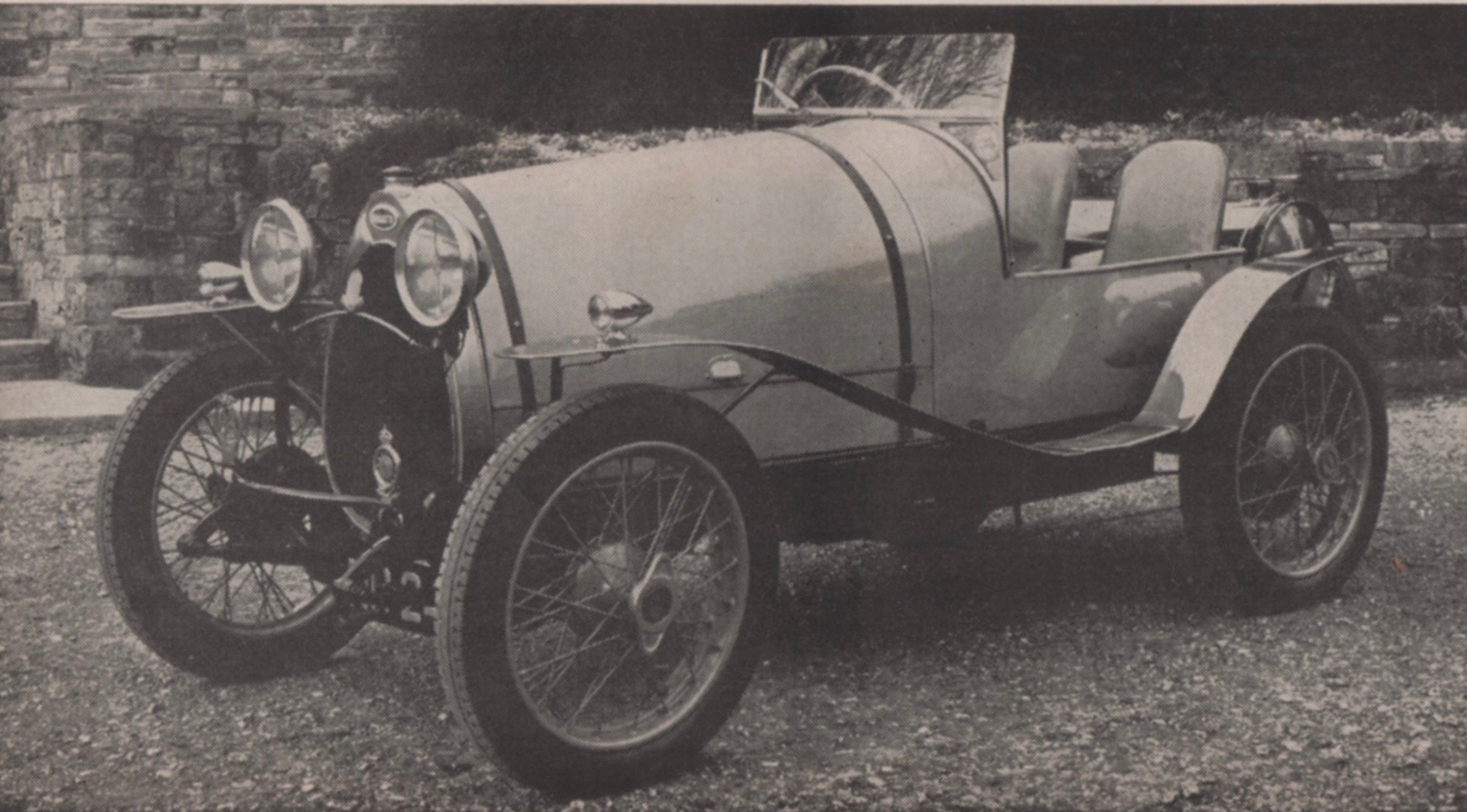
“The Sporting motorist of the early twenties,” R&T said, “did not enjoy (or ask for) the comforts of wind-up windows.”
R&T continued, “A single overhead camshaft operated four valves per cylinder via pivoted levers.”
In fact, as Eaton recounted, “The cambox carried the well-known so-called ‘banana’ tappets.” This fruit occurred twice in the engine’s description: Its exhaust manifold earning the sobriquet “bunch of bananas.” Eaton also observed, “Mention should be made of the pistons since they were of incredible length with three compression rings and one scraper ring.”

Above, the Bugatti 16-valve four-cylinder engine; below, its banana tappets. These and the following image from Bugatti Magnum.

Ettore’s Quick Thinking. In Bugatti Magnum, Hugh Conway relates an oft-told tale of Le Patron’s promoting the efficacy of his racing cars: “A number of racing models on the short chassis Type 13 was also produced, starting off with three cars with the engines produced before the war and buried during it.”

“These three cars,” Conway recounted, “entered the 1920 Coupe des Voiturettes at Le Mans run over a distance of 415 km, driven by Frederich, Pierre de Vizcaya, and Baccoli; Frederich was the winner at an average speed of 90 kph which for the period was sensational and brought Bugatti instant fame.”
“Baccoli was fifth,” Conway wrote, “but de Vizcaya ran a bearing, Ettore cleverly covering this failure by ‘inadvertently’ helping to add water when the car stopped at the pits so that it was ‘regrettably’ instantly disqualified.”
Ha.
Summing Up. Eaton observed, “Those who have driven the Brescias and their derivatives still extoll their virtues—handling was superb and as with most Bugattis the roadholding magnificent. The four-speed G.P. gearbox on the sports racing cars made gear changing a pleasure.”
“With all this,” Eaton wrote, “who would be so churlish as to cavil at their noisiness or even protest at their far-from-civilised seating arrangements?”

A Brescia, “restored by the husband of its present owner, Kirsten Bertheau,” being enjoyed in a Scandinavian rally. Image from Eaton’s piece in Classic Cars in Profile Volume 3.
I certainly wouldn’t be churlish at all. ds
© Dennis Simanaitis, SimanaitisSays.com, 2023
 Simanaitis Says