
Simanaitis Says
On cars, old, new and future; science & technology; vintage airplanes, computer flight simulation of them; Sherlockiana; our English language; travel; and other stuff
“THAT BUILDING IS BRUTAL!”
I TEND TOWARD RECTILINEARITY in my aesthetic appreciation, and I believe I’ve come upon an extreme of this: Brutalist Architecture. Here are tidbits on this sharply worded genre.
Origin. Julia Hammond says in “7 Iconic Brutalist Buildings for Architecture Buffs to Visit,” dailypassport, “Brutalism originated after World War II in Marseilles, France, where the famous Swiss architect Le Corbusier described a housing development he was working on as ‘bétonbrut,’ which translates to raw concrete.” His 1920s concept of Unité d’Habitation took years to see reality: As Hammond notes, “La Cité Radieuse took shape in Marseille, a port city in the south of France, between 1947 and 1952.”

La Cité Radieuse, Marseille, 1947-1952. Image by Shaun Higson/Provence/Alamy Stock Photo from daily passport.
“A collection of 337 two-story apartments—plus shops, galleries, restaurants, and a hotel—create a concrete community on stilts. Broad corridors run through the complex on some of the floors, forming elevated streets, while the flat roof is home to a running track, swimming pool, and shared terrace,” Hammond describes.
Another Etymological View. Wikipedia traces the word’s origin to the Swedish phrase nybrutalism, “the term ‘new brutalism’ first used by British architects Alison and Peter Smithson for their pioneering approach to design…. Descending from the modernist movement, brutalism is said to be a reaction against the nostalgia of architecture in the 1940s.”
Apparently, nostalgia wasn’t what it used to be.
Minimalist Aesthetics. “Brutalist architecture,” Wikipedia defines, “is an architectural style that emerged during the 1950s in the United Kingdom, among the reconstruction projects of the post-war era but commonly known for its presence in post-war communist nations. Brutalist buildings are characterised by minimalist constructions that showcase the bare building materials and structural elements over decorative design. The style commonly makes use of exposed, unpainted concrete or brick, angular geometric shapes and a predominantly monochrome colour palette; other materials, such as steel, timber, and glass, are also featured.”
Think of Baroque, then let your imagination do a U-turn.
The First Nybrutalism. In 1950, Swedish architects Bengt Edman and Lennart Holm designed Villa Göth, a modern brick home in Uppsala.
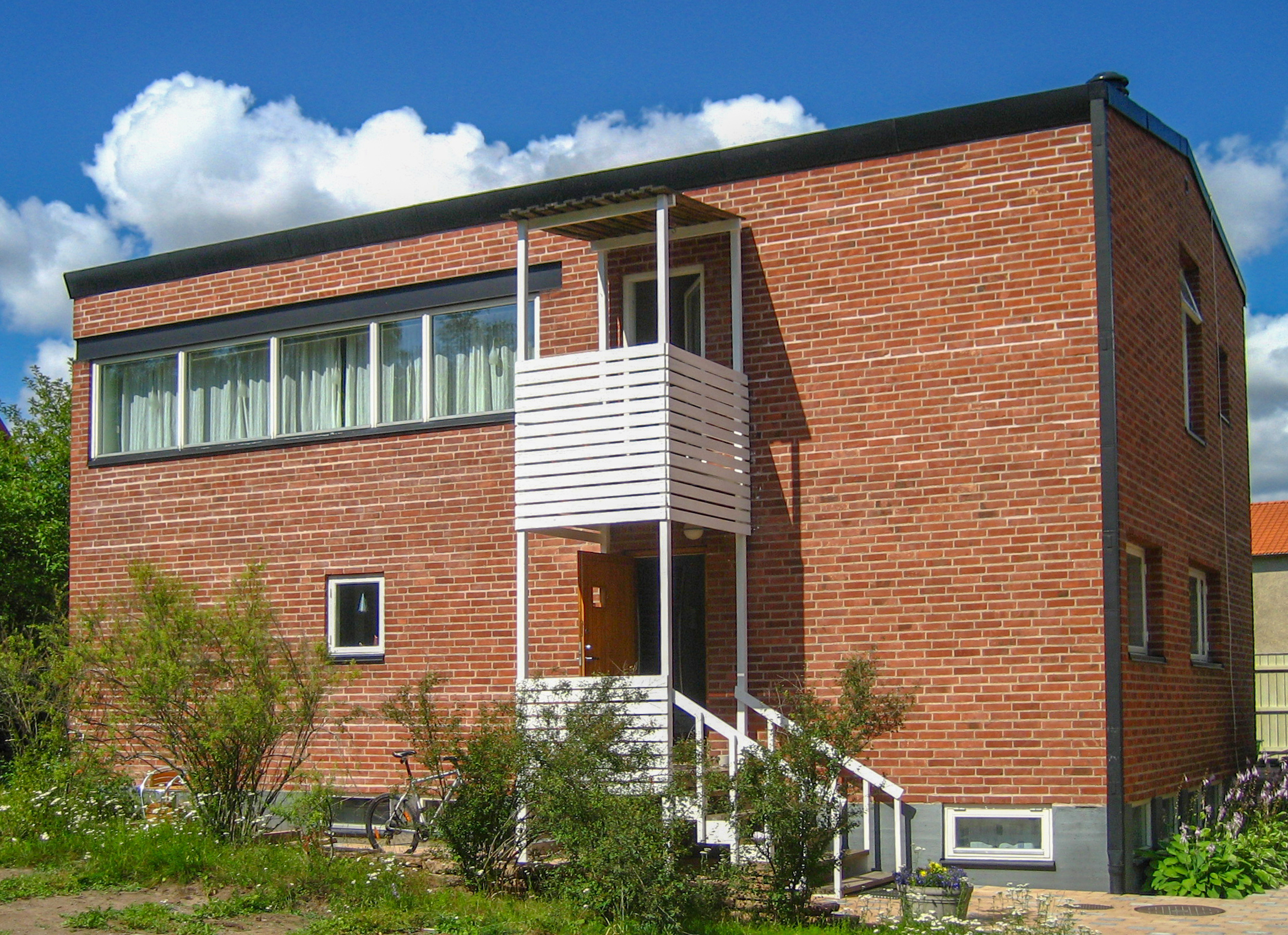
Villa Göth, 1950. Image by Sebastian F from Wikipedia.
Wikipedia notes, “Showcasing the ‘as found’ design approach that would later be at the core of brutalism, the house displays visible I-beams over windows, exposed brick inside and out, and poured concrete in several rooms where the tongue-and-groove pattern of the boards used to build the forms can be seen.”
“New brutalism,” Wikipedia says, “is not only an architectural style; it is also a philosophical approach to architectural design, a striving to create simple, honest, and functional buildings that accommodate their purpose, inhabitants, and location.”
But Not Without Controversy. Hammond offers a controversial example in Boston City Hall: “You know you’ve hit on a controversial design,” she writes, “when people start calling for demolition before the building is even finished. That’s exactly what happened as Boston City Hall approached completion in the late 1960s, and it has polarized opinions ever since. Some find beauty in its stark lines, while others believe they’ve never laid eyes on anything as ugly.”
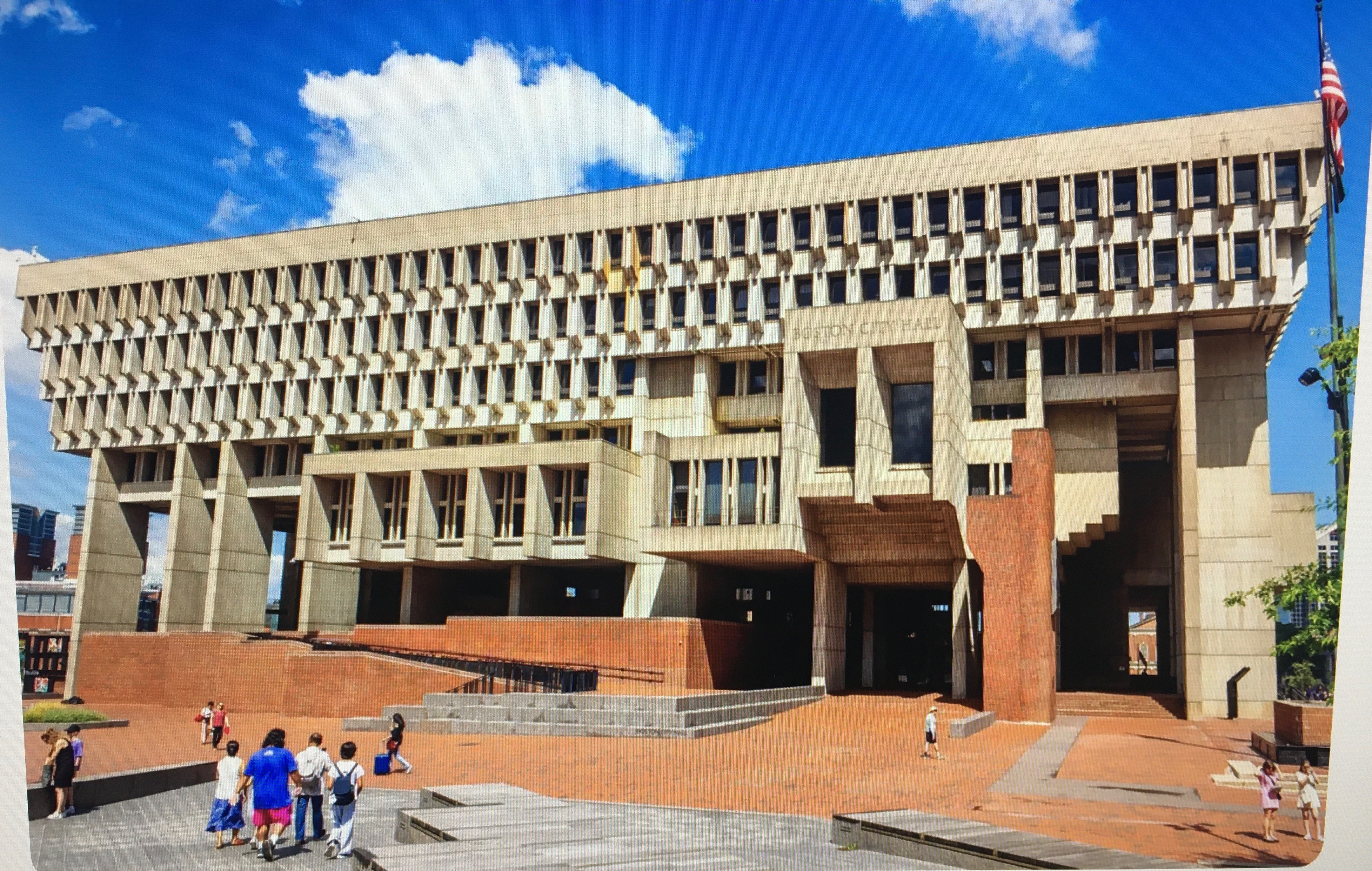
Boston City Hall. Image by APCorizasJr/iStock from dailypassport.
Wikipedia writes, “A common theme in brutalist designs is the exposure of the building’s inner-workings—ranging from their structure and services to their human use—in the exterior of the building. In the Boston City Hall, designed in 1962, the strikingly different and projected portions of the building indicate the special nature of the rooms behind those walls, such as the mayor’s office or the city council chambers.”
Holding Knowledge in One’s Hands. Wikipedia says, “One of the most famous brutalist buildings in America is the Geisel Library at the University of California, San Diego. Designed by William Pereira and built 1969–70, it is said to ‘occup[y] a fascinating nexus between brutalism and futurism,’ but was originally intended as a modernist building in steel and glass before cost considerations meant the structural elements were redesigned in concrete and moved to the outside of the building.”
Thus meeting Brutalism’s choice of exposed structural elements of concrete.

Geisel Library, University of California, San Diego. Image by Ben Lundsford from Wikipedia.
Hammond says, “Appropriately for a library, the architect wanted to create a sense of holding knowledge in one’s hands. The building took two years to come together, opening in 1970, and consists of eight floors made of glass and reinforced concrete. The cantilevered structure required heavy-duty slope beam columns to provide sufficient support, but these also serve to enhance the design.”
“Since 1995,” Hammond recounts, “this Brutalist gem has been dedicated to Theodor Geisel, the children’s author responsible for Dr. Seuss, and his wife Audrey.”
Funny, I’ve never associated Dr. Seuss with brutality. ds
© Dennis Simanaitis, SimanaitisSays.com, 2023
 Simanaitis Says
In your own backyard: go to Cal Poly SLO and check out the Yosemite and Tenaya Hall dorms. Classic (late, mid-1970s) concrete brutalist.