
Simanaitis Says
On cars, old, new and future; science & technology; vintage airplanes, computer flight simulation of them; Sherlockiana; our English language; travel; and other stuff
PSITTACIDAE ANGELINOS
THERE ARE LIKELY MORE RED-CROWNED PARROTS in Los Angeles than in their native range in Mexico. This tidbit caught my eye when KTLA5’s Travis Schlep asked “Why Are There So Many Parrots in Los Angeles?” Here are other tidbits of his article, another by science writer Justine E. Hausheer, and a conversation I just had with a Post Office lady while buying Forever stamps (one set on Endangered Wild Life).
“They’re all around in my neighborhood,” she told me. “I love their squawking. It’s so happy.”
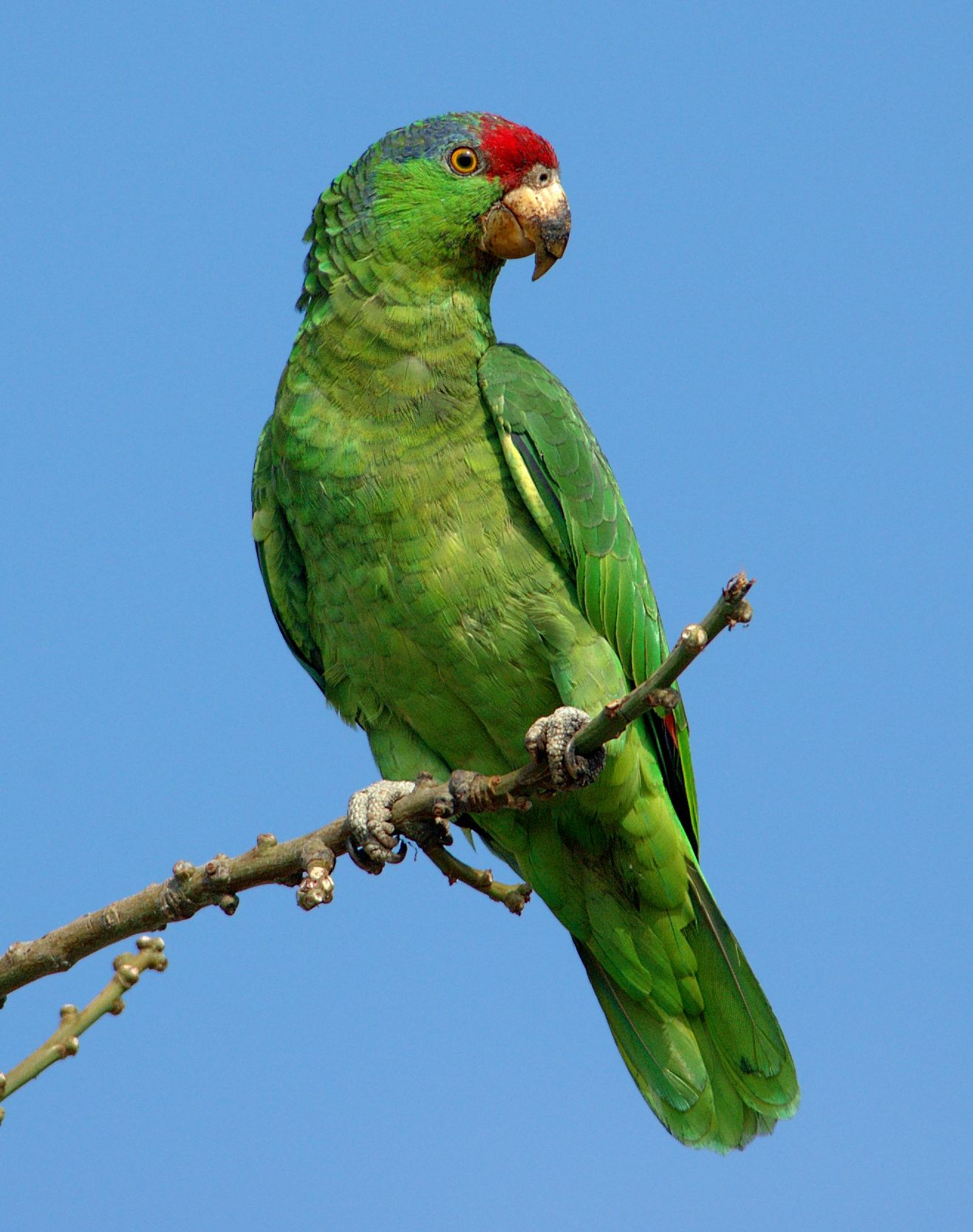
A Red-crowned Amazon, Amazona viridigenalis, from a feral flock in Southern California. Image by Glandauer/Roger Moore from en.wiki.
Why Los Angeles? Schlep says, “While no extant species of parrot are native to the continental U.S., experts say there are as many as nine species of parrot found in the Los Angeles area, introduced decades ago and continuing to grow in population.”
He asks Luke Tiller, president of the Pasadena Audubon Society, how they arrived in Los Angeles. Tales abound: an LAX crate that broke open, a “persistent rumor that the birds once lived at the Van Nuys Busch Gardens and escaped when the theme park shuttered its doors in the late 1970s.”
Wikipedia says, “As of 2021, about 50 million parrots (half of all parrots) live in captivity, with the vast majority of these living as pets in people’s homes.”
Tiller told Schlep “They can be actually quite destructive around the house as a pet. I think people get them as pets and then kind of maybe second guess that and that’s one of the ways they get into the population.”

A Red-crowned Parrot. Image by Heather Paul/Flickr from Justine E. Hausheer’s Field Guide to The Feral Parrots of the U.S.
Endangered at Home, But Lovin’ L.A. Tiller notes, “The red-crowned parrot is actually listed by the International Union for the Conservation of Nature as endangered, which essentially means that it’s at high-risk of extinction in the wild.”
Schlep writes, “Habitat loss and the pet trade are leading factors in the struggles facing the red-crowned parrots. But in L.A., they’re breeding—very successfully—with their communal roosts and breeding spots a popular stop for birdwatchers. Tiller himself lives just across the street from where some parrots have been known to roost during breeding season.”
Cool Green Science. Justine E. Hausheer offers “A Field Guide to The Feral Parrots of the U.S.” at Cool Green Science/The Nature Conservatory. She observes, “As some birders and sharp-eyed observers may already know, the U.S. is home to dozens of feral parrot species. Using data from eBird and the Christmas Bird Count, scientists recently tallied 56 different parrot species sighted in 43 states, 25 of which are now breeding in the wild across 23 different states.”

The Monk as an Example. Hausheer says, “Today, the vast majority of parrots sighted in the US are non-natives. Birds are either escaped pets, creating one-off sightings, or they are the descendants of pets that have now established permanent breeding colonies.”
Hausheer offers an example: “Take the Monk Parakeet: a squat, lime green bird native to South America. In the 1950s and 60s, tens of thousands of Monk Parakeets were imported to the US as pets. Inevitably, some escaped or were set free when their owners tired of a loud, messy, demanding, long-lived pet. Now 70 years later, the Monk Parakeet is the most abundant feral parrot in the country.”

A Monk Parakeet. Photo by Bernard DUPONT/Wikipedia Commons from Cool Green Science.
The Red-crowned Parrot (Amazona viridigenalis). “Also known as the Red-crowned Amazon,” Hausheer says. “Whether or not this species counts as ‘native’ depends on who you talk to. Some say that the populations in the Rio Grande Valley are the product of both escapee pets and wild birds, others disagree. Complicating matters is the question of whether or not the bird deserves protection as an endangered species.”
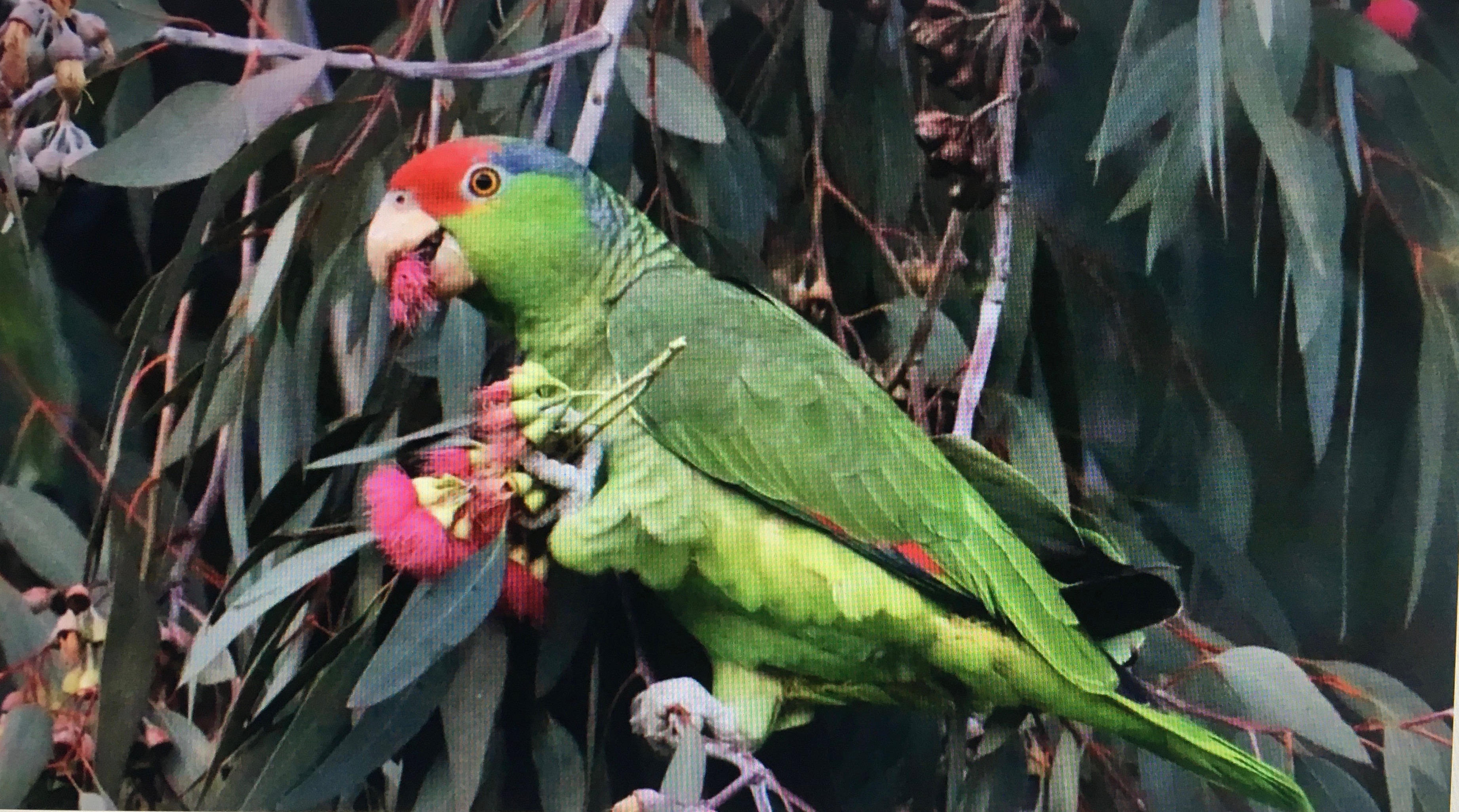
A Red-crowned Parrot feeding on eucalyptus flowers (yet another SoCal come-from-away). Image by Tom Benson/Flickr.
Hausheer notes, “Scientists think it’s possible that there are now more feral Red-crowned Parrots in the US than there are in their original habitats in Mexico.”
Typical Angelinos. KTLA5’s Travis Schlep observes, “Like many Angelenos, these parrots are transplants, drawn to Los Angeles by its idyllic weather and seemingly boundless opportunity, looking for love and taking things day by day.”

A Los Angeles Red-crown Parrot. Image by Katherine Hamilton from Schlep’s article.
And apparently lovin’ every minute of it. ds
© Dennis Simanaitis, SimanaitisSays.com, 2023
 Simanaitis Says
I like this article .
In the early 1970’s these parrots were in Arcadia and spreading West into Pasadena and Altadena, now they’re firmly entrenched every where it seems .
My next door neighbor has a towering walnut tree that never produces fruit but is often full (like 100, I have counted) of breeding pairs .
As a teenager I hated the endless screeching but now it’s music to my ears .
-Nate