
Simanaitis Says
On cars, old, new and future; science & technology; vintage airplanes, computer flight simulation of them; Sherlockiana; our English language; travel; and other stuff
A POCKETFUL OF COMPUTATIONS
JAMES VINCENT’S “INSTRUMENTAL TRICKS,” London Review of Books, October 5, 2023, isn’t about the musical variety, but rather computational: It’s a review of Keith Houston’s Empire of the Sum: The Rise and Reign of the Pocket Calculator.

“The need for prosthetic brainpower,” reviewer Vincent observes, “has been apparent throughout human history, evidenced by the continual development of techniques and technologies to compensate for our biological inadequacies.” Houston’s book recounts examples from the Mesopotamian number system of some five thousand years ago to the most recent ChatGPT controversies.
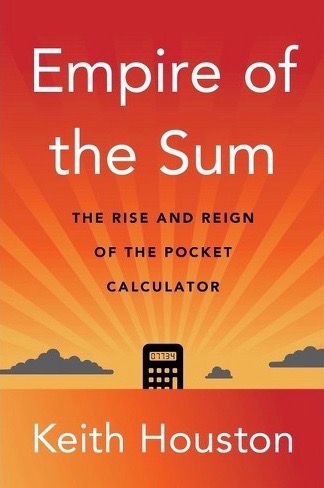
Empire of the Sum: The Rise and Reign of the Pocket Calculator, by Keith Houston, W.W. Norton & Company, 2023.
Houston is familiar to SimanaitisSays readers from appearances of his earlier book Shady Characters, among them “Celebrating #, the Octothorpe” and “Quote Marks Redux.” Here are tidbits gleaned from Vincent’s LRB article and Houston’s latest book.
Fingers and Toes. Vincent describes the innovation of “dactylonomy, which assigns numbers to joints and hand positions, transforming multiplication and addition into a business of folding fingers and brushing knuckles.The discipline was popular enough, as Houston tells it, that as late as the 15th century mathematics textbooks included instructions in finger-counting ‘as a matter of course’ – the English ‘digit’ derives from the Latin digitus, finger or toe.”
Then Pebbles and Abacuses. Keeping track of things with pebbles advanced into the first calculating devices putting the pebbles in a frame. Vincent notes, “Some historians have argued, on the basis of a few gnomic references in scattered texts, for the existence of ancient Sumerian abacuses in the second millennium bce, but the earliest solid evidence of such devices is from the last few centuries bce, in ancient Greece and China.”
The advantage of the framework is clear: It represents place-value notation by putting units, tens, hundreds, and so on into separate columns.

Image from Etsy.com.
A Teaching Aid. An abacus came in handy in describing the place-value concept in “Math for Elementary School Teachers,” one of the courses we taught at College of the Virgin Islands. Indeed, I dined out on one of the stories recounted in the LRB review: “With abacus in hand,” Vincent writes, “the four basic operations of arithmetic—addition, subtraction, multiplication and division—can be conducted with incredible speed by an experienced bead-shuffler. So much so that as late as 1946, when US forces occupying Japan organised a maths competition between an army private with an electric calculator and a local civil servant with a beaded soroban (Japanese abacus), it was the ancient calculating device that triumphed. The Nippon Times covered the event with due majesty: ‘Civilisation, on the threshold of the atomic age, tottered Monday afternoon.’ ”
Abacuses to Slide Rules: Compression of Operation. Vincent recounts, “As the name suggests, the appeal of the pocket calculator is all about compression—the smallness of the device itself, but more important its capacity to reduce the time and effort needed to carry out calculations. In this regard, the abacus was a shabby stand-in compared to the device that came next: the slide rule, a marvel of design that compressed mathematical work to the point of invisibility.”
Vincent devotes a longish paragraph verifying that “The tricks performed with the slide rule are logarithms….” I went into a bit more detail in “What’s a Slide Rule, Grandpa?” I was also compelled to tell the math/snake joke about how adders can multiply.
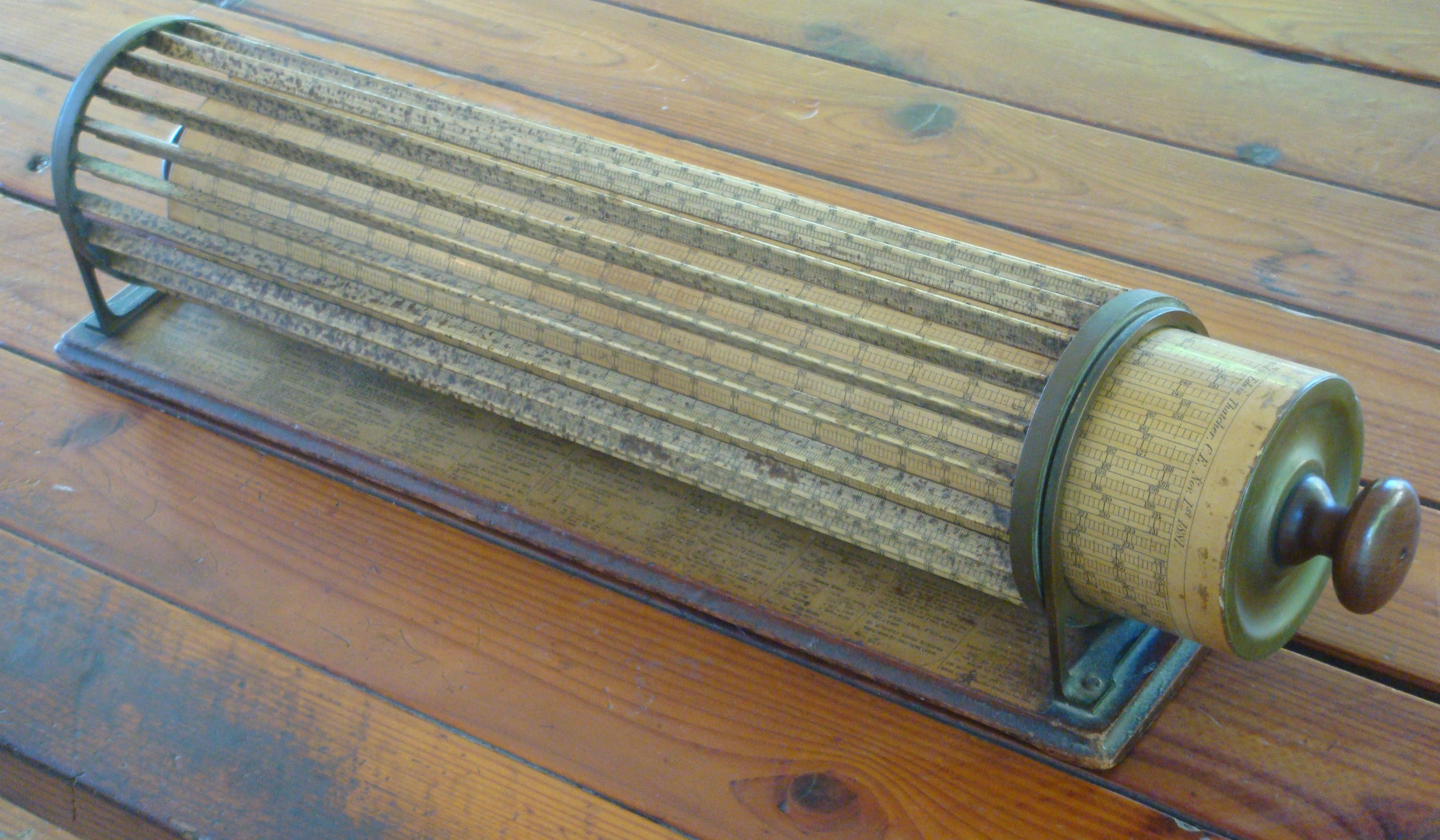
My circular slide rule, equivalent to traditional one 30-ft. in length. Readings are to four-place accuracy, in some ranges five-place.
There’s Always a Kvetcher. Vincent cites English clergyman and mathematician William Oughtred, 1574-1660, who complained of “superficiall scumme and froth of Instrumentall tricks: It is a preposterous course of vulgar Teachers, to beginne with Instruments, and not with the Sciences, and so instead of Artists, to make their Schollers onely doers of tricks, and as it were jugllers.’ ”
Where Have We Heard That Today? Free-style spelling apart, the same objection has been leveled against pocket calculators—and now the likes of ChatGPT—in modern education.
Vincent writes, “Consider the introduction of calculators to schools. In 1975, one in five schools in Ohio was using calculators during lessons, while one in three had forbidden them…. But the calculator’s ubiquity in life outside school persuaded many educators that they needed to ‘prepare children for today’s world rather than yesterday’s’, and by 1980 the US National Council of Teachers of Mathematics was officially recommending that schools incorporate calculators and computers ‘at all grade levels’.”
What’s more, in defensive of pocket calculators they don’t hallucinate. ds
© Dennis Simanaitis, SimanaitisSays.com, 2023
 Simanaitis Says
We can also note than an early iphone has more computing power than NASA had when we went to the moon. Imagine an iPhone 15 Max Pro or an iPad.
Vincent makes this observation as well.
Very timely! I’m just polishing off a set of recommendations on how to think about and deal with all the latest snake oil on AI and your content fills a hole that needed filling.
Thanks!
>