
Simanaitis Says
On cars, old, new and future; science & technology; vintage airplanes, computer flight simulation of them; Sherlockiana; our English language; travel; and other stuff
HOW DO YOU SAY THAT IN MID-ATLANTIC?
KATHARINE HEPBURN OR ORSON WELLES would have known. And, being as I am into old movies, I recognize this artificial accent as its name suggests sort of a mix of the English language and the American version thereof. Here are tidbits gleaned from a variety of sources.
Mid-Atlantic’s Origin. Wikipedia notes that “The Mid-Atlantic accent, or Transatlantic accent, is a consciously learned accent of English, fashionably used by the late 19th century and early 20-century American upper class and entertainment industry…. It is not a native or regional accent; rather, according to voice and drama professor Dudley Knight, ‘its earliest advocates bragged that its chief quality was that no Americans actually spoke it unless educated to do so.’ ”

Image from WORD GENIUS, May 3, 2023, “How To Do a Mid-Atlantic Accent Like the Old Hollywood Stars.”
Theatrical Talk. Wikipedia continues, “When the 20th century began, classical training for actors in the United States explicitly focused on imitating upper-class British accents onstage. From the 1920s to 1940s, the ‘World English’ of William Tilly, and his followers’ slight variations of it taught in classes of theatre and oratory, became popular affectations onstage and in other forms of high culture in North America.”
Wikipedia says, “Cary Grant, who arrived in the United States from England aged 16, had an accent that was often considered Mid-Atlantic, though with a more natural and unconscious mixture of both British and American features.” Indeed, I recall a recent tidbit here at SimanaitisSays sharing Grant’s opinion that his accent growing up was akin to an original Eliza Doolittle’s.
Those trained specifically in Mid-Atlantic, Wikipedia notes, include Tyrone Power, Bette Davis, Katharine Hepburn, Laird Cregar, Vincent Price, Christopher Plummer, Sally Kellerman, Tammy Grimes, and Westbrook Van Voorhis.
An Artificial Dialect. Adam Rathe observes in Town & Country, May 3, 2020, “Throughout the Golden Age of Hollywood, stars including Katharine Hepburn, Cary Grant, Bette Davis, and Orson Welles employed what’s known as a ‘Mid-Atlantic accent,’ a sort of American-British hybrid of speaking that relies on tricks like dropping ‘R’ sounds and softening vowels, in order to convey wealth and sophistication on the silver screen.”
“It’s a trick that fell out of favor by the middle of the 20th century,” he writes, “but still pops up in popular culture—cheerio, Madonna!—and is on full display in Hollywood, the new Netflix series produced by Ryan Murphy.”

Image of Netflix‘s Hollywood from Town & Country.
Rathe cites telling dialogue from this tv show: “In the second episode of the series, a group of aspiring young actresses are seated in a classroom at the fictional Ace Studios being tutored in the art of using the mid-Atlantic accent properly… In the scene, Kincaid [studio exec trainer] asks one student ‘where does the Mid-Atlantic accent come from?’ ‘The middle of the Atlantic,’ she answers. ‘And who lives there?’ Another student pipes up: ‘No one.’ ”
Other Variations. Groton School, an upper-class college-prep and boarding school in Massachusetts, fostered a variation spoken by graduates, the likes of Franklin Delano Roosevelt, Averell Harriman, and Dean Acheson. The accent’s non-rhotic (soft r’s after vowels) feature is a giveaway. Think of FDR’s historical “We have nothing to fear but fear itself.” That’s “feah,” of course.
Another variation cited by Wikipedia is “’Locust Valley lockjaw’ or ‘Larchmont lockjaw,’ named for the stereotypical clenching of the speaker’s jaw muscles to achieve an exaggerated enunciation quality. The related term ‘boarding-school lockjaw’ has also been used to describe the accent once considered a characteristic of elite New England boarding-school culture.”
Wikipedia cites “In the film Auntie Mame (1958), Gloria Upson’s accent identifies her as a ‘lockjawed prep princess’ from Connecticut’s WASP elite.”
Speaking Mid-Atlantic Today. Wikipedia notes, “After the accent’s decline following the end of World War II, this American version of a ‘posh’ accent has all but disappeared even among the American upper classes, as Americans have increasingly dissociated from the speaking styles of the East Coast elite; if anything, the accent is now subject to ridicule in American popular culture.”
If you insist on learning it, though, be aware of its phonological complexities; Wikipedia lists 24 rules for vowels alone. I confess, many of the differences are lost on my Cleveland-bred ears: father (fɑːther) versus all (ɔːwll); or sure (sʊəre) versus burn (bɜː~əːrn).
But, then again, I’m reminded of a high-school English teacher who asked me, “Dennis, how long have you been in this country?”
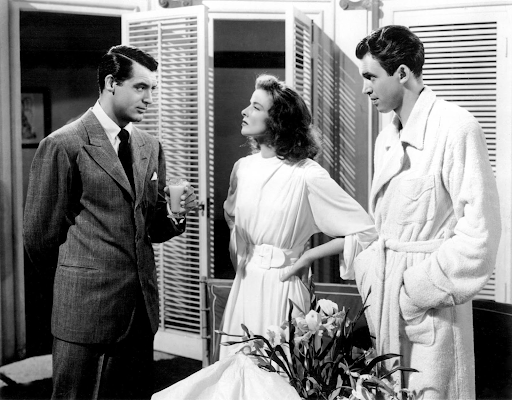
Cary Grant, Katharine Hepburn, and James Stewart in The Philadelphia Story, 1940. Katharine speaks Mid-Atlantic; Cary does sorta; Jimmy speak American.
Sarah Angela Almaden offers hints in “The Transatlantic Accent: What Is It & How Do You Talk In It?, Beelinguapp, March 30, 2023: Among her suggestions: Drop final r’s: “After” would be “af-tuh.” Stress the letter t: “Butter” is bu-tuh” Use long vowels: “Party” would sound like “pahhh-tee.”
Also, she says, “If we want to travel back in time and hear this Hollywood accent, all we have to do is watch a golden age Hollywood film.”
Great advice. ds
© Dennis Simanaitis, SimanaitisSays.com, 2023
 Simanaitis Says
“But, then again, I’m reminded of a high-school English teacher who asked me, ‘Dennis, how long have you been in this country?’”
Wonderful. Perhaps there are permutations of the Mid-Atlantic, some steeped in the language, respect for it, the value of the right word, inevitably drawn to it, as much or more cultural than fiscal, as with concise but breezy prose.
A subset might be someone with a t r a c e of Southern gentility albeit well-read, knowing Shakespeare and harking to the “dead English poets.” Today’s K-12 is in dire need of Professor Higgins, and such role model might help us from trailing that in at least 16 other modern industrial nations, and learning being learning, producing more than a quarter per capita the scientists, engineers, doctors as China, Pakistan, India.
T’ain’t pompous in the least. When Indian customer service kids speak better English than ‘Murican brats, we’re in trouble.