
Simanaitis Says
On cars, old, new and future; science & technology; vintage airplanes, computer flight simulation of them; Sherlockiana; our English language; travel; and other stuff
WHAT MAKES FOR A PERFECT TWO-SEAT COMMUTER?
BACK IN DECEMBER 1983, R&T WROTE “The 1.5-liter CRX is the most fun you can have on four wheels for less than $7000.” Cover blurbs blurbed, “Lotus Turbo Esprit: blindingly quick at 148 mph, 0-60 in 6.6 seconds” and “Honda Civic CRX: quicker than the Lotus on slalom & skidpad—and $42,000 less.”
Gee. It’s enough to make me want a CRX today. By the way, I had already been at R&T for almost five years back then. However, since our road tests had yet to be bylined, I’ll avoid “we” in these tidbits.

At Tochigi. The press intro at Honda’s Tochigi Proving Ground introduced all seven Civic models: three 3-door hatchbacks, one 4-door, a wagon, and two versions of the sporty CRX coupe. “They do share engines, transmissions and front and rear suspension design,” R&T observed, “but aside from that they have little in common. To put this accomplishment in perspective, it’s tantamount to Ford announcing a new Fairmont and then mentioning, ‘Oh yes, by the way, we’re also introducing a new Mustang, a new Thunderbird and a new Continental Mark VII, all sharing portions of the same platform but otherwise very individual automobiles.’ ”
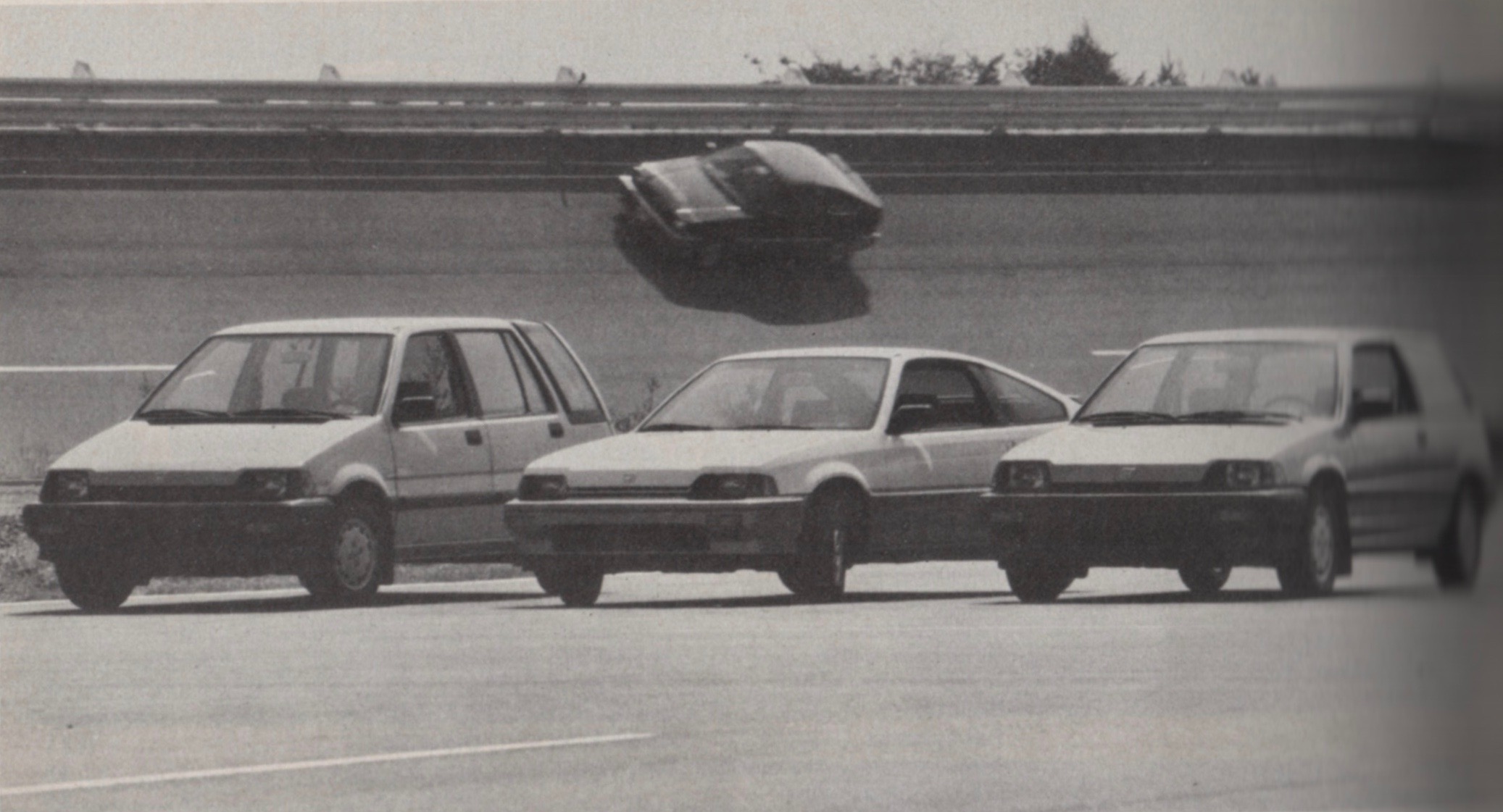
From the beginning, the wagon was a favorite of mine. But when R&T got to local testing at OCIR, it was impossible not to be impressed by the two-seat CRX, especially with the hyperbuck hyperquick Lotus Turbo Esprit around as well.
Honda’s M/M Concept. R&T noted, “One of the cornerstones of the new designs was something Honda refers to as the M/M concept, meaning maximum interior space/minimal exterior space.”
Indeed, the magazine had experienced this already, one size down, in the amazing Morris Mini. But as noted, “The current crop of small cars is ample proof that it’s difficult to make one company’s product line stand out. But the new Civics are exceptions that disprove the rule. Form following function really works.”
CVCC 2.0. R&T noted, “The ‘economy’ 1.3-liter and ‘performance’ 1.5 have common bore centers with different displacements counted for by a longer stroke, 78.00 mm for the 1.3 and 86.50 for the 1.5.”
The common bore, of course, eased production line matters.
“Both engines,” R&T continued, “are single-overhead-camshaft crossflow designs with branched conduit torch combustion chambers, basically an evolution of the CVCC concept.”
Compound Vortex Controlled Combustion, introduced by Honda in the 1970s, allowed the company to meet U.S. emission standards initially without catalytic converters. Evolutions of it appear in today’s Formula 1 engines.
Combating Torque Steer 3.0. Front-wheel-drive cars of the era were notorious for torque steer, a disconcerting power-on/power-off change in direction. However, R&T recounted, “Beginning with the 2nd-generation Civic introduced in 1980, engineers reduced the angles of the driveshafts to make them more horizontal and reduce torque steer. This worked and we were much less critical of these cars than the first Civics. Now Honda has gone one step further, dropping the transfer case lower to reduce driveshaft angularity still more. Also, with the less powerful 1.3-liter models, the right shaft is twice as stiff as the left while with the 1.5-liter engine, the left shaft is hollow with a twisting moment equal to that of the solid right shaft.”
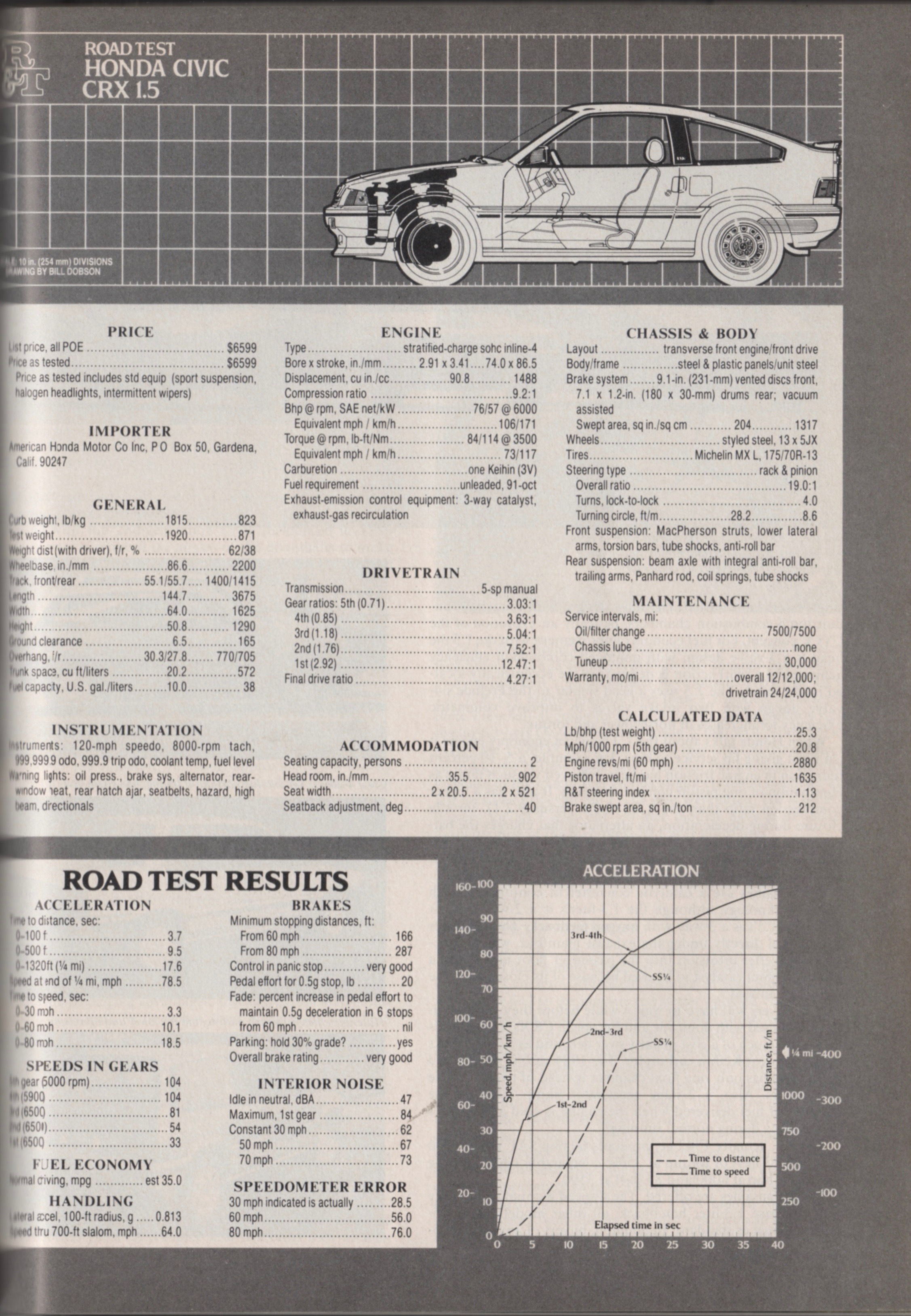
At Home at OCIR. R&T reported, “How about an amazing 64.0 mph through our slalom? The CRX absolutely delighted in weaving around the cones, its throttle planted firmly to the wood after the initial transition, its steering providing excellent input about grip and responding crisply, and its rear tires following along predictably while doing an admirable job of holding up the cargo area.”
On an immodest note, I recognize this verbiage as my own (given that I was the guy doing our eight-cone 700-ft slalom at the time). By the way, that cargo area had a lockable cubby for valuables.


“Indeed,” I we er… R&T admitted, “we’ve known that small fwd cars tend to do well in such tight transitions and, based on this super-quick slalom, we expected to see an only middling display of fwd push around the skidpad. Surprise: The CRX turned in a highly commendable 0.813g in this exercise. To put these two figures in perspective, note that they compare favorably with those of the Lotus Turbo Esprit reported on elsewhere in this issue.”

Or reproduced right here. ds
© Dennis Simanaitis, SimanaitisSays.com, 2023
 Simanaitis Says
I loved the Honda CRX, but even when I finished University in 88 and got a real job, it was out of my price range. I got a Chevy Turbo Sprint (just a rebadged Suzuki Swift). 1 liter aluminum 3-cylinder. Super quick and still got 40 mpg :-). My longing for a Honda never went away, but the Sprint was half the price.
I always thought the Lotus looked great in the rear view mirror of my tow truck. Towed a few back to the dealer. Of course I was driving a Saab at the time. Neither car a stranger to the tow hook.
Geez! I’d hate to know what an Esprit would cost today!
My first new car was a Mini Cooper, and I’ve owned over 100 cars with less than 1 liter, so am a dedicated eco-lover.
That was a golden age for mini Muscle Cars, and everyone from Ford, Geo, Toyota, Suzuki, Subaru, etc offered a “mouse that roared!” I loved my Suzuki Swift GTii and Toyota Corolla FX16. In this day of high gas and green emphasis, I just joined the commuter crowd going downtown, and noted many more trucks and mid-size and larger SUVs than passenger cars … and the “build it and they will come” bike lanes totally empty in fine, 70 degree weather! Note that despite smart car’s 40+ mpg city/hiway, proven solid crash structure, wide open doors, ez parking, and an EV version that not even Roger Penske could convince Americans to buy it … not even with $4/gal gas!