
Simanaitis Says
On cars, old, new and future; science & technology; vintage airplanes, computer flight simulation of them; Sherlockiana; our English language; travel; and other stuff
BRINGING ZHUZH TO THE PADAWANS
LEXICOGRAPHIC PALS MERRIAM AND WEBSTER bring 690 new entries into their dictionary, two of them utterly new to me and included into today’s title. Here are tidbits about them and several of the others, some of them surprisingly familiar. In no particular order:

Zhuzh. A culinary term, zhuzh is “a small improvement, adjustment, or addition that completes the overall look, taste, etc., of something.”

Image from M-W’s “How to ‘Zhuzh’ Up Your Vocabulary.”
Merriam-Webster says “probably of expressive origin,” i.e., sorta onomatopoetic: “naming of a thing or action by a vocal imitation of the sound associated with it (such as buzz or hiss).” It continues, “The earliest records of zhuzh show that it is part of Polari, an argot used in Britain since perhaps the eighteenth century primarily among gay theatrical and circus performers. The claims that the word was borrowed from Yiddish or Romani are not supportable. Given the lack of a clear origin, it is impossible to tell if the verb has priority over the noun or vice versa.”
Though M-W lists only the noun and verb, I also like the adjectival sound of zhuzhy, And, given the quantification “small,” I would find it difficult to term my own culinary excesses as zhuzhes. (I’m also told that I have “pliers for taste buds.”)
Padawan. “noun, informal: a young person especially when regarded as naïve, inexperienced.” This one shows my Star Wars naïvety: M-W says, “This use of padawan has its origin in the fictional universe of the Star Wars franchaise, where the term padawan refers to aspiring Jedi knights whose education is overseen by a Jedi master.”

Somehow I’m thinking that padawanesque is akin to jejune, in the sense of juvenile or puerile. But I fear I’m underplaying the potential of aspiring Jedi knights.
Carbon Capture/Carbon Sequestration. I’m surprised these two terms are so tardy in being recognized by M-W. I sure hope that lexicographers aren’t among climate deniers!
Quite correctly, carbon captures are “any of various methods of removing carbon dioxide (as from industrial emissions) to reduce its presence in the atmosphere.” In the same entry, curiously M-W limits carbon sequestration to “the removal of carbon dioxide from the atmosphere by living vegetation.”

Image from azocleantech.com.
True enough, plants perform carbon sequestration through photosynthesis. But what about the technology of carbon sequestration? It’s only in the this term’s separate listing that M-W says, “any of various methods or processes for capturing and storing carbon dioxide from the atmosphere.” What’s more, its two examples stress natural means: “living vegetation” and “carbon sinks (such as oceans, soil, or forests) by natural or artificial means.”
UAP. I appreciate the nuanced implication of “unidentified aerial phenomenon” or “unidentified anomalous phenomena” rather than the more traditional UFO’s “unidentified flying object.” These new terms retain the phenomenon’s unknown nature but allow for broader sense than a specific “object.”

Image from YouTube.
Somehow, “objects” are inexorably linked with flying saucers piloted by little green men (and what makes you think they’re so little?).
Digital Riches. SimanaitisSays has already discussed two of M-W’s digital additions, large language models and hallucinations. And another addition, vector graphics, is one that supports my time-gobbling hobby of GMax/Microsoft Flight Simulator.
As I (albeit only partially) learned years ago, M-W says vector graphics is “a process of creating digital images by using mathematical formulas to specify the relationship between the elements of the image (such as the start and end points of a line) rather than by defining each individual pixel.”
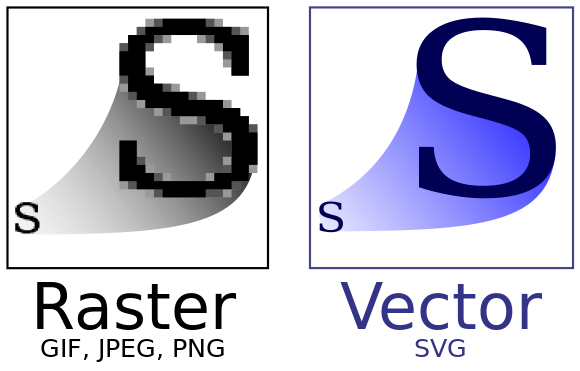
Image from Wikipedia.
This is succinct indeed, as definitions perforce must be. It’s akin to another of my favorite lines: Digital computers do nothing more than count on two fingers orderly and quickly. ds
© Dennis Simanaitis, SimanaitisSays.com, 2023
 Simanaitis Says
Between an anomaly and a phenomenon there is, to my mind, more distinction than difference. An anomalous phenomenon must be a rare thing indeed.