
Simanaitis Says
On cars, old, new and future; science & technology; vintage airplanes, computer flight simulation of them; Sherlockiana; our English language; travel; and other stuff
EVALUATING THE DE TOMASO PANTERA—AND THE U.P. PART 1
CRAMMING AN AMERICAN V-8 into a mid-engine Italian exotic may not be without its shortcomings, but many of these can be remedied—or overlooked. Indeed, two young ladies from California had the temerity to borrow a De Tomaso Pantera from Ford Dearborn and motor through Michigan’s remote Upper Peninsula, the U.P. being the ancestral home of one of them. Here in Parts 1 and 2 today and tomorrow are tidbits about the car and their adventure gleaned from two issues of R&T, May 1973 and September 1974, together with my usual Internet sleuthing and personal commentaries from the other of this intrepid pair, Dottie Clendenin.
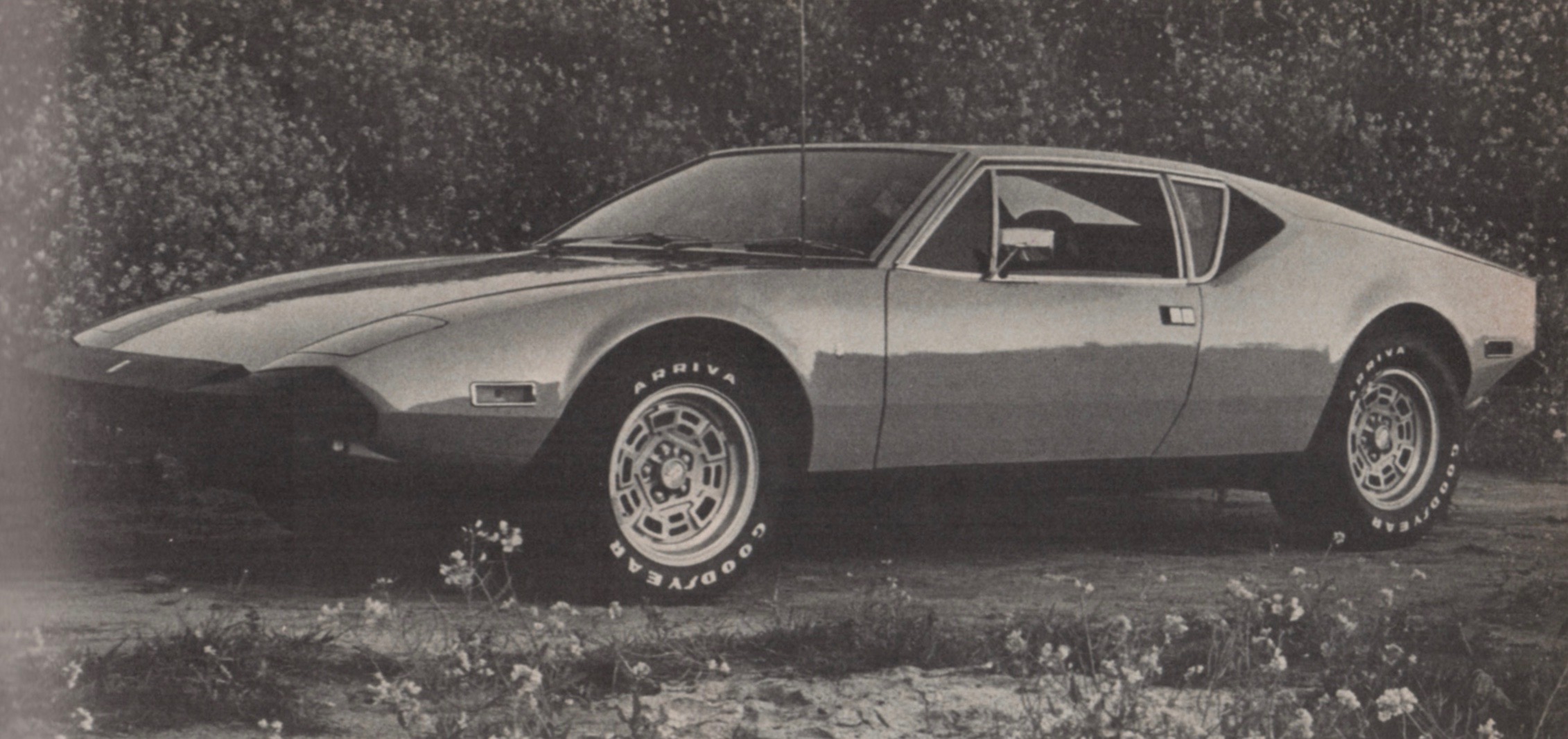
An Improved Car, and Still By Far the Least Expensive Big-Engine Midship GT. This May 1973 road test was R&T’s third evaluation of this Italo-American machine: “The first was when production was just underway, and that early car was hardly ready for the road. About ten months later we tried one that had been worked over with solutions to the most serious early problems—ineffective air conditioning, engine overheating and inappropriate gearing in 5th speed.”
“Now,” said R&T, “we can report some more improvements to the Pantera and bring all the performance data up to date….”
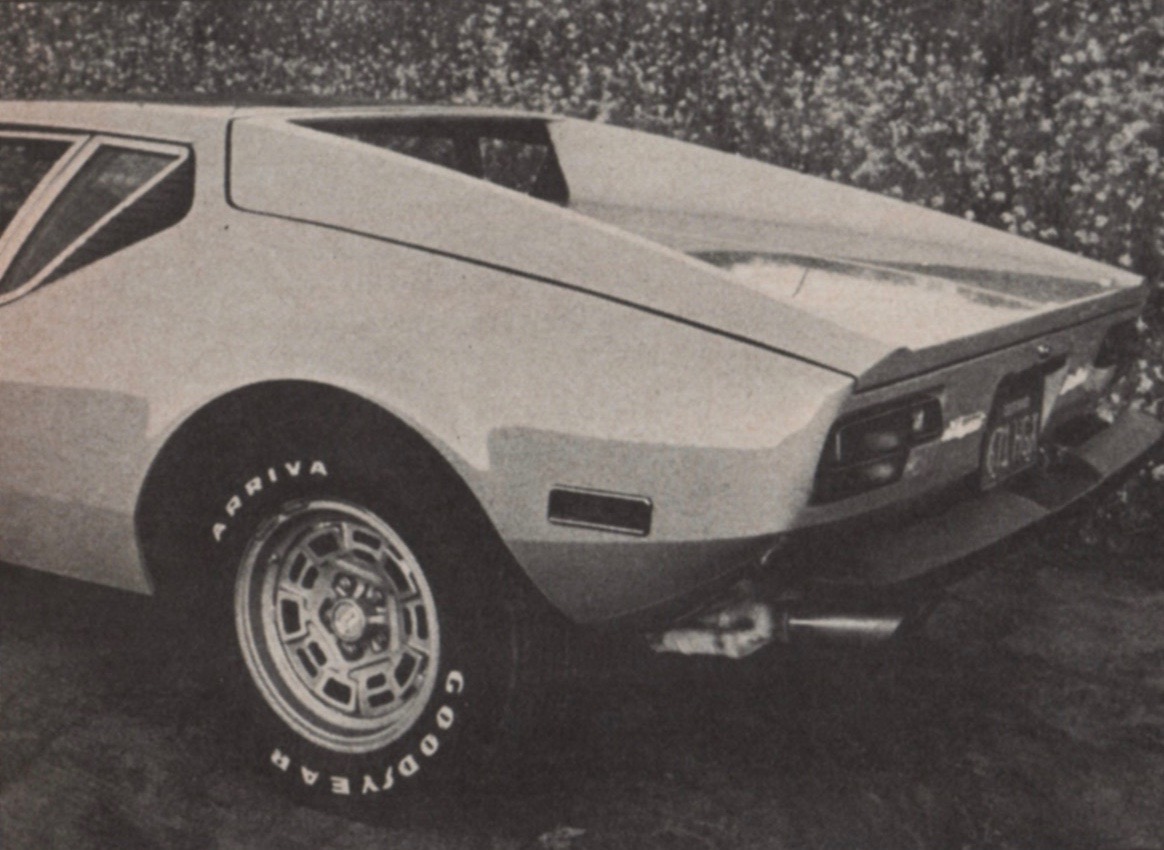
The Crash-Bumper Era. R&T recounted, “The 1973 Pantera is especially interesting in that it’s the first ‘exoticar’ to appear with fully law-conforming (actually somewhat law-exceeding) 1973 crash bumpers. Both front and rear bumpers are on hydraulic cylinders and are of metal construction with rubber facing.”
Fixing Earlier Foibles. R&T reported, “Other changes for 1973 are in the seats, tires and brakes. We’d have singled out the seats as our favorite area for change; the Pantera’s cockpit layout is its worst feature and the early seats were impossible.”
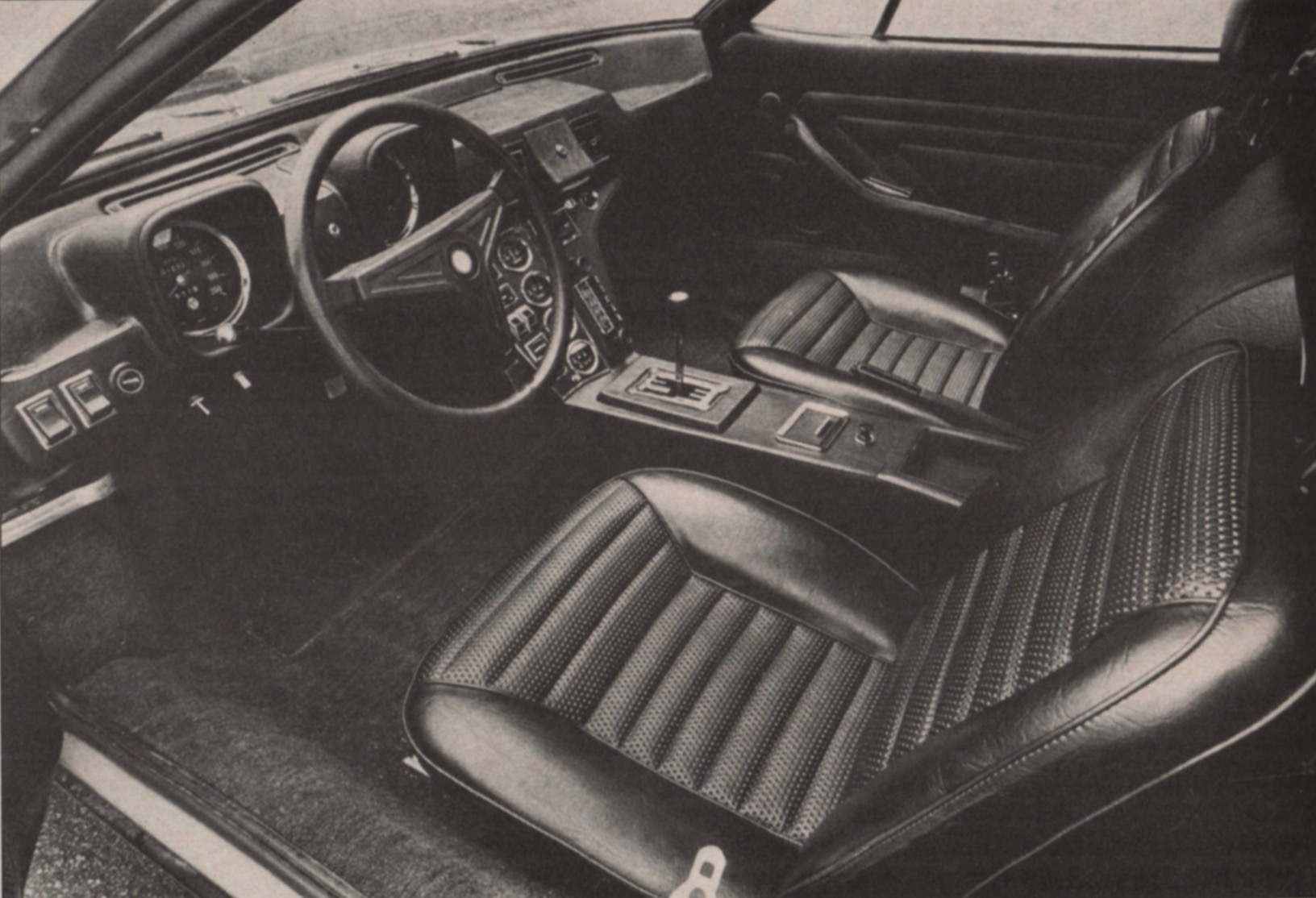
Still problematic were “its instruments being obscured by the small and angled steering wheel, the offset pedals, the lack of headroom, etc., but every little bit helps.”
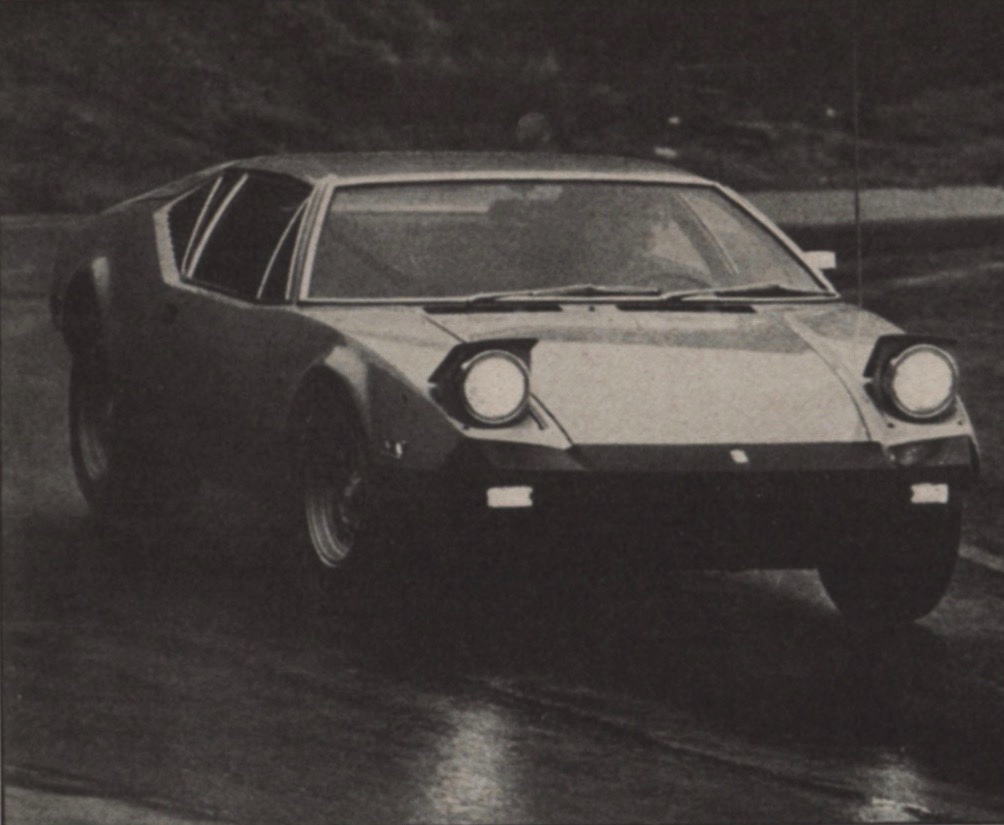
Countering Trailing-Throttle Oversteer. “To achieve a better compromise in handling qualities,” R&T recounted, “De Tomaso had Goodyear design a special 60-series (meaning ultra-wide and low) bias-belted tire for the car.”
“The good news” R&T said, “is that it is now difficult to get into trouble with the car, even when lifting off the throttle in the middle of a hard corner. The Pantera’s tail will drift out when this is done, but gently, and the driver can recover it easily by either re-applying power or decreasing steering lock.”
A Mystery Brake-balance Fix? R&T continued, “The brakes are more good news, though the Lincoln-Mercury people aren’t sure what has been done to them…. It would seem that the distribution of braking power between the front and rear wheels has been altered…. Not all is well yet; the pedal feel was spongy and got worse as our test progressed….”
Still a Stormer, But.… “Otherwise,” R&T wrote, “the Pantera is the same exciting, unrefined beast it’s always been…. The car is still beautifully finished on the outside, though not so impressive inside. The air conditioning works now and heat doesn’t rise from the shift gate as it did earlier….”

The Ford 351 (5.7 liters) propelled the car grandly “with plenteous noise”: 0-60 in 7.6 seconds, the quarter in 15.6 at 94.5 mph, and a top end of 143 mph (if one so dared). In an earlier appearance of the R&T 100-ft.-radius skidpad, the Pantera recorded an impressive 0.816g.
In the same May 1973 issue, a Maserati Bora (also V-8 mid-engined) tweaked the Pantera’s numbers: 0-60 in 7.2, the quarter at 15.2 and 97.0, 163 top end, and 0.823 around the pad. It cost $25,200; the Pantera, $10,295.
R&T’s Summary. “As big-engine midship GTs go,” R&T concluded, the Pantera is a bargain—for instance it costs only 40% of what the Bora does. This is made possible partly by its production quantity (about 10 times as many Panteras as Boras are produced in a year), partly by the use of the even more volume-produced Ford engine, and partly by the omission of fine detail work that makes the super-expensive car like the Bora so nice. If you must have a car of this type and can afford ‘only’ $10,000, don’t expect utmost refinement; just be glad Ford and De Tomaso had the courage and foresight to provide you with the Pantera.”
Tomorrow in Part 2, we’ll see that Dottie Clendenin and her friend Ellida Maki agreed. What’s more, they knew the good folks at Dearborn…. ds
© Dennis Simanaitis, SimanaitisSays.com, 2023
 Simanaitis Says