
Simanaitis Says
On cars, old, new and future; science & technology; vintage airplanes, computer flight simulation of them; Sherlockiana; our English language; travel; and other stuff
A WELL-SUITED EDO SAMURAI
FROM TIME TO TIME, M.S. Rau, Fine Arts, Antiques, Jewels offers enticing advertisements in The New York Times. This time around, it’s “A Warrior’s Armor: Japanese Samurai Suit.” And quite the samurai suit it is.
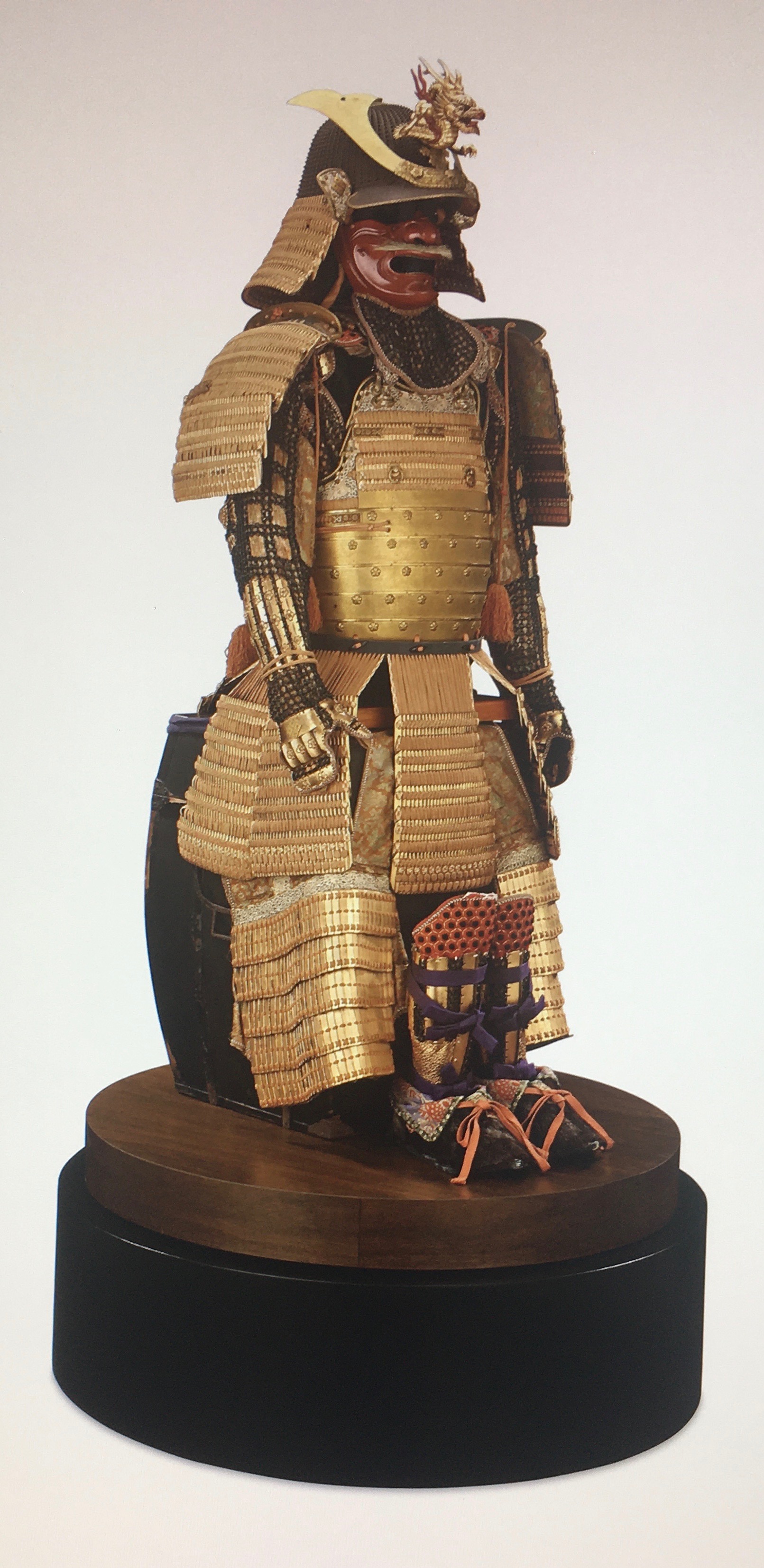
This and following images from the M.S. Rau advertisement, The New York Times, September 3, 2023.
Edo Armor. The armor comes from Japan’s Edo Period, which began in 1603 with the ascension of Ieyasu Tokugawa. Rau recounts, “This suit was made for a high-ranking official of the Kyogoku clan, a house of samurai in Japan. Though today the word samurai is often thought of interchangeably with warrior, it traditionally referred to a specific class of military nobility in Japan. From the late 12th century until the late 1860s when the Meiji era began, the samurai were the ruling military class, ranking directly beneath the emperor.”
Rau continues, “Esteemed Edo-period armorer Yamashiro Kuni Fujiwara Kanehisa created this extraordinary set for a noble samurai, incorporating elaborate details and opulent materials, appropriately highlighting the prestige of the armor’s owner. The set includes all of the traditional armor needed for a samurai warrior, including an elaborate helmet bearing the signature of the armorer.”

Other details: “The 62-plate russet iron helmet with standing rivets called a hoshi kabuto features an intricately carved crest or maedate in the form of a dragon. The armor also features a fearsome and elaborately detailed customary mask known as a ressei men. Created from red lacquered iron, the fierce mask includes gilded teeth, a removable nose and a broad white mustache crafted from animal hair.”
Rau describes, “The remaining armor comprises materials including gilded iron plate, weave chainmail, gilded copper rope, gilded leather and stenciled doeskin. As functional as it was ornate, the suit includes green and gold floral patterned silk lining that is further decorated with heraldry and gilded copper cherry blossoms. A pair of bear fur boots complete this remarkable suit of armor.”
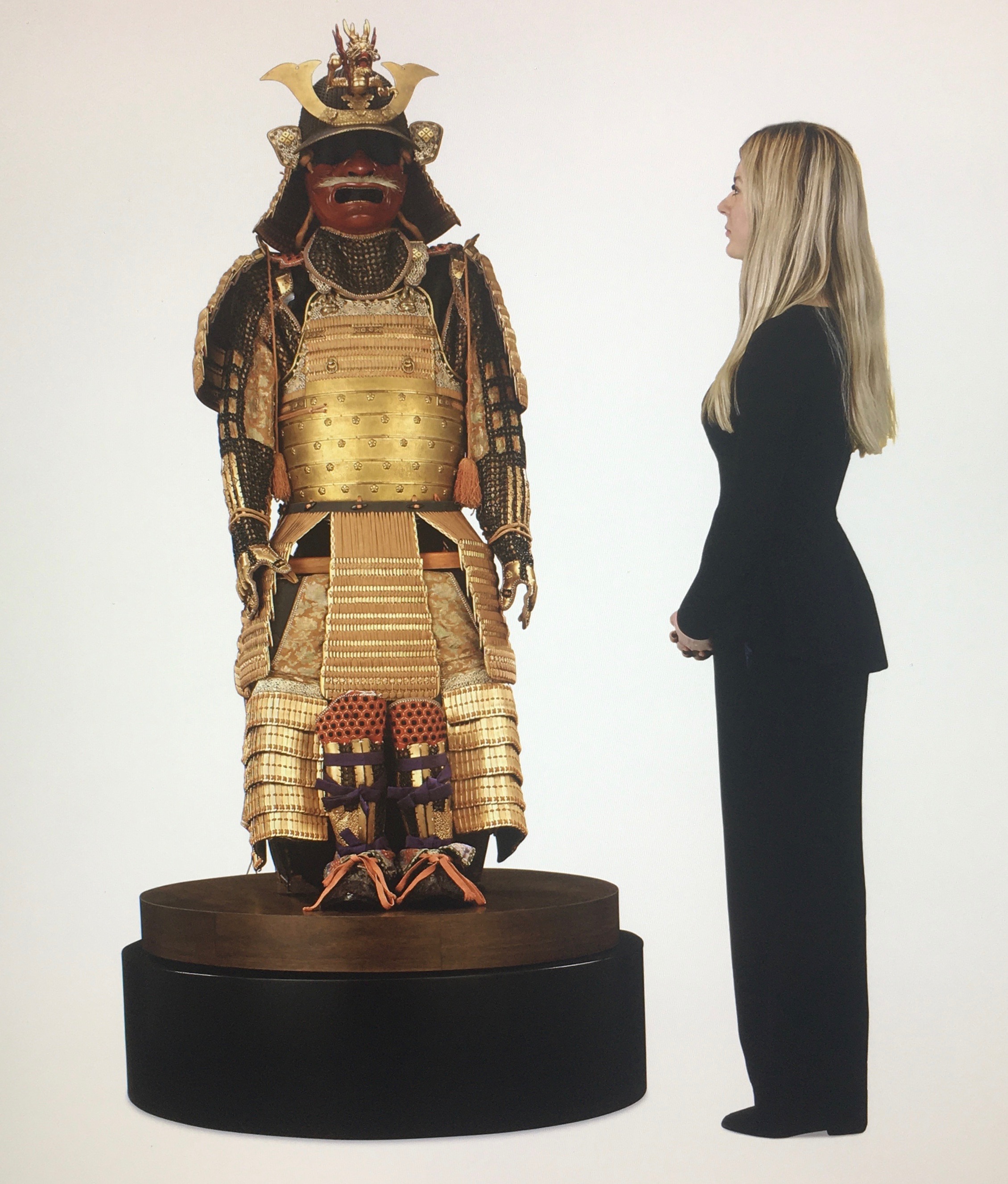
“The late 18th-century armor, 57 inches in height, is retained in its original paulownia wood box and is accompanied by a highly desirable certificate from the Japan Arms & Armour Research & Preservation Society. Also included is a key detailing the Japanese and English named for each of the elements.”
Price is available upon request.
A Glossary. Construction of samurai armour; Source: Wendelin Boeheim Leipzig 1890 from Wikipedia.
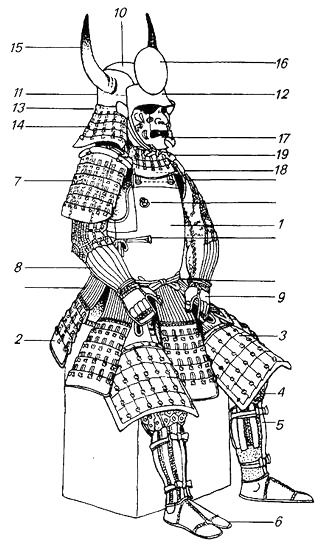
1. Cuirass – dō (胴(仏胴))
2. Fauld – kusazuri (草摺)
3. Cuisse – haidate (佩楯)
4. Poleyn – tateage (立挙)
5. Greaves – suneate (臑当(篠臑当)
6. Sabaton – kōgake (甲懸)
7. Spaulders – sode (袖(当世袖))
8. Vambrace – kote (籠手(篠籠手))
9. Gauntlets – tekkō (手甲(摘手甲))
10. Helm – kabuto (兜(日根野形頭形兜))
11. Badge (helmet) – kasa-jirushi (笠印)
12. Forehead plate – mabisashi (眉庇)
13. Lame – fukikaeshi (吹返)
14. Neck guard – shikoro (しころ(日根野しころ))
15. Crest (here: water buffalo horns) – wakidate (立物(水牛の脇立))
16. Crest (here: sun disk) – maedate (立物(日輪の前立))
17. Faceplate – menpō or mempō (面頬(目の下頬))
18. Badge (shoulder) – sode-jirushi (垂)
19. Bevor – yodare-kake (襟廻
Japanese Armor History. Wikipedia says, “The earliest Japanese armour is thought to have evolved from the armour used in ancient China. Cuirasses [breastplates and backplates] and helmets were manufactured in Japan as early as the 4th century CE…. In the 16th century, Japan began trading with Europe in what would become known as the Nanban trade. Matchlock muskets were first introduced to Japan by the Portuguese in 1543.”
Wikipedia recounts, “The era of warfare called the Sengoku period (1467-1590) ended around 1600, when a united Japan entered the peaceful Edo period (1603-1868). Although samurai continued to use both plate and lamellar armour as a symbol of their status, traditional armours were no longer necessary for battles. For this reason, in the Edo period, armour in the style of the revival of the medieval period, incorporating gorgeous ō-yoroi and dō-maru designs, became popular.”

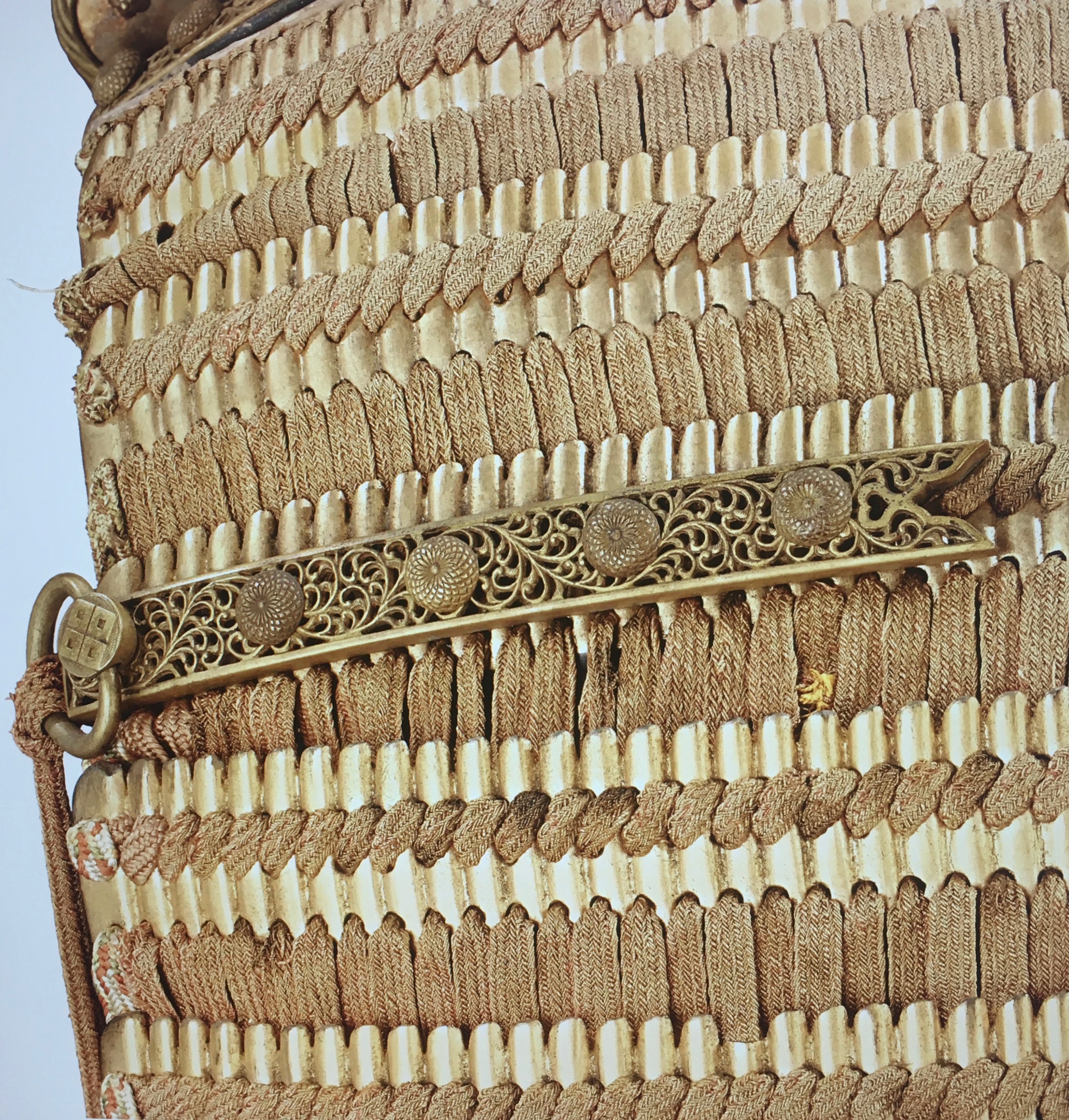
The intricate yet protective construction of samurai armor is evident in details of the Rau offering.
My Own Modest Example—A Kabuto. Isuzu Motors Limited described a Japanese “pleasant custom to decorate and display ancient dolls armors and swords in their home to celebrate child’s growth on the occasion of children’s day, so-called Tando No Sekku on May 5th for boys and Johmi No Sekku on March 3rd for girls.”
“Among these ornaments,” the instruction sheet says, “helmet Kabuto and armor Yoroi are the most prominent.”

My Kabuto.

I note that, like the Kyogoku clan example being offered by M.S. Rau, my kabuto prominently features an ornamental creature. Mine is identified as a lion, and though courageous, it certainly doesn’t look as fierce as the Kyogoku dragon. ds
© Dennis Simanaitis, SimanaitisSays.com, 2023
 Simanaitis Says