
Simanaitis Says
On cars, old, new and future; science & technology; vintage airplanes, computer flight simulation of them; Sherlockiana; our English language; travel; and other stuff
A FATHER’S DAY GMAX INSPIRATION PART 1
I WAS RESEARCHING a next GMax project for Microsoft Flight Simulator to follow my Alexander Eaglerock. Reading “Meet the Often-Forgotten Cessna XMC,” by Jason McDowell in Flying, June 7, 2022, came after examining Paul Matt’s excellent technical drawings of the Anderson Greenwood AG-14.

The Cessna XMC. This and a following image from Flying, June 7, 2022. Credit: Textron Aviation, Inc.
Jason McDowell wrote, “First flown in January 1971, only one XMC was built, and it was never intended for series production. Instead, it was intended to serve as a research aircraft, enabling the company to more thoroughly explore various concepts, technologies, and manufacturing technologies. Perhaps to remove any doubt regarding the purpose of the XMC, Cessna explained that the name was an acronym that stood for ‘eXperimental Magic Carpet.’ ”
Coincidentally as I read this, immediately to my right on the shelf I admired my Father’s Day card from Daughter Suz.

The Cessna XMC just had to be my next GMax plane. Here, in Parts 1 and 2 today and tomorrow, are tidbits gleaned from the Flying article together with my usual Internet sleuthing and also the excellent scale drawings by Paul Matt of a related aircraft.
Anderson Greenwood AG-14. Wikipedia notes the interesting design heritage of the Anderson Greenwood AG-14: The plane “was actually a collaborative effort of three engineers: Ben Anderson, Marvin Greenwood, and Lomis Slaughter Jr. The name of the last member of the design team was not included in the product name as it was thought it would not boost sales.”

Image from Paul Matt’s Scale Airplane Drawings Volume 1 & 2.
Despite the marketing discernity, only five AG-14s were built. One of them was acquired by Cessna Aircraft Company and taken to its Wichita, Kansas, headquarters for evaluation in 1969.
Cessna XMC. Wikipedia notes, “The two-seat Cessna XMC was built to test several concepts in light aircraft design including a ducted propeller and swept cantilever wing. The program ran from the beginning of 1971 until the end of 1972. The aircraft was used to assess improved visibility, center of gravity effects, control surface locations and response, cabin noise levels and also the relationship of wing versus engine and propeller.”

Image by Bzuk from Wikipedia.
“Looking at the stats,” McDowell wrote in Flying, “the XMC resembled a futuristic [Cessna] 150. It was equipped with the same 100 hp Continental O-200 four-cylinder engine, it weighed approximately 1,000 pounds, and it had two seats. Even the wingspan was similar, only 6 inches less than the 150.”
McDowell continued, “But similar as the technical specifications may have been, the two airplanes couldn’t have been more different…which was the entire point. The XMC’s engine was relocated to the aft end of the fuselage, and the traditional tail was replaced with a twin-boom arrangement that resembled the much larger Skymaster twin. This resulted in a decidedly new look that was a significant departure from the existing airframes.”
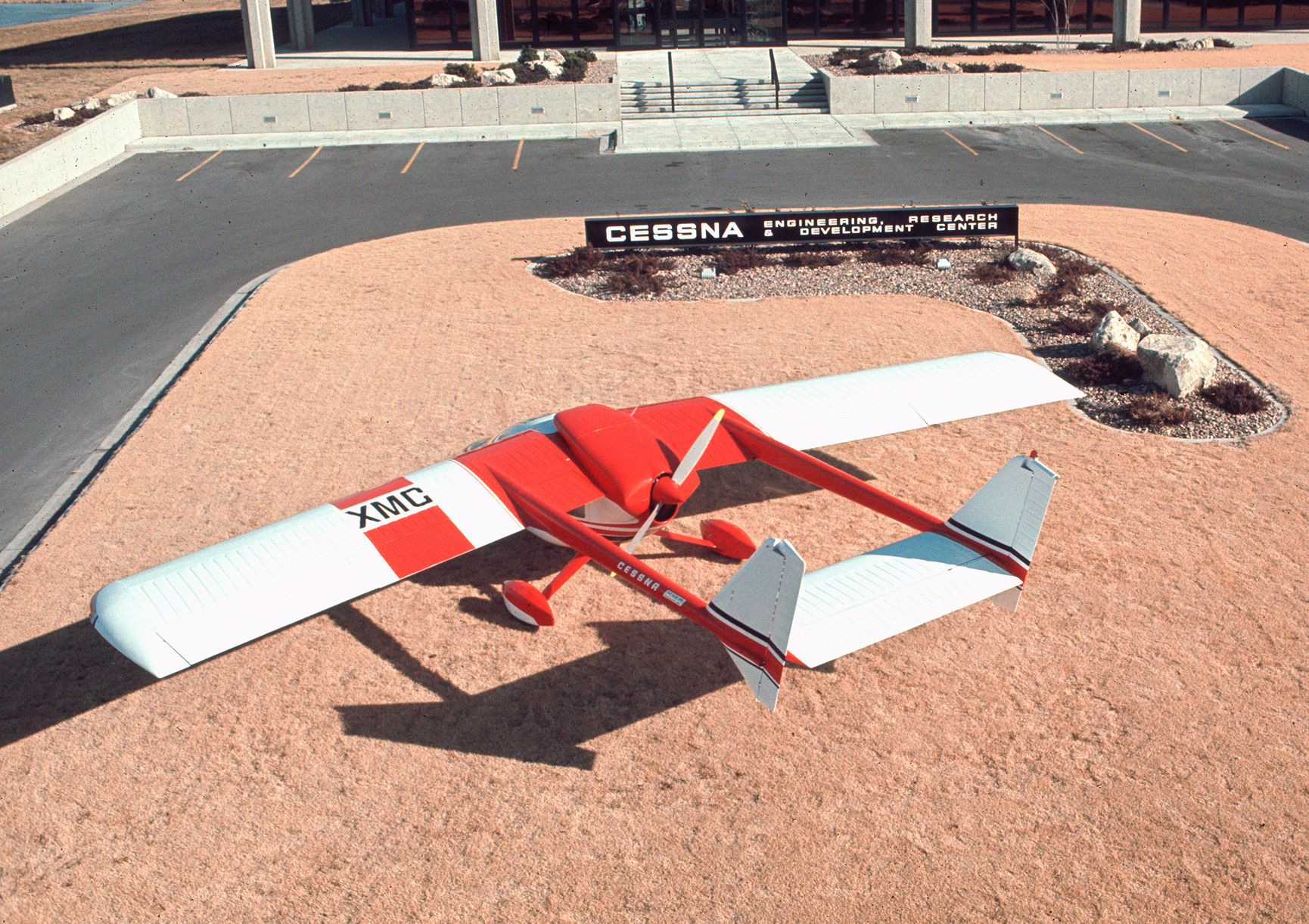
The XMC had the distinction of being the first Cessna ever to feature a swept wing. Many Citation business jets were to follow.
What a perfect GMax project: plenty of interesting details to model (and flight dynamics cribbed from Microsoft Flight Sim’s default Cessna 172SP). We’ll address these tomorrow in Part 2. ds
© Dennis Simanaitis, SimanaitisSays.com, 2023
 Simanaitis Says