
Simanaitis Says
On cars, old, new and future; science & technology; vintage airplanes, computer flight simulation of them; Sherlockiana; our English language; travel; and other stuff
MORE THAN A LARK IN A LOEWY CAGE?
“STUDEBAKER’S AVANTI,” R&T WROTE IN OCTOBER 1962, “has been before the public for only a short time, yet it has created a remarkable stir of interest. Not since the New Look of 1947 have we heard so much discussion of Studebaker products—or heard so many sharply divided opinions.”

The Loewy Look. “Basic responsibility for the Avanti’s styling,” R&T notes, “goes to the flamboyant and much publicized Raymond Loewy, whose credits include such notable successes for Studebaker as the 1947 which-way-are-they-going cars and the inspired 1953 coupes.“
The magazine cites other Loewy concepts, for BMW, Jaguar, and Lancia, “because they contain many elements of the Avanti (although we consider the Avanti to be a better-looking car). The Avanti has the same high tail, and the the ‘Coke bottle’ treatment of the flanks is even more pronounced.” Also, R&T admires the integration of bumpers into the design, “less like battering rams than is present day custom.”
Contrived…. Straining…. “It is not a copy of anything,” R&T observes, “and it is mercifully free of excrescent ornamentation. Its great fault lies in the fact that great liberties have been taken merely to achieve effect—the styling is contrived, straining for visual impact to the exclusion of utility, or efficiency, or grace.”

Cockpit Envy. “Apparently it was thought that wish-fulfillment tendencies among would-be pilots are very strong, for the Avanti’s cockpit (we can’t think of it as anything else) is strongly aircraft motivated.” R&T cited the panel of rocker switches for light and heater-blower located above the windshield and air vent control levers “grouped in aircraft pitch-throttle-mixture quadrant fashion on the forward part of the flat console cum transmission tunnel running between the seats.”
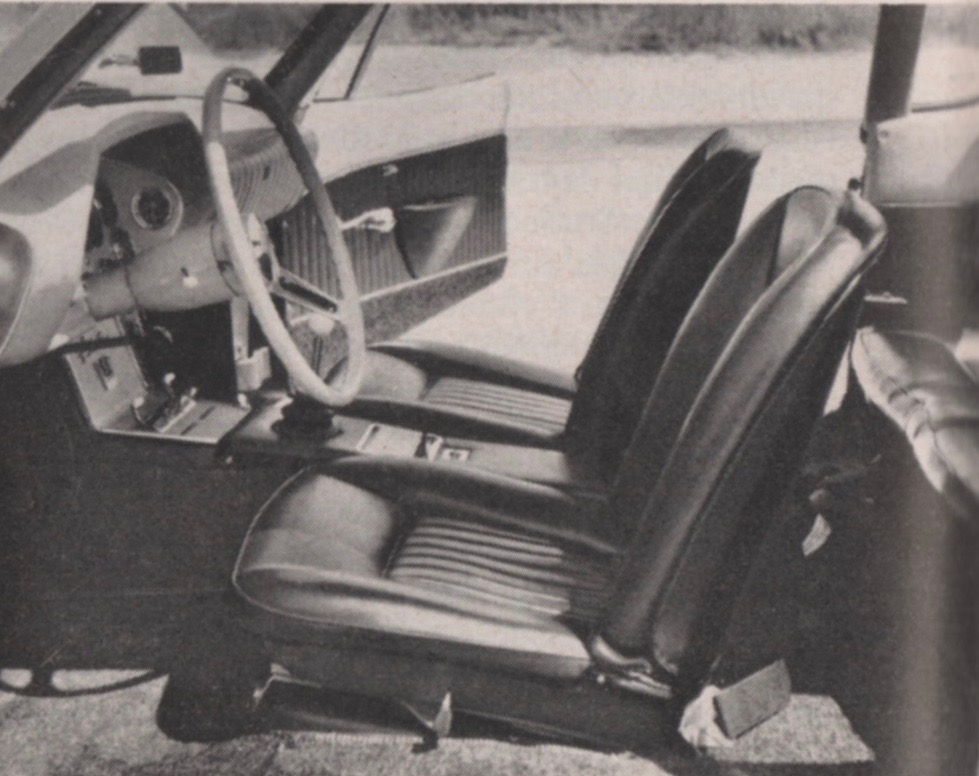
Superb Seating. “To the Avanti’s everlasting credit,” R&T said, “it should be noted that it has absolutely the best seats we have sat in for many a day. The Avanti’s seats are not very soft or very wide, but they give real, form-fitting comfort and the kind of support against lateral loads (due to spirited cornering) that is essential in a Grand Touring car.”
But to What End? “To tell the truth, though,” R&T recounted, “the seat will not likely be asked to do too much; the car simply will not corner fast enough to work up a very high centrifugal loading. The chassis is the same as is used under Studebaker’s Lark convertible, and although the suspension has been stiffened and torque-reaction rods and a torsional anti-roll bar added at the rear axle, such expedients have only a limited effect.”

Avanti Handling. R&T reported, “With 59% of the weight on the front wheels, there is a marked initial understeer. However, the lightly-loaded back axle tends to hop about somewhat and there is not much traction at the rear wheels, with the result that too-enthusiastic use of throttle will induce the rear wheels to slip. Immediately, the tail of the car swings out like lightening and the unwary driver may find himself in a game of spin the )Coke( bottle.”
A little typographic humor here; very little.
“After some experimenting,” R&T said, “we found that quite good results could be had by applying just enough throttle, in corners, to keep the rear wheels slipping outward at the same rate as those carrying all that weight up front…. We don’t think the Avanti poses a racing threat to the established group of GT cars, but it will get around with much less wobbling and confusion than most sedans.”
Don’t try this at home, kids; the R&T testers were professionals.
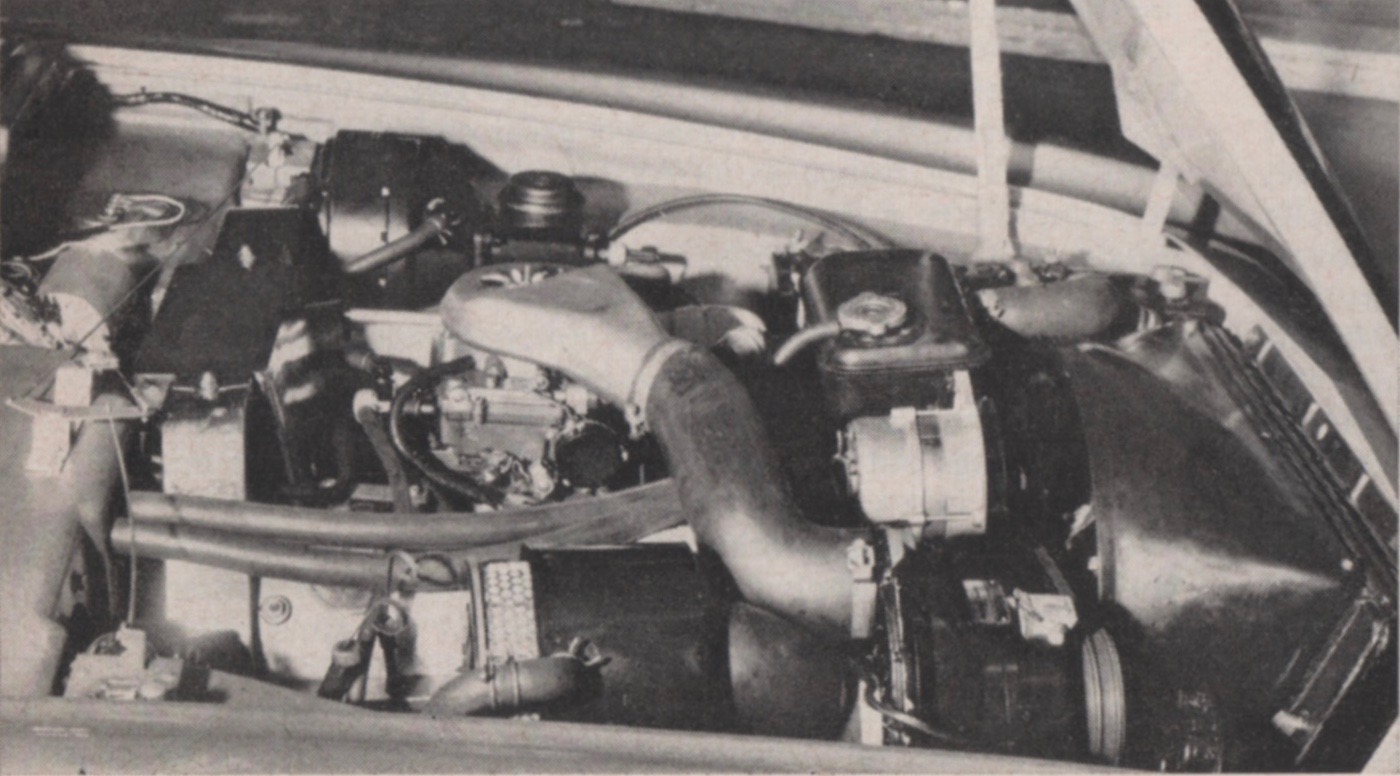
An Optimized Test Car? R&T’s Avanti had the optional Paxton supercharger, the 4-speed manual (not the 3-speed manual nor ditto automatic), and the optional 4.09:1 axle ratio (shortest/highest numercally; a 3.73 was standard). Acceleration profited from these: 0-60 in 7.3 seconds and quarter-mile results of 16.2 seconds at 88 mph.
To put these in perspective, an Aston Martin DB-4 did 0-60 in 8.4 seconds and the quarter in 16.0 seconds at 85 mph in April 1962. The Aston Martin’s list was $10,475 versus the Avanti’s $4445.
A $2849 Triumph TR-4 of the era had respective numbers of 10.5 seconds, 17.8 seconds, and 77.2 mph. A newly announced 1963 Corvette (price n.a.), 5.9 seconds, 14.9 seconds, and 95 mph.
That is to say, the supercharged Avanti, if indeed “test-optimized,” did just fine for itself.
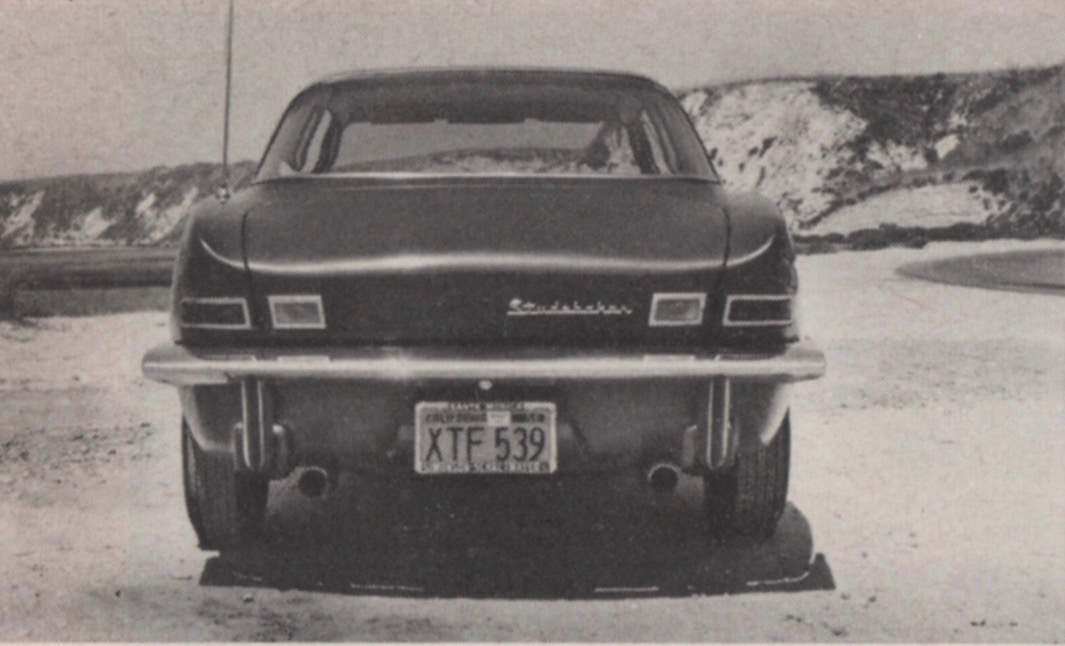
Conclusion. “By and large,” R&T wrote, “we think that the Avanti is a reasonably satisfactory automobile, although not necessarily in the ‘fast’ version given us for a test. Air conditioned, soundproofed and with an automatic transmission, it would offer the driving sport (as opposed to the sporting driver) a comfortable and attention-grabbing means of getting from here to there—and it will give him better handling than he really needs as well. The ‘big butter and egg man’ of the Texas Guinan era would have loved Studebaker’s Avanti.”
Texas Guinan? Another tale for another day.
Chronological Addendum. Wikipedia notes that, “Following Studebaker’s discontinuation of the model [in December 1963], a succession of five ventures manufactured and marketed derivatives of the Avanti model through 2006.” Now that’s legs.
© Dennis Simanaitis, SimanaitisSays.com, 2023
 Simanaitis Says
Performance (for the time) was great, but IMHO it is 2/3s butt ugly outside. The front end looks like a depressed robot and the B pillar looks like a wannabe town car with angles that hurt my eyes. The back end looks nice. The interior (again for the time) even nicer. But that’s just me…