
Simanaitis Says
On cars, old, new and future; science & technology; vintage airplanes, computer flight simulation of them; Sherlockiana; our English language; travel; and other stuff
LOTUS CORTINA (VERSUS FIRST FORD MUSTANG)—1964 PART 2
YESTERDAY’S RECOUNTING OF R&T’S July 1964 Lotus Cortina road test cited that only a month later the magazine tested the first Ford Mustang. Which car to generate an enthusiast’s lust? My mind was already made up in 1964, though other matters (like Worcester Poly) left the lust unsatisfied.
Today in Part 2, let’s see what R&T thought about the Mustang back then. And we’ll hear a Lotus Cortina tale from John Dinkel, the guy who hired me into R&T.
World’s Fair Intro, But.… R&T wrote in August 1964, “The introduction of the Ford Mustang created more excitement and interest than the introduction of any car we can remember. After months of rumors and gossip, the car was finally introduced at the New York World’s Fair…. Since that time, the first exhilarating flush has passed (though delivery is still running as much as three months behind in some areas) and we have had a chance to put the Mustang through its paces for a Road & Track road test.”

However (spoiler) the road test’s subtitle read, “It’s not the car we hoped it would be, but is a step in the right direction.”
Same Old, Same Old. “There is nothing unusual about the suspension,” R&T observed. “It is typically straightforward Detroit independent at the front and has a beam axle located by semi-elliptical leaf springs at the rear.”

The magazine wrote, “The suspension was the same on all three cars we drove, as were the brakes and it is difficult to find anything to say about either except that they were typical of the sedans Detroit has been producing. The ride is willowy, there’s a tendency for the car to float when being driven at touring speeds and the ‘porpoise’ factor is high on an undulating surface.”
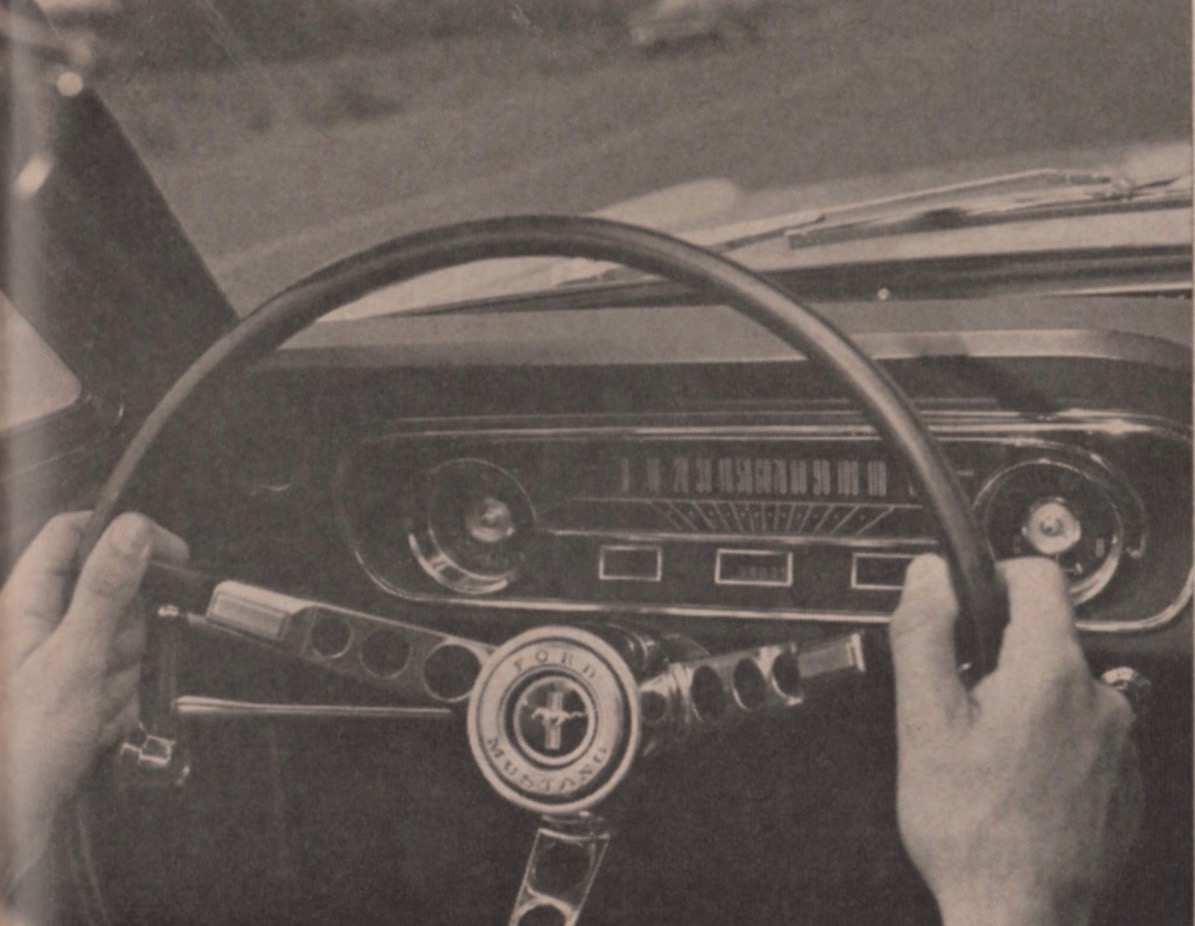
The Blindfold Test. “Our testing crew,” R&T said, “has a theory that if all the Detroit cars were lined up and a blindfolded driver allowed to drive each one on a deserted 10-mi. square of concrete, he would be hard put to tell one sedan from another and one compact from another.”
True, a Corvette’s handling and Corvair’s rear engine would give them away. But, “The Mustangs we tested… would be indistinguishable from any of half a dozen other Detroit compacts.… And this, we think, is unfortunate.”
The magazine’s analysis continued: “. … there seems little excuse for such frankly sloppy suspension in any car with the sporting characteristics which have been claimed for the Mustang.”

Styling, If Not Spirit. “The appearance of the Mustang is undoubtedly its most distinctive feature. As it is the same overall length as the Falcon, most of the distinction results from sliding the passenger compartment about nine inches toward the rear which gives it a proportionately longer hood and shorter rear deck…. It was agreed… that the overall body styling—accentuated by the upswept rear lower body treatment—did create the feeling of litheness, agility and speed that it was intended to convey.”
The road test concluded with a lament: “It seemed to us that Ford designers had a chance with the Mustang to genuinely improve the breed and introduce untold numbers of American drivers to driving pleasures they’ve never before experienced. Instead, they simply built all the familiar characteristics for which the typical American sedan has been cursed so long, into a sporty looking package.”
Ouch. On the other hand, R&T failed to predict the ponycar craze. Neither did I back in 1964: I replaced my English Ford Consul convertible with a second-hand 1963 Falcon convertible, a bright red one.
Lotus Cortina Bits Languishing in Massachusetts. Back in 1985, John Dinkel (R&T Editor, 1979-1988) acquired one of the rare left-hand-drive Lotus Cortinas. According to Classic Motorsports, “Out of the reported 2894 Lotus Cortinas produced, it’s said that only 660 of those were built as left-hand-drive cars, with even a fewer 160 originally sold in North America.”

John’s car languished, essentially stored in pieces in Wilbraham Massachusetts, until 2015 when he said to his wife Leslie, “I need to get the Cortina out here or it’ll never be finished.” British European Auto in San Pedro completed the restoration. The car is now occasionally seen at Southern California Cars and Coffees.

Good for John, for eventually satisfying one of my mid-1960s lusts. ds
© Dennis Simanaitis, SimanaitisSays.com, 2023
 Simanaitis Says