
Simanaitis Says
On cars, old, new and future; science & technology; vintage airplanes, computer flight simulation of them; Sherlockiana; our English language; travel; and other stuff
LOTUS CORTINA (VERSUS FIRST FORD MUSTANG)—1964 PART 1
WHAT AN INTERESTING QUANDARY for an auto enthusiast in the summer of 1964: Buy one of the just-introduced Ford Mustangs tested in R&T August 1964? Or, having read R&T July 1964, opt instead for a Lotus Cortina.
After having reading both road tests, which would you have chosen? Or, for that matter, which would you chose these days? Here today and tomorrow in Parts 1 and 2 are tidbits gleaned from these two R&T articles together with my usual Internet sleuthing.

A Cheshunt/Dagenham Marriage. “The Ford Lotus Cortina,” R&T wrote, “is the result of a successful marriage between Colin Chapman’s tiny Lotus factory and the vast English Ford operation.… By using the Lotus facilities to assemble the car, Ford has successfully avoided the disruption to its production lines entailed by any form of limited and specialized construction. At the same time, Lotus benefits from a steady income from the ‘mass production’ of some 30 cars a week.”

Manufacturing Details. R&T described, “The main feature of the Lotus Cortina is the twin cam Lotus engine which produces 105 bhp at 5500 rpm from its 1588 cc. However, the remainder of the car has been tweaked by Chapman in many subtle ways so that the road holding, braking, and general handling are the equal of the power output. Even the bodies are altered by addition of aluminum doors, hood, and trunk lid to compensate in part for the weight of other Chapman modifications….”
R&T recounted, “The bodies are shipped from Ford to Lotus already painted white, and the aluminum parts are then added by Lotus after they have been painted. The result is that the potential customer can order his car in any color he chooses, provided it is white with a distinctive green flash along each side.”

Chapman Struts. “It is evident,” R&T said, “that the complete rear suspension of the stock Cortina was unacceptable to Chapman, as the conventional leaf springs have been thrown out and replaced with coil suspension units. These are retained by trailing radius arms on each side and a central A-frame.”
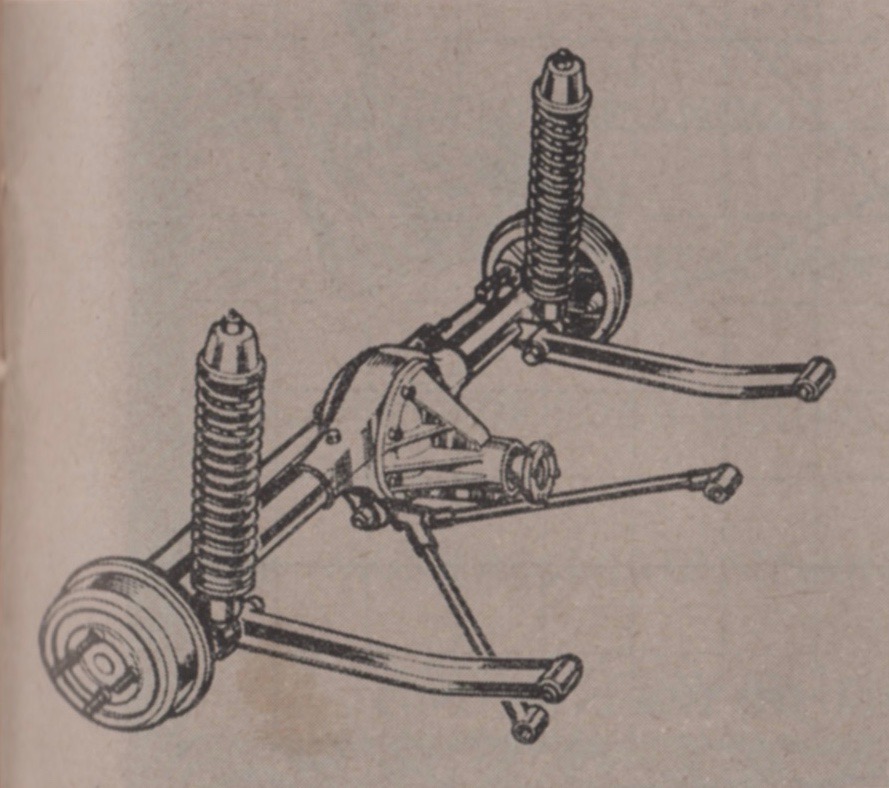
Chapman Logic. R&T noted, “Another modification is the aluminum differential housing to reduce unsprung weight, and two tubular strengthening struts inside the trunk. To improve the weight distribution and permit more room under hood, the battery has been relocated in the trunk and the spare wheel lies flat on the floor instead of being carried upright.”
To Chapman, anything lowering the car’s CG was beneficial.

Performance. “The whole car,” R&T reported, “has an extremely firm feel and the road holding is at its best at high speeds. One can enter a fast bend and maintain a predetermined line without any sense of insecurity because the car is basically understeering, the wide tread on the 6.00 x 13 tires seem to glue the car to the road and the steering is very positive.”

Lotus Cortina Assessment. R&T wrote, “Our test car appeared to be an excellent compromise between performance and comfort, and our assessment of the car is that it would find a small but ready market in America if it was offered for sale.” Alas, only relatively few left-hand-drive Lotus Cortinas were eventually offered, though cars of the era could be bought in the U.K. and shipped home.

“It is a perfect answer,” R&T said, “for the sports car enthusiast who has a family, because its performance is as good as many sports cars (and better than some), while at the same time it offers the accommodations and comfort of a sedan.”
Tomorrow in Part 2, we consider what R&T had to say about the then-all-new Ford Mustang. I also chat with a latter-day Lotus Cortina owner, John Dinkel, the guy who hired me into R&T. ds
 Simanaitis Says
In general, does/did fitting radial tires throw off the handling that Lotus worked so hard to achieve?