
Simanaitis Says
On cars, old, new and future; science & technology; vintage airplanes, computer flight simulation of them; Sherlockiana; our English language; travel; and other stuff
DOUBLE FEATURES PART 2
YESTERDAY WE CONSIDERED movie double features, both inexplicable and otherwise. Today in Part 2, there’s memorable endurance viewing, together with double features of operatic nature.
Endurance Viewing. Here’s a double feature that has an amazing running time of 15 hours 16 minutes, though I confess I’ve actually watched only about half of it. And, indeed, that was over more than a few days.

There’s drama galore, both in Tolstoy’s War and Peace and in the movie’s two-year filming.
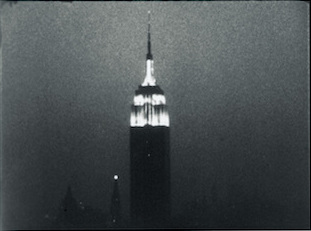
And there’s drama of a completely different sort in the extended Warhol flick. Wikipedia notes, “Empire is a 1965 American black-and-white silent art film by Andy Warhol. When projected according to Warhol’s specifications, it consists of eight hours and five minutes of slow motion footage of an unchanging view of New York City’s Empire State Building…. Warhol stated that the purpose of the film was ‘to see time go by.’ ”
Wikipedia continues, “In 2004, Empire was included in the annual selection of 25 motion pictures added to the National Film Registry by the Library of Congress, who deemed it ‘culturally, historically, or aesthetically significant.’ ”
I pause here to note that no other film cited here nor in Part 1 has this distinction. Not even Driven.
Endurance Filming. By the way, another Russian film, Alexander Sokurov’s Russian Ark, deserves Honorable Mention in the endurance context: Its ample running time of 96 minutes (involving a cast of more than 2000 in 33 rooms of St. Petersburg’s Hermitage) is composed of a single take.
Operatic Double Features. No fair counting Wagner’s four operas of Der Ring des Nibelungen as a 15-hour double double feature, because even Ringnuts don’t watch them with only popcorn breaks.
On the other hand, short operas have been known to be paired, often with dramatic, musical, or setting commonality. “Cav and Pag” (the name always reminding me of vintage-car steering) is short for Pietro Mascagni’s Cavalleria rusticana and Ruggero Leoncavallo’s I Pagliacci. Both are late 19th-century Italian operas in verismo style, the Italian word for “realism.”
No Kings. No Queens. No Gods. No Devils. Just ordinary folks who cheat on their spouses, or at least their spouses think so, which can be just as dramatic. In his A Night at the Opera: An Irreverent Guide to the Plots, the Singers, the Composers, the Recordings, Sir Denis Forman calls Cav “The one about a Sicilian village with an Easter hymn and a terminal knife fight.” Of Pag he says, “The one where the broken-hearted clown has to put on the motley and then stabs his wife.” (And, yes, she does have a local lover.)
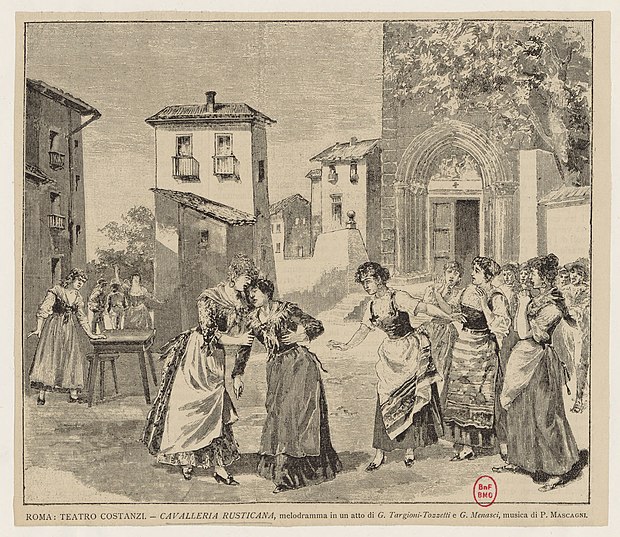

“Pag,” Sir Denis writes, “caught on at once and sped around the world operatic circuit in quick time. As early as December 1893 it was twinned with Cav and the relationship has since become Siamese. Today still probably the two most performed operas in the whole repertory.”
Pag and Carm. Curiously enough, Pagliacci has been paired with Carl Orf’s cantana Carmina Burana in a wonderful contrast of verismo and lusty 12th-century monks. An opera review in The Oregonian, September 25, 2010, recounts “Portland Opera’s double bill of Ruggero Leoncavallo’s ‘Pagliacci’ and Carl Orff’s ‘Carmina Burana’ is the company’s greatest hit, its most successful production to date: It’s been taken up a half-dozen times by other companies and is now in its second revival at Keller Auditorium. It was a bold concept when it first opened 13 years ago, and Friday night’s season-opening performance proved that it’s still a powerful, enthralling spectacle.”

Orange County’s late lamented Opera Pacific staged this original production in its 1998-1999 season. Choreographer Jamey Hampton told the Los Angeles Times, February 23, 1999, “It definitely follows the major themes of the work—love, fate, lust, debauchery, trying to control life. The differences are that in ‘Pagliacci’ they are very literal. They get much more abstract in ‘Carmina.’ ”
How true: Pag scenery for the production is verismo, a village square partially shaded by a large tree. Then the curtain opens to Carm, devoid of scenery but for that tree now free of foliage. Then, slowly and inexplicably, the tree rises and turns at right angle to the ground.
Gad. What were those 12th-century monks smoking? ds
© Dennis Simanaitis, SimanaitisSays.com, 2023
 Simanaitis Says
You’ve also got Warhol’s opus “Sleep,” a silent black-and-white film showing Andy’s lover Giorno asleep. It is over five hours, twenty-one minutes long, divided across five reels. A favorite of insomniacs.
The productive Robert Altman’s “Nashville” is considered his magnum opus, with 24 top stars in interleaving story lines, and ran 160 minutes in theaters. However, Altman had enough footage to produce a four-hour director’s cut, and suggested that it should be shown in two parts, “Nashville Red” and “Nashville Blue”, After a rush of critical acclaim, ABC discussed a 10-hour miniseries of Nashville, based on the footage not used,
I’ve seen the director’s cut, and it’s a shame theaters are fixed on their two hour limit.
I’ve never seen Carmina Burana, but the movement “O Fortuna” gave me one heck of an earworm until I was finally able to identify it and buy a copy of the song.
Play it, Sam…
I forgot to add that my favorite endurance feature was one of those edits of the Godfather, Parts 1 & 2, that ran all the scenes in chronological order. The theater (located in a college town) showed old movies for a buck, and charged modest prices for sodas, popcorn and snacks. Fun way to spend over seven hours.