
Simanaitis Says
On cars, old, new and future; science & technology; vintage airplanes, computer flight simulation of them; Sherlockiana; our English language; travel; and other stuff
COME SI DICE SPRITE IN ITALIANO?
THE QUESTION ABOVE (“HOW TO SAY SPRITE IN ITALIAN?”) has a perfect response in “Innocenti,” pronounced “I-no-CHEN-ty.” R&T concurred in May 1964: “A newcomer among the sports car currently offered on the American market is the Innocenti S, which, on closer inspection, turns out to be our old friend the Austin-Healey Sprite (or MG Midget) neatly disguised in Italian bodywork.”

Innocenti, R&T reminded readers, “is better known as the manufacturer of the Lambretta motor scooter, an extremely successful 2-wheeler.” Readers of a certain age may think of Audrey Hepburn’s wild piloting in the 1953 flick Roman Holiday; close but no sigaro: That was a Vespa built by Piaggio, not a Lambretta.
A Good Deal, All Around. But, as R&T noted, the deal with British Motor Corporation to assemble and market BMC products in Italy, among them the Sprite, “would appear to be an excellent arrangement for all concerned because it gives BMC an outlet in a Common Market country, and it permits Innocenti to offer a range of small cars suitable for the Italian market without investing in extensive manufacturing facilities.”
If Not Particularly Efficient. R&T observed, “One of the most striking differences between the Innocenti S and the Sprite or Midget is the price; at $2920 West Coast POE, the Innocenti is some $800 more than its English cousins with similar equipment. Undoubtedly, a part of the price difference results from the relative inefficiency of a method of automotive construction which involves shipping components from one country to another and then assembling the automobile from parts from a variety of sources.”
“However,” R&T noted cogently, “this does not add to the value of the finished product.”

What is Italian? R&T recounted, “On our test car, the Veglia instruments were all strictly Italian, with a speedometer reading in kilometers and gauges for acqua, olio, benzina, and giri. However, these present no problem, with the exception of the speedometer, which requires a quick calculation to find out whether one is speeding or not. Future cars brought into America will be equipped with speedometers reading in miles.”
I’m reminded of the dear old woman saying, “It always seems so quick traveling in clicks.” And also of the relative lack of U.S. regulations at the time. Years later, pal Bill Fink went through officialdom hoops revising Morgan labels.
Ghia Styling. R&T wrote, “The body was designed by Ghia, and it is a definite improvement over the current Sprite, although [Warning: Controversial opinion ahead!] it must be remembered that the Sprite has come a long way in appearance since the original goggle-eyed little monster appeared.”

“However,” R&T said, “we felt that some of the Italian flair is lacking, and if the car was dressed up in one of those really exciting little coupe bodies, with perhaps a set of Borrani wheels, it would find a larger market in America at the price.”
Hmm. I’m imaging a Moretti coupe with BMC mechanicals.
Slightly Curved Roll-ups, And a New Measurement.… The magazine applauded the Innocenti’s inclusion of windup windows, “which are slightly curved to add elbow room to the interior…. Although the interior of the car is both attractive and well laid out, the seating accommodation does not measure up too well in our new ‘driver comfort rating,’ which will be included in the data panel of all our future road tests.”

“For drivers up to about 5 ft 9 in. it is excellent, but the rating drops off sharply for taller drivers, so that six-footers and over will find it pretty snug.”
R&T’s Driver Comfort Rating. Briefly, R&T’s Driver comfort rating (introduced in January 1964’s “The 99th Man”) used anthropomorphic data compiled for Air Force Flying Personnel in 1950. By the time I showed up early in 1979, the magazine had revised the Data Panel. Driver comfort ratings were part of the “full test” format through 1970, but got replaced by Reliability information in 1971.
Adequate Pep, But Buzzy on the Freeway. “On the road,” R&T reported, “the performance is as spritely as could be expected…. However, the axle ratio is well suited to this type of driving because the engine is turning 3400 rpm at 50 mph, which is 400 rpm above the point of maximum torque. On the other hand, the situation is reversed under freeway driving conditions because the engine is turning at more than 4500 rpm at a cruising speed of 70 mph and this seems an excessively high engine speed for long periods of cruising.”
R&T’s Wear Index. This was confirmed analytically by R&T’s Wear Index: The Innocenti’s calculated out to 86.2; the original Austin-Healey Sprite’s, 73.0; the Datsun SPL’s, 57.0; and the Alfa Romeo Giulietta’s, 51.6.
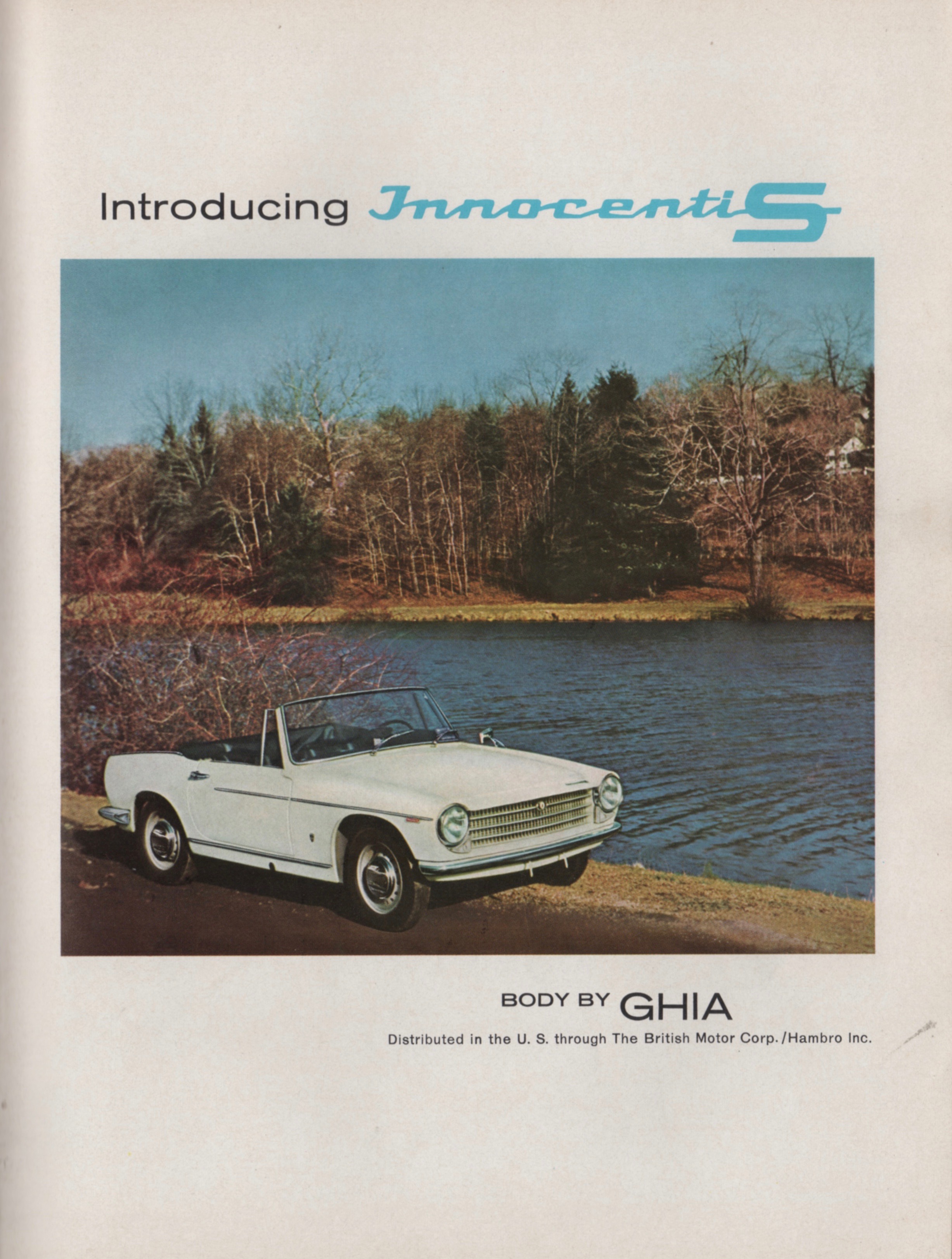
Summary. R&T said, “There is considerable pleasure to be derived from owning a car which is not frequently encountered, particularly if it bears the mark of an Italian coachbuilder…. For those people who are enamored with the Sprite but would like, and can afford, a little more comfort and a little more class, the Innocenti S may well be the answer.” ds
© Dennis Simanaitis, SimanaitisSays.com, 2023
 Simanaitis Says
Ah yes, what could go wrong? British mechanicals assembled by Italians (with Italian sheet metal). Good times…
Ha. A good one. Tea cup breaks con brio.
One of the things I hate most about globalization (other than the pollution and labor-crushing) is that it is virtually impossible for small car companies to survive.
The article notes how it is “relatively inefficient” to build the car in separate countries. I would argue that efficiency has improved, but in great part by completely negating the massive emissions costs we are all paying by shipping parts everywhere in massive container ships, then rail/truck.
I don’t mean to sound like a crotchety old man, but not all development is progress. We saw during covid how having everything built just in time with parts from abroad, or even just built abroad, is a huge risk.