
Simanaitis Says
On cars, old, new and future; science & technology; vintage airplanes, computer flight simulation of them; Sherlockiana; our English language; travel; and other stuff
“FAIR USE” AND A.I. PART 2
COPYRIGHTED MATERIAL POPPING UP in generative A.I. is causing legal complications of the Fair Use Doctrine. Here in Part 2, more tidbits are gleaned from Paula Samuelson’s “Generative AI Meets Copyright,” Science, July 13, 2023.

Transformative Versus Non-transformative Use. Samuelson writes, “Since 1994, when the Supreme Court considered the fairness of 2 Live Crew’s rap parody of a popular Roy Orbison song in Campbell v. Acuff-Rose Music, Inc., courts have given considerable weight to whether the purpose of a challenged use was ‘transformative.’ The Court defined this term as uses that ‘add something new, with a further purpose or different character, altering the first with new expression, meaning, or message.’ Transformative uses are also less likely than non-transformative uses to harm the market for the first work. People are, for instance, unlikely to purchase 2 Live Crew’s parody if they want to listen to Roy Orbison’s rendition.”
Yes, I agree. Or, for instance, people are unlikely to seek my H-4 Hughes Flying Boat rather than Howie’s original.

A Personal Note. Let’s sidetrack here to consider the Fair Use Doctrine and SimanaitisSays: I too assemble material from the Internet as well as from books in my collection, albeit this scooping is absurdly miniscule by Large Language Model standards. Any use of copyrighted material is attributed. My use is evidently non-commercial (the website is ad-free; I’ve never considered peddling reader data). And its effect, if any, on the copyrighted material is positive.
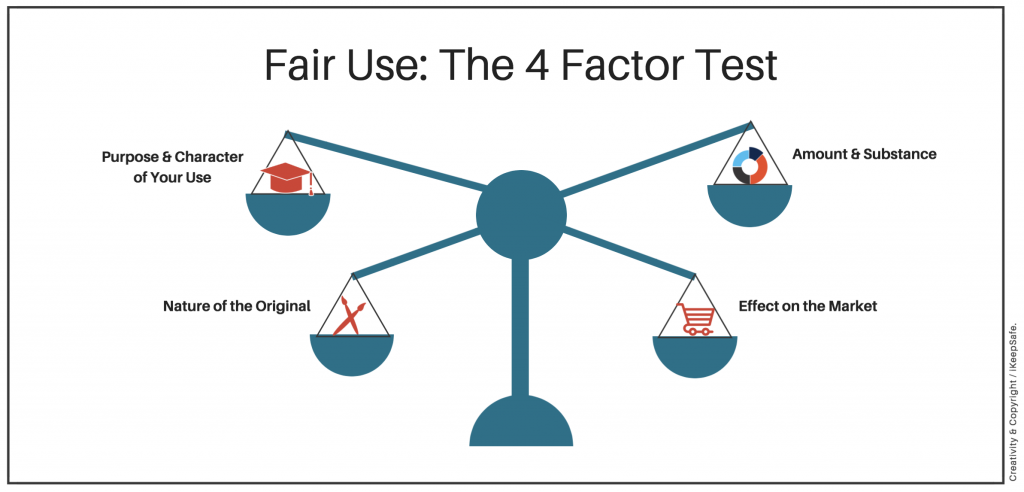
Whew. SimanaitisSays appears safe. Not that I haven’t studiously avoided squabbles: When I wrote to one source of old film footage, I received word that it had a “non-commercial rate” for such usage. Ouch. With regards to photos, a respected pal advised me that Getty Images protect its vast collection (and thus I avoid using them).
Getty Images, Stability AI, and Innovation Arbitrage. Funny I should mention Getty Images: Samuelson writes, “Stability AI is defending two copyright infringement lawsuits in the United States that are focused on Stable Diffusion, a widely used image generator. Getty Images is the plaintiff in one of these lawsuits. The other is a class-action lawsuit on behalf of visual artists on whose images Stable Diffusion was trained. Both complaints assert that Stability AI made unlawful copies of the plaintiffs’ images when ingesting them as inputs for training Stable Diffusion’s model and that output images produced by Stable Diffusion in response to user prompts are infringing derivative works.”

Samuelson continues, “Rulings in favor of plaintiffs might trigger ‘innovation arbitrage,’ causing developers of generative AI systems to move their bases of operation to countries that regard the ingestion of copyrighted works as training data as fair use, like Israel’s Ministry of Justice did in early 2023. Other countries that want to attract AI innovations may follow suit.”
Give It Away Free. Samuelson cites “a nonprofit German research organization known as LAION (Large-Scale Artificial Intelligence Open Network). LAION initially developed LAION-5B, a dataset consisting of 5.85 billion hyperlinks that pair images and text descriptions from the open internet. LAION makes this dataset available to the public for free for use as training data for those who want to use it to build generative models.”
What’s more, she notes, “LAION’s creation of this dataset was very likely lawful because the European Union (EU) adopted an exemption allowing nonprofit research organizations to make copies of incopyright works for text and data mining (TDM) purposes. The EU created this exception in recognition of the societal value of TDM as a means by which researchers can create new knowledge.”
A Memorable Quip. This legal complexity reminds me of a wonderfully witty comeback uttered by late pal Beverly Thompson. Once in my own lame witticism, I said, “Y’know, I never paid for it as a kid.” She replied, “Ha. I never had to give it away for free.”
I’m not sure how this fits into the Large Language Model quandary, but imagine what might happen if it’s scooped up. ds
© Dennis Simanaitis, SimanaitisSays.com, 2023
 Simanaitis Says