
Simanaitis Says
On cars, old, new and future; science & technology; vintage airplanes, computer flight simulation of them; Sherlockiana; our English language; travel; and other stuff
DATSUN 1000—“WHOLESOME RICE CAKES, NOT EXOTIC SINGING AND DANCING”
I DON’T KNOW THAT JAPAN HAS EVER been known for “exotic” singing and dancing, but someone at R&T in 1958 thought up this contrast. Not that any Japanese imports of the time fit the exotic moniker, come to think of it.

Styling. The Datsun 1000 was the second Japanese car road tested in R&T, the Toyota Toyopet being the first in March of 1958. Neither marque proved successful initially, though they certainly didn’t lack for contrast. Of the Datsun, R&T wrote, “If its appearance could hardly be described as beautiful, it at least avoids the currently popular neo-Detroit look.” (A swipe at the Toyopet?)
Accommodations. R&T said, “The interior, singularly unimpressive at first glance, proved to be surprisingly roomy and comfortable—for everyone but the driver, who must fight his way past the hand brake (mounted awkwardly between the seat and door….) and under the steering wheel.”

Japan (and England) on the Cheap. R&T recounted, “The steering-post-mounted shift lever deserves some sort of special mention for its smooth and completely backward action. It seems a shame that what is potentially one of the car’s best points should be ruined by so small a thing as a non-standard shift pattern.”
“An ingenious mechanic could probably rework the pattern by reversing the crossover linkage motion, putting the reverse slot nearest the steering wheel,” suggested R&T.
I suspect both the Japanese and the English took the easy way out in converting right- to left-hand drive. Recall that the 1954 Sunbeam Alpine suffered from a similar cheap fix of simply inverting the rhd linkage hardware.
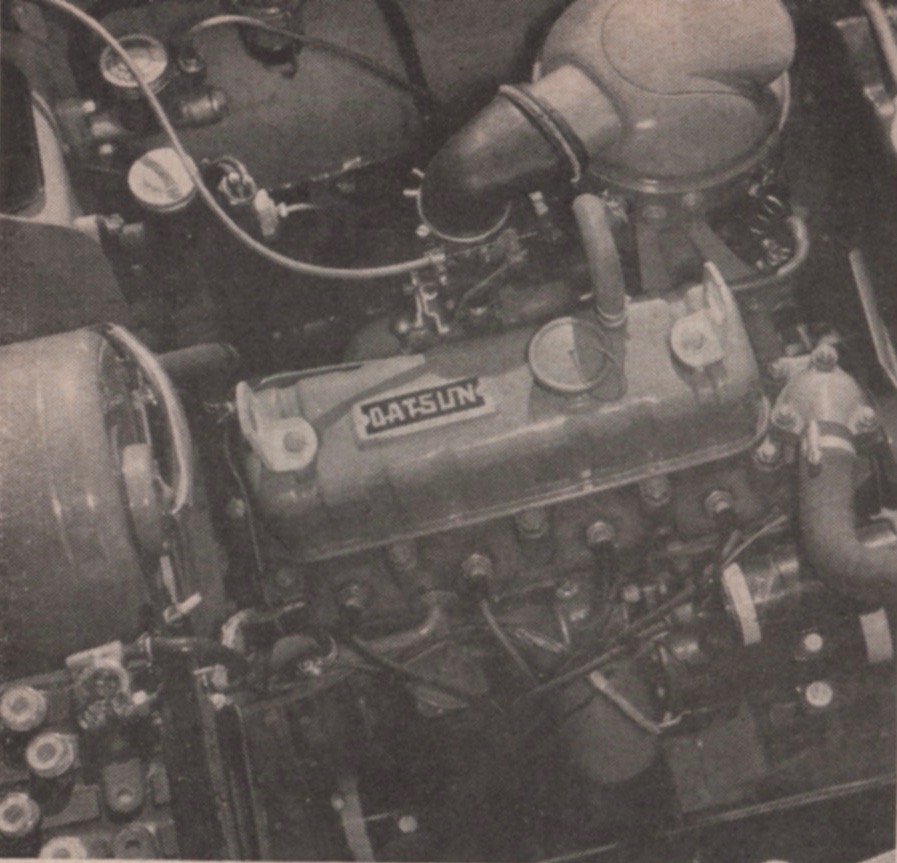
“Powertrain” a Misnomer. R&T wrote, “The tiny—or, as one scoffer said, puny—engine rates some discussion. It is not, as one might think, an Austin A-35 unit. They have, instead, de-stroked the BMC 1500-cubic centimeter engine by nearly an inch and a quarter, this alternative to boring the A-30 being the sturdier of the two choices in arriving at a just-short-of-1-liter engine.”

Alas, R&T found, “The performance of the Datsun is best described as melancholy. Even though its gearing is well chosen, the engine is just too small to cope with the car’s weight, leaving one with the impression that it is struggling against overwhelming odds.”
How sadly true: “Pity the Austin A-30,” the magazine had written in its August 1954 road test. The melancholy Datsun took even longer to reach 60 mph: 46.0 seconds versus the A-30’s 41.1.

Summary, December 1958. “It’s a pity,” R&T concluded, “that the Datsun should come so close to, and yet be so far from, suiting the American market…. It is, even in its present form, better than most of the small British cars currently being sold in this country: not so fast, perhaps, but it should be more reliable and it has a nice solid feeling about it.”
R&T noted, “The one big factor that will discourage potential buyers more than anything else is the fact that the Volkswagen and the Renault Dauphine, both selling for very nearly the same price, will run circles around it and are already well established here.”
How long before Datsun catches up? Certainly before the Bluebird 510 in 1967 and the iconic 240Z a year later. Then hold on tight! ds
© Dennis Simanaitis, SimanaitisSays.com, 2023
 Simanaitis Says
So then ;
It was fitted with the ‘B’ series engine ? . easy enough to replace with a 1500 / 1622 unit I’d think .
I like the looks of this car but remember mostly Datsun’s tiny little pickups from this era, they were decent but way too small for the American market and rusted worse than Chevrolet’s Vegas did in the future .
-Nate
Lacking a good U.S. dealer network was another disadvantage, and of course, many potential buyers still recalled the Great Misunderstanding, as HNM would have said.