
Simanaitis Says
On cars, old, new and future; science & technology; vintage airplanes, computer flight simulation of them; Sherlockiana; our English language; travel; and other stuff
HAPPY 400TH FIRST FOLIO
THE JUNE 2023 BBC HISTORY MAGAZINE has a fascinating article by Michael Wood on “400 Years of the First Folio.” Here are tidbits gleaned from Professor Wood’s piece, together with my usual Internet sleuthing.

900 Pages. Wood writes, “It was in November 1623, in William Jaggard’s printing house at the ‘sign of the Half-Eagle and Key’ in Aldergate, that the last pages of the whopping 900-page book came off the presses. The whole print run (unbound) was then taken to the bookshops in St Paul’s churchyard.”
So it seems, buyers were able (no, make that “required”) to have their purchases bound to their own particular likings.

Familiar and Not So. “The collection,” Wood notes, “featured 36 plays—half of which we would never know were it not for the Folio, including The Tempest, Julius Caesar, Twelfth Night and Macbeth.”.
Today, Wikipedia recounts that Shakespeare’s works, “including collaborations, consist of some 39 plays, 154 sonnets, three long narrative poems, and a few other verses, some of uncertain authorship.”
The Shakespeare Birthplace Trust identifies plays missing from the First Folio: Love’s Labour’s Won and Cardenio; co-authored plays such as Edward III, Pericles, and The Two Noble Kinsman; and plays in which Shakespeare seems to have had a revising hand, such as The Spanish Tragedy and Sir Thomas More.”
Early Owners. Wood says, “The first known buyer was Edward Dering on 5 December 1623—he was a fan who had already bought play quatros and did amateur shows at his home in Kent.”
By the way, as described by Oxford Academic, “Folios are books made out of large sheets of paper folded in half to create two leaves or four pages. Quartos are books made out of the same large sheets of paper as folios, but now folded in half twice to make four leaves or eight pages.”
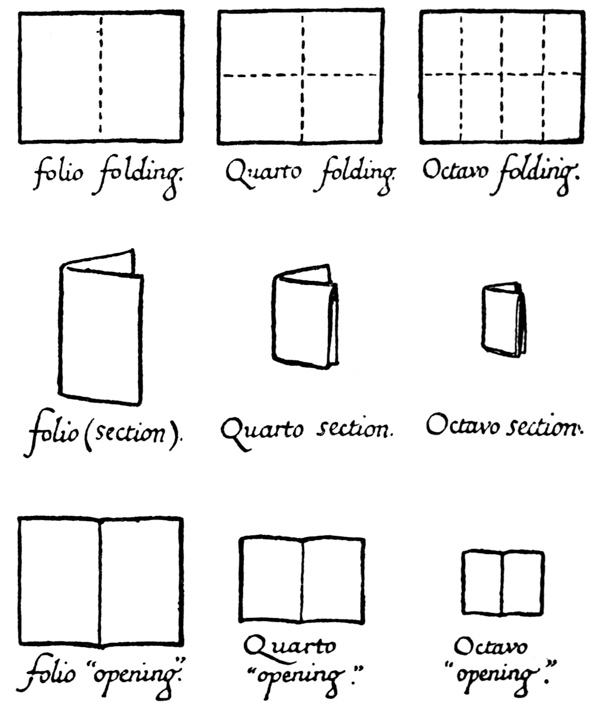
Generally, quatros are familiar 9 1/2 x 12 in.; folios, 12 x 19 in.
Antique Roadshow Discovery. Speaking of annotations Wood describes, “A recent discovery on BBC One’s Antique Roadshow was a tiny notebook dating between the 1630s and 1650s, written by an early, devoted fan and crammed with the first detailed notes about the Folio that show sustained reading.”
U.S. Readers. “By the late 17th century,” Wood notes, the Folio was carried to North America by emigrants from Britain. The first known reader there was in 1686, while the first U.S. edition was printed in Philadelphia in 1795. Thomas Jefferson was a fan; George Washington too.”
Wikipedia notes, “Out of perhaps 750 copies printed, 235 are known to remain, most of which are kept in either public archives or private collections. More than one third of the extant copies are housed at the Folger Shakespeare Library in Washington, D.C., which is home to a total of 82 First Folios.
Shakespeare and Black Culture. Wood continues, “But what’s really surprising is how soon it got adopted into black culture, in the early 1820s by the African Grove theatre Troupe in New York. The great actor Ira Aldridge saw Shakespeare as a liberating force with his sense of justice.”

Wood describes that Aldridge “played Othello with no makeup and put white makeup on for Lear. What James Baldwin says in his magnificent 1964 essay ‘Why I Stopped Hating Shakespeare’ was already apparent to some American black people.”
“Woke” Shakespeare. Wood writes, “And in the last 30 years there has been a flood of new takes, encompassing feminist and LGBTQ+ perspectives, black and trans rights, and critiques of antisemitism.”
“As texts of their time,” Wood concludes, “they are inevitably problematic in places today, subscribing to values we no longer share, indeed, sometimes reject…. But the best of his plays are still among the most powerful statements of the human condition.”
Human only? “And even farther afield,” Wood notes, “as we are reminded in Star Trek VI: The Undiscovered Country, in the original Klingon: ‘taH pagh taHbe!’ To be or not to be!” ds
© Dennis Simanaitis, SimanaitisSays.com, 2023
 Simanaitis Says