
Simanaitis Says
On cars, old, new and future; science & technology; vintage airplanes, computer flight simulation of them; Sherlockiana; our English language; travel; and other stuff
FILLING OUT FORMS PART 1
JONATHAN SAWDAY’S “FILL IN THE BLANKS,” London Review of Books, June 29, 2023, shares vignettes of official correspondence employed by the British during the First World War. Like other LRB subjects, the article provides illumination of little known history, in this case military paperwork. Here, not inappropriately in Parts 1 and 2 today and tomorrow, are tidbits from this article together with my usual Internet sleuthing.

Blanks to Fill. Sawday describes, “A. 2042 was designed to be sent to family or friends at home by those on active service. It began by warning that ‘nothing is to be written on this side’ other than the sender’s signature and the date, and ‘if anything else is added the post card will be destroyed.’ It then offered a series of phrases, each of which could be deleted, to create a rudimentary narrative. The opening words, ‘I am quite well,’ could be crossed out or supplemented with more troubling news: ‘I have been admitted into hospital.’ That phrase could then be modified to give a little more information: ‘sick’ or ‘wounded’, then ‘and am going on well’ or ‘and hope to be discharged soon.’ ”
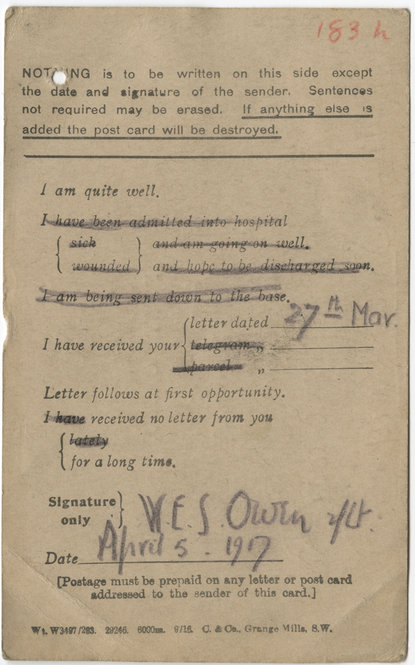
Sawday continued, “The phrase ‘I am being sent down to the base’ began and ended a new topic. The next line read: ‘I have received your letter/telegram/parcel’, followed by a space to insert the date. Next came the reassuring ‘Letter follows at first opportunity.’ The card ended with a more plaintive message: ‘I have received no letter from you lately/for a long time.’ ”
“A. 2402,” Sawday emphasized, “constructed the sender not as a writer but as a crosser-out of words. It was very different from the German Feldpostkarte or the French carte postale, both of which gave space for the soldier to write.”
Papal Origins. Sawday recounts that “the earliest blank form predates A. 2042 by several hundred years. Printed papal indulgence letters, offering partial remission from the penalties of sin in this world or the next, first appeared in the mid-15th century. They contained blank spaces, known as ‘windows’, which allowed the handwritten name of the purchaser to be inserted together with an authorising signature. Early printers, including Gutenberg and Caxton, produced thousands of copies of these documents of absolution.”

I remember, lamentably enough, the sale of such “mass cards” in a small-town Catholic parish back in the 1950s. (Where was Martin Luther when we needed him? He was there, across town.) ds
Tomorrow, Sawday has more to say about fill-in-the-form A. 2042 and other Brit bumf. (More to come on this last word too.) ds
© Dennis Simanaitis, SimanaitisSays.com, 2023
 Simanaitis Says
Beautiful posts.