
Simanaitis Says
On cars, old, new and future; science & technology; vintage airplanes, computer flight simulation of them; Sherlockiana; our English language; travel; and other stuff
TOYOTA TOYOPET DE LUXE—A 65-YEAR LOOK BACK
“WE BELIEVE,” WROTE R&T IN March 1958, “this is a first complete report of any kind of a new car whose significance may not be fully realized for at least two years.”
“As is well known,” the magazine recounted, “Japanese manufactured goods in general have not always enjoyed the best of reputations, but since the war these industrious people have slowly but steadily built a reputation for not merely good value but excellent workmanship and top quality.”
At the time, Japanese cameras were the example cited.
Background. R&T said, “The Japanese automobile industry appears to have been founded by Datsun, who in 1930 took a licensing agreement to built the British Austin 7 at about the same time that the American Bantam Company of Butler, Pennsylvania, did the same in the U.S. Today [1958] Datsun is still in business, but faces stiff competition for the limited home market from two other Japanese firms [Toyota and (later to be merged with Datsun, Prince ]…. Of the three top Japanese contenders, the Toyota firm get full credit to see opportunities in America.”
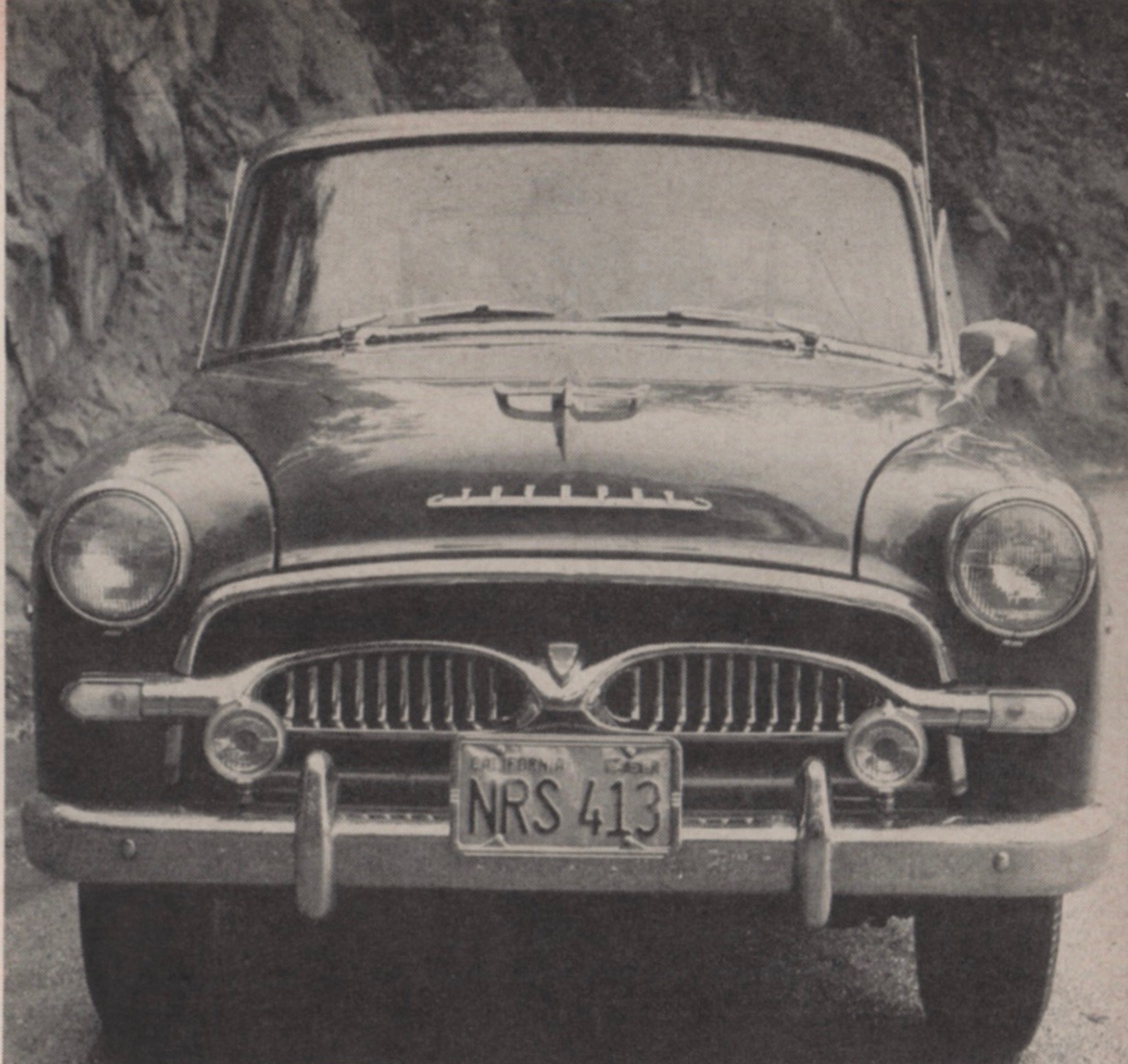
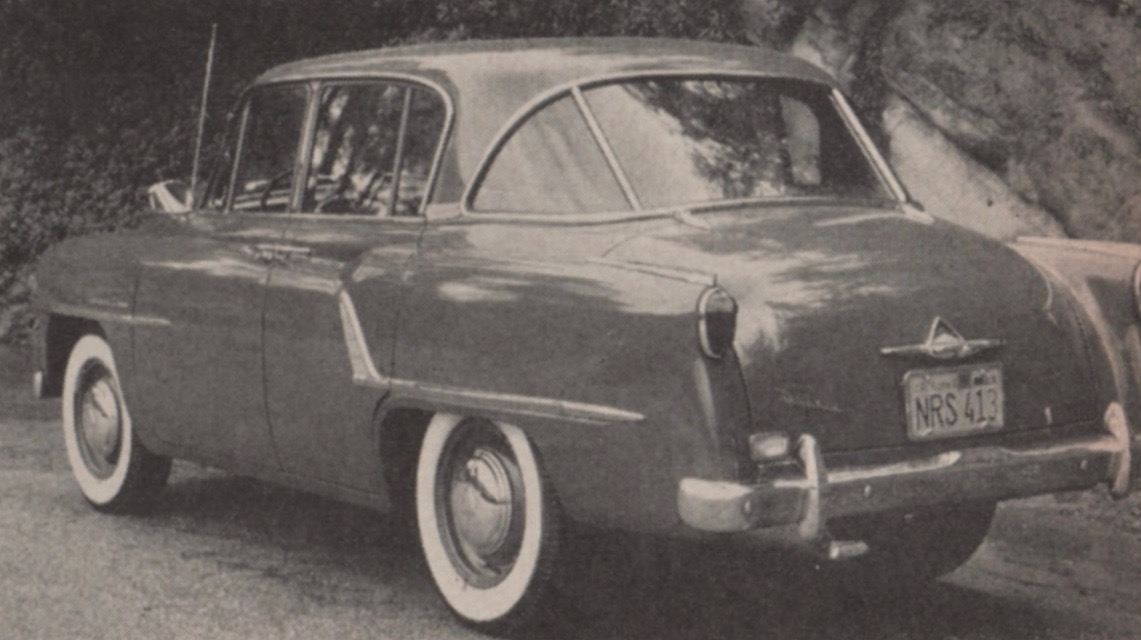
Among the First. “We, in turn,” R&T boasted, “were fortunate in being among the first to see, try and drive this unique new import. Our test car was the first and only sample Toyopet ‘Crown De Luxe’ in the U.S.A. In some respects the car was a favorable surprise, but there were also a few serious shortcomings.”
Only a Quick Glance. “Due to the fact that this was the only one on the West Coast,” R&T admitted, “we had the car for only one afternoon. There was no opportunity to make any timed runs for top speed or to record accurate fuel consumption. Accordingly, the figures quoted in the data panel are those supplied by the factory. i.e., 72 mph top speed and up to 33 miles per gallon.”
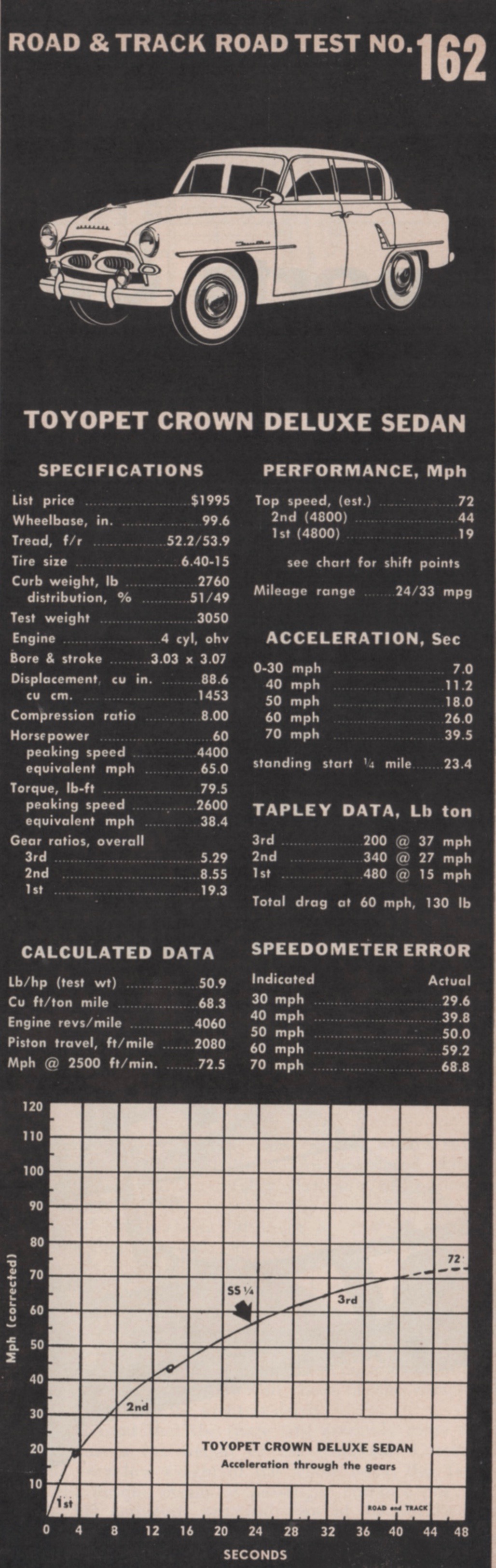
To put these and the Toyopet’s 0-60 acceleration in 26.0 seconds in perspective, R&T’s recent test of a similar vehicle reported a tidy $1995 four-door Vauxhaul Victor’s 75.2 mph, 23/29 mpg, and 25.3 seconds, respectively; the benchmark VW Beetle of the era, 70.3 mph, 30/35 mpg, and 28.0 seconds.

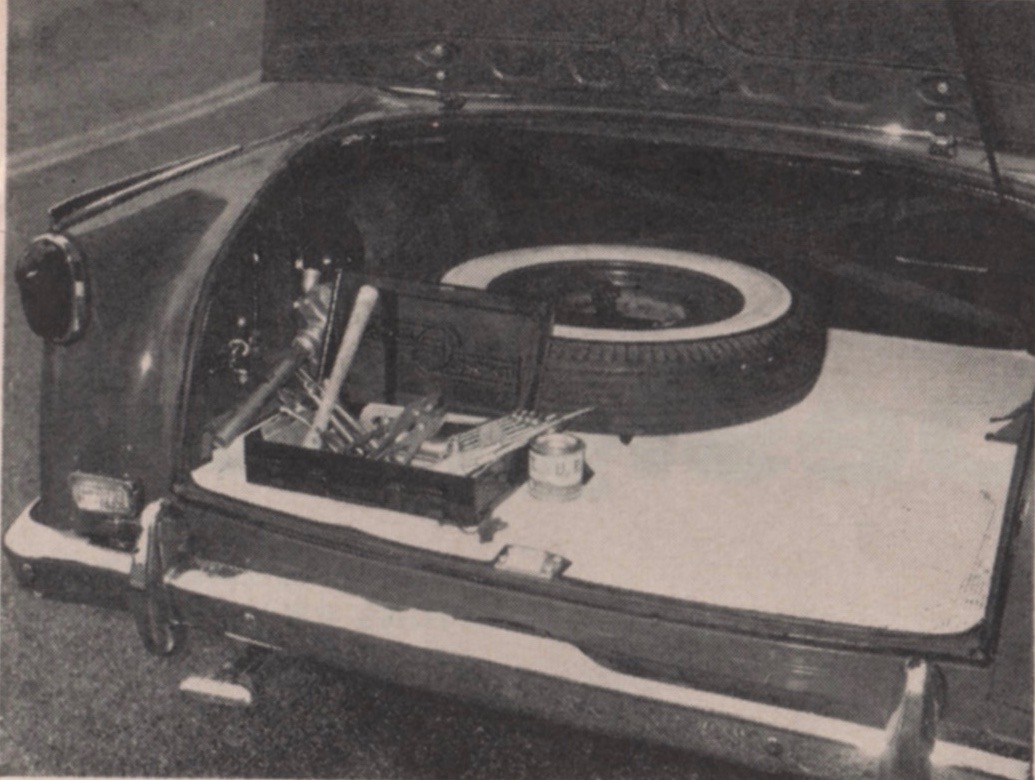
Peppiness. Of the Toyopet, R&T wrote, “It somehow doesn’t feel quite as peppy as some other cars we have tested with approximately the same acceleration curve. In trying to analyze ‘why,’ we believe that the Toyopet’s engine is somewhat smoother and quieter than any other 1.5 liter we can recall. On the other hand, the engine is not capable of very high revolutions per minute, for the valves begin to float at 4800 rpm.”
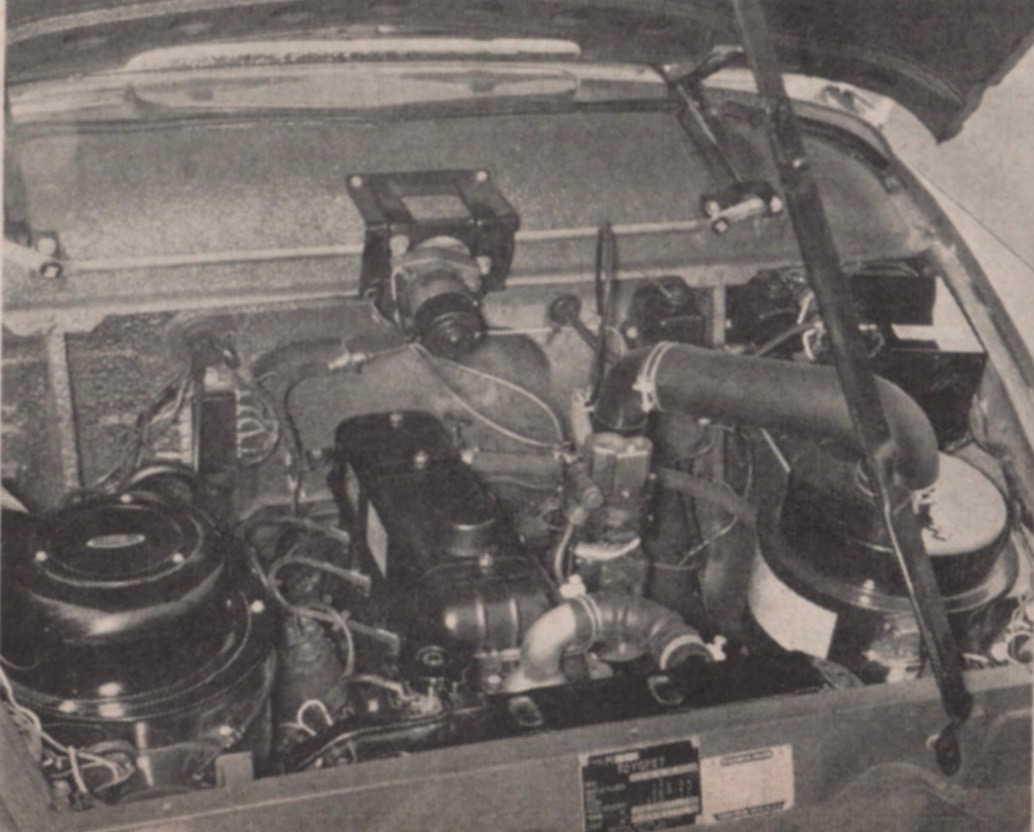
“On the road,” R&T said, “the car cruises comfortably at 60 mph, and it gets to this speed, or even 65 mph, easily.”
Familiar Handling. “The high weight figure [2760 lb.],” R&T observed, “and the suspension design combine to give a moderately soft ride in comparison to 1.5-liter sedans of European origin, which are suspended rather more firmly in order to cope with their own peculiar road conditions.”
“The car understeers,” the magazine said, “even with two people in front and one in back, and although corners can be taken with verve, there is considerable roll.” The test’s subhead read, “a dignified, soft-sprung Tokyo taxi comes to seek its fortune in America.” Spot-on.
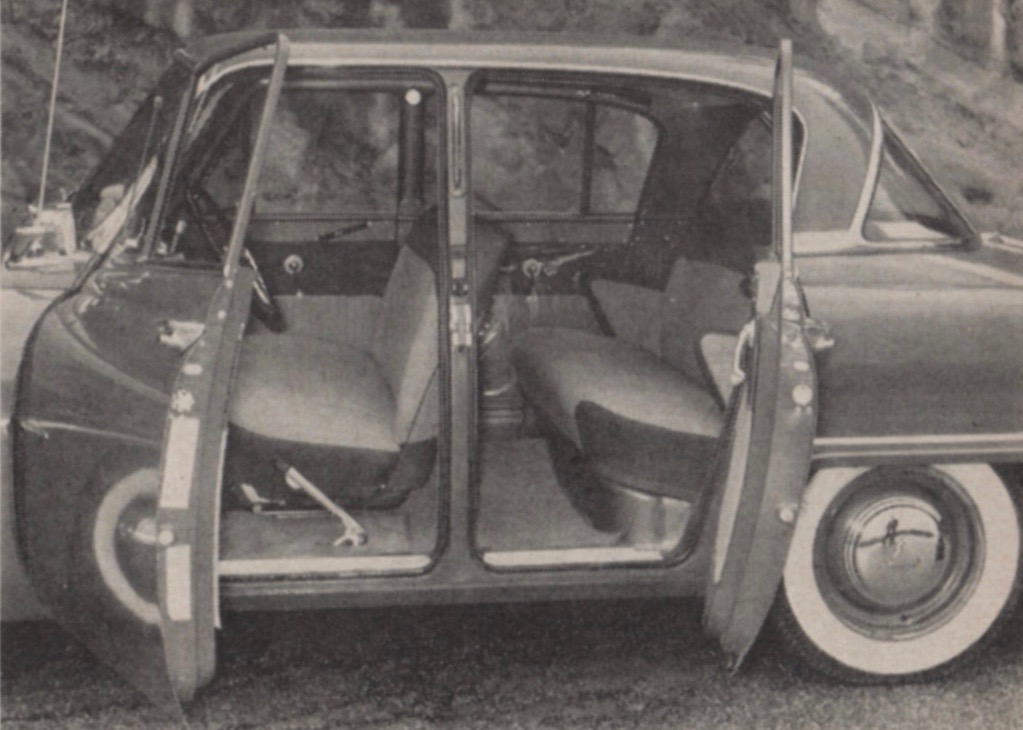
Seating to be Changed. R&T noted, “The front seat, which is 51 inches wide [i.e. a single bench seat], is to be changed, with more depth than on our sample and with a longer adjustment travel. The rear seat is 4 inches wider than the front and is quite comfortable, with generous leg room [i.e., that Tokyo taxi reference].”
“However,” R&T said, “our sample’s front seat would not move back as far as our two 5 ft. 10 in. test people would have liked and the promised change will cut rear seat leg room.”
A Modest Options List. R&T wrote, “As for optional extras there are a few fundamental ones, but no frills like automatic transmissions, power windows, or air-conditioning. The list of available extras includes radio, heater, electric clock, rear-window blind, fog and back-up lights.”
“The Toyopet Crown De Luxe, at $2000,” R&T summarized, “is a car which brings back memories of the good old days when cars were transportation—and not boudoirs with tail fins loaded with $1000 worth of extra cost items. The only serious fault we can find with Toyopet is that its specifications are so ordinary, so average, that they have no advanced engineering features to advertise. And maybe that isn’t a shortcoming at all.”
American car-buying public, you ain’t seen nothin’ yet. ds
© Dennis Simanaitis, SimanaitisSays.com, 2023
 Simanaitis Says
Looks interesting, I remember Toyotas beginning in 1966, I liked the styling but remember they weren’t overly reliable at that time .
-Nate