
Simanaitis Says
On cars, old, new and future; science & technology; vintage airplanes, computer flight simulation of them; Sherlockiana; our English language; travel; and other stuff
COOK’S TRAVELLER’S HANDBOOK HEALTH RESORTS PART 2
YESTERDAY WE PREPARED FOR (ARMCHAIR) TRAVEL to the South of France as described in Cook’s Handbook to the Health Resorts of the South of France, Riviera, and Pyrenees. Today in Part 2, let’s get specific about towns visited, both in 1905 and rather more recently.

Vienne. At 545 kils. southeast of Paris, “Vienne is one of the most ancient towns in France,” Cook’s observed. “It is mentioned by Caesar, by Ausonius, and by Martial, and contains some interesting Roman remains.”
Cook’s mentions the Temple of Augustus and Livia, “said to have been built by Emperor Claudius about 44 A.D.” Wikipedia adds the Plan de l’Aiguille, “a truncated pyramid resting on a portico with four arches, from the Roman circus.”
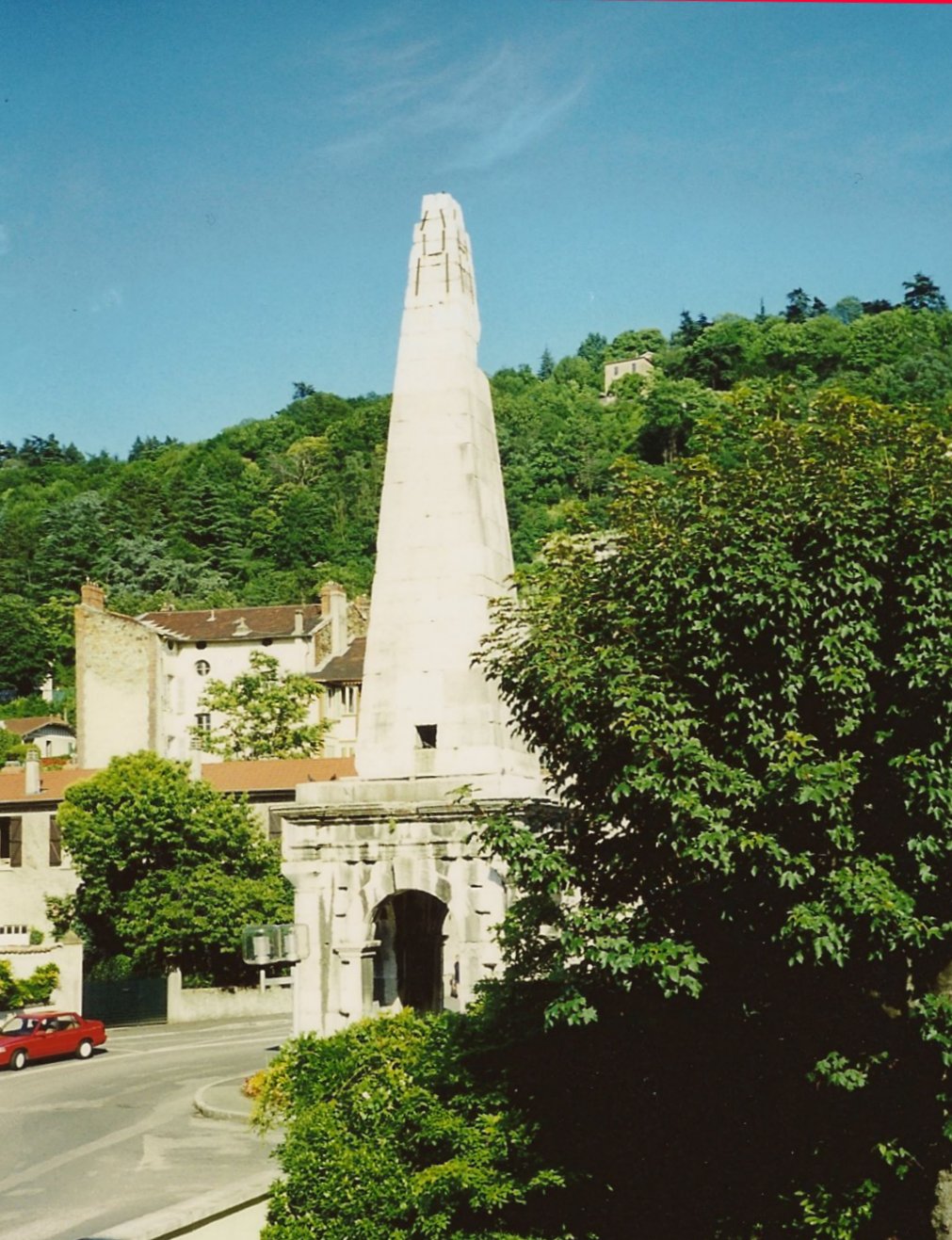
Not far from the pyramid is a restaurant established in 1922 by the famille Point. Two years later, son Fernand named it La Pyramide.
Tarascon. Cook’s noted that Tarascon (764 kils.) possesses “a remarkable Gothic castle, begun in 1400 and finished by King Réne d’Anjou.” Other Cook’s, Josephine Tozier, and I know of this town as the home of Tartarin de Tarascon.

Tozier’s book, A Spring Fortnight in France, was published in 1907, two years after Cook’s Health Resorts.
Marseilles. On another route, Cook’s cited “the blue, ever-rippling waves of the Mediterranean; in the distance, at the entrance to the harbour, the black, bare rocks of the Frioul Islands, one of them crowned by the frowning Château d’If, a famous State prison, in which, among others, Mirabeau and other known characters in French history were confined, but better known as being the scene of a thrilling incident in Alexandre Dumas’ ‘Monte Cristo.’ ”

I know Marseilles as the “top city for bouillabaisse.”

Nice. “Visitors to Nice,” Cook’s Health Resorts recounted “have now an opportunity of visiting an Ostrich Farm. It has been started by an Englishman, Mr. Edward Cawston, whose experiments have disproved the theory that ostriches can only thrive in South Africa.”
Curiously, this place (and its word-for-word description) recurred in Cook’s Riviera and Pyrenees, 1923.

Eze. “Continuing by road from Beaulieu, amid ever changing and delightful marine views,” Cook’s waxed poetic, “in about 2 miles is passed the railway station of Eze, from which may be seen and visited the romantic and unapproachable village of Eze.”
Its “skillfully constructed road” is steepish, but Geez.

“Eze,” Cook’s described, “situated on an isolated rock 1500 feet above sea level, was once the stronghold of Saracen robbers, who terrorised over the district, and by whom its ruined castle was built in 814. Its small church, recently restored, is built on the foundation of a temple of Isis.”
Pal/fellow journalist Rich Homan and I had opportunity to wax poetic as well: The Jardin Exotique d’Èze displayed a wonderful collection of succulent plants and xerophytes (those requiring very little water) from all over the world, including an American Saguaro.

Cook’s Comment. “The information hitherto,” Cook’s noted, “has been compiled chiefly for the benefit of persons visiting the south of France to recruit or preserve delicate health, or of those who, having ample time and money at their disposal, leave their own country in search of perpetual summer and perpetual gaiety.”
Press trips weren’t perpetual, but they were sure fun. And so are old handbooks of travel. ds
© Dennis Simanaitis, SimanaitisSays.com, 2023
 Simanaitis Says