
Simanaitis Says
On cars, old, new and future; science & technology; vintage airplanes, computer flight simulation of them; Sherlockiana; our English language; travel; and other stuff
1959 ELVA—VRAIMENT, ELLE VA!
“IN ENGLAND, AS IN THIS COUNTRY,” R&T wrote in June 1959, “nearly every amateur ‘special’ builder has more or less grandiose dreams of seeing his machine win race after race so dramatically that his fellow enthusiasts will line up, money in hand, anxious to buy a duplicate.”
This was several years before “Win on Sunday, Sell on Monday” became an advertising riff for Detroit. But it certainly made sense in sports car racing of the era, where the English Elva Courier, a specialty-built concoction of MG-A bits eventually did very well indeed in SCCA Class G competition.

Whence Elva? As described in Wikipedia, “Elva was a sports and racing car manufacturing company based in Bexhill, then Hastings and Rye, East Sussex, United Kingdom. The company was founded in 1955 by Frank G. Nichols. The name comes from the French phrase elle va (she goes).”
Elva Courier production, 1958–1968, totaled perhaps 500 cars. It was undertaken briefly by Trojan, which made 210 examples 1962–1965, and by Ken Sheppard Customised Sports Cars, 1965–1968.
By the way, you may have heard of the modern McLaren Elva. This hyperexotic was produced in 2020 as part of the McLaren Ultimate Series, which included the F1, the P1, Senna, and the Speedtail.
The Courier’s BMC Bits. “Consider the Elva Courier’s specifications,” R&T wrote, “which can be summed up very briefly in this way: an MG [the A] with 430 fewer pounds to carry, yet a price tag only $500 higher. However, this is an oversimplification of the facts. The MG buyer, who gets a more comfortable, more luxurious machine for his money, takes his lumps when he runs in production class racing. The lumps may become more numerous when the Elva is eventually eligible for production racing by the SCCA (when 150 have been built and sold).”
“Elva’s Courier,” R&T noted, “uses standard British Motor Corporation components in the engine, transmission and rear axle. The unit weights of these being fixed, savings have been accomplished by making the vehicle smaller, by using a simple tube frame, and by mounting a fiberglass body.”


R&T Kvetching. “In the first place,” R&T said, “its appearance may not appeal to everyone. The front end seems particularly appealing to most observers, perhaps a trifle Citroen-like but much better done as far as shape is considered. The windshield looks a little too high, but the tail section is worse. Everyone who looked at the car from the rear felt it should be lowered: The car actually looks as if it were running downhill.”
I beg to differ. I believe the first time I saw a Courier was in 1959 at the Lake Erie Invitationals held at Dunkirk, New York, Municipal Airport. Two Couriers were running, albeit too soon for SCCA G Production status.
I recall being duly impressed by one passing me on the way home to Cleveland on I-90. An evident enthusiast, the fellow still had the car’s headlights taped. No trailer-queen, this Courier. And its tail looked fine.
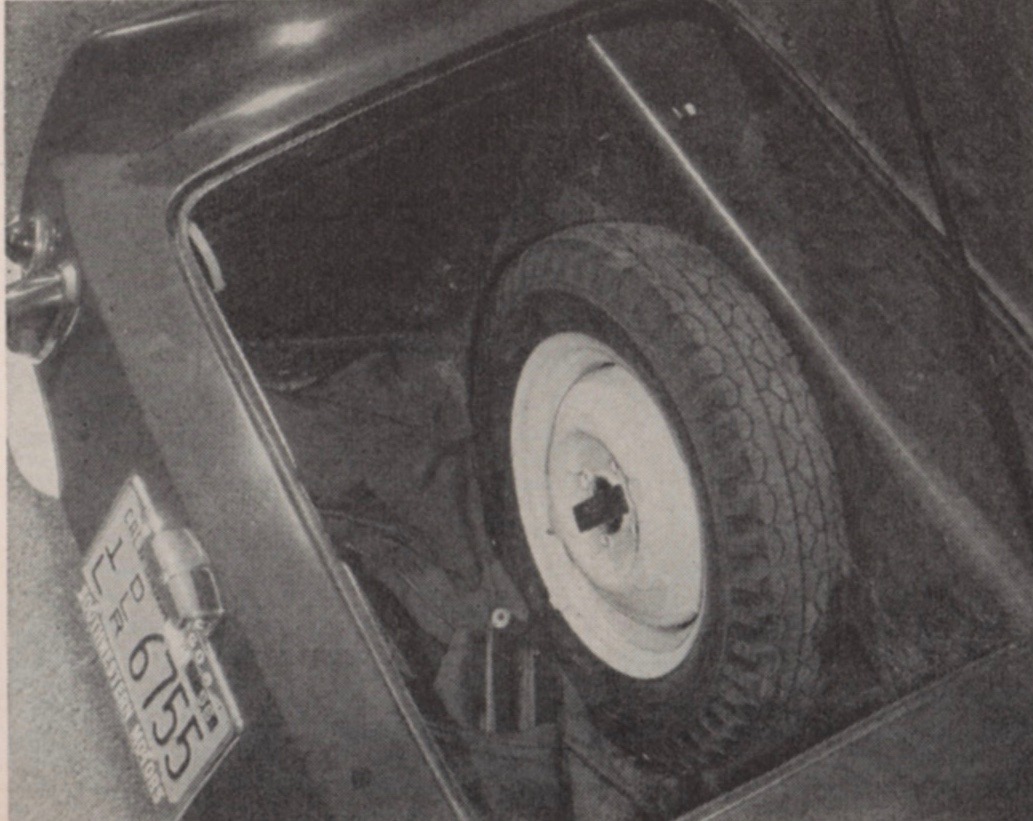
By the way, R&T did observe that “considerable vertical height makes the ‘trunk’ useful.” Unlike so many other sports cars I might mention.
Accommodations. “The interior is rather plain,” R&T wrote, “but not stark. The bucket seats are leather upholstered and need a little more padding. In order to secure a very desirable 50/50 weight distribution (with driver and observer seated) the engine intrudes into the cockpit rather severely. The resultant flywheel, clutch and transmission cover is a huge affair, but strangely enough it is not objectionable and there is actually more room for the driver’s feet (and pedals) than in an MG.”

R&T continued, “Once seated, one has a general feel much like that of an MG except that the wheel is slightly smaller and considerably farther forward; we and many other drivers approve of this. The steering column is noticeably askew (it angles slightly downward toward the center of the chassis), but many recent American cars have been built this way and owners invariably report that the angled wheel is never noticed after a day or two.”
Indeed, I recall when R&T artist and pal Bill Dobson brought this to my attention with his scrupulously drawn Data Panel illustrations.

Besting the MG. “For example,” R&T reported, “it will beat a stock MG to 60 miles per hour by nearly 2 seconds and cover the standing 1/4 mile in 18.2 sec as compared to about 19.5 for its more luxurious cousin. Top speed is just about even.”

And don’t forget unicity of appearance. Even if occasionally maligned. ds
© Dennis Simanaitis, SimanaitisSays.com, 2023
 Simanaitis Says
Thank you for another overlooked ride. Racing, and some sport car folk, grasp “weight is the enemy.” But we’ve long wondered why so few among the vintage/collector/Classic/special interest/old car crowd do not, lest we note a third of Americans are not just overweight, but clinically morbidly obese.
Bill Lear said “I’d sell my grandmother to lose another pound from a Lear Jet.”
On the other end of the fiscal scale, we read thrice-told tales about 1952-on Bentley Continentals’ efforts to curb weight, that apparently being, then and now, an exotic construct. But for many of us with old “road cars,” luxe or not, it’s common sense.