
Simanaitis Says
On cars, old, new and future; science & technology; vintage airplanes, computer flight simulation of them; Sherlockiana; our English language; travel; and other stuff
PEANUTS FOR YOUR BEER?
IN ARGENTINA, A GLASS OF BEER is served with a small handful of roasted shelled peanuts. A ploy to raise thirst for another beer? A counter to the hops flavor? Or is it all in the interest of science?
For Luiz Pereira, Department of Earth and Environmental Sciences, Ludwig-Maximilians-Universitat Munchen, Germany, it encouraged a research article, “The Physics of Dancing Peanuts in Beer,” The Royal Society Open Science, June 2023. Here are tidbits gleaned from this research paper and ensuing articles “Scientists Explain Why Peanuts ‘Dance’ When Dropped in Beer,” Phys Org, June 14, 2023; and “What Peanuts Dancing in Beer Teaches Us About the Earth’s Crust,” Voice of America, June 14, 2023.
What’s Going On Here? Phys Org describes, “Because the peanuts are denser than the beer, they first sink down to the bottom of the glass. Then each peanut becomes what is called a ‘nucleation site.’ Hundreds of tiny bubbles of carbon dioxide form on their surface, acting as buoys to drag them upwards. When the peanuts reach the surface, they burst.”
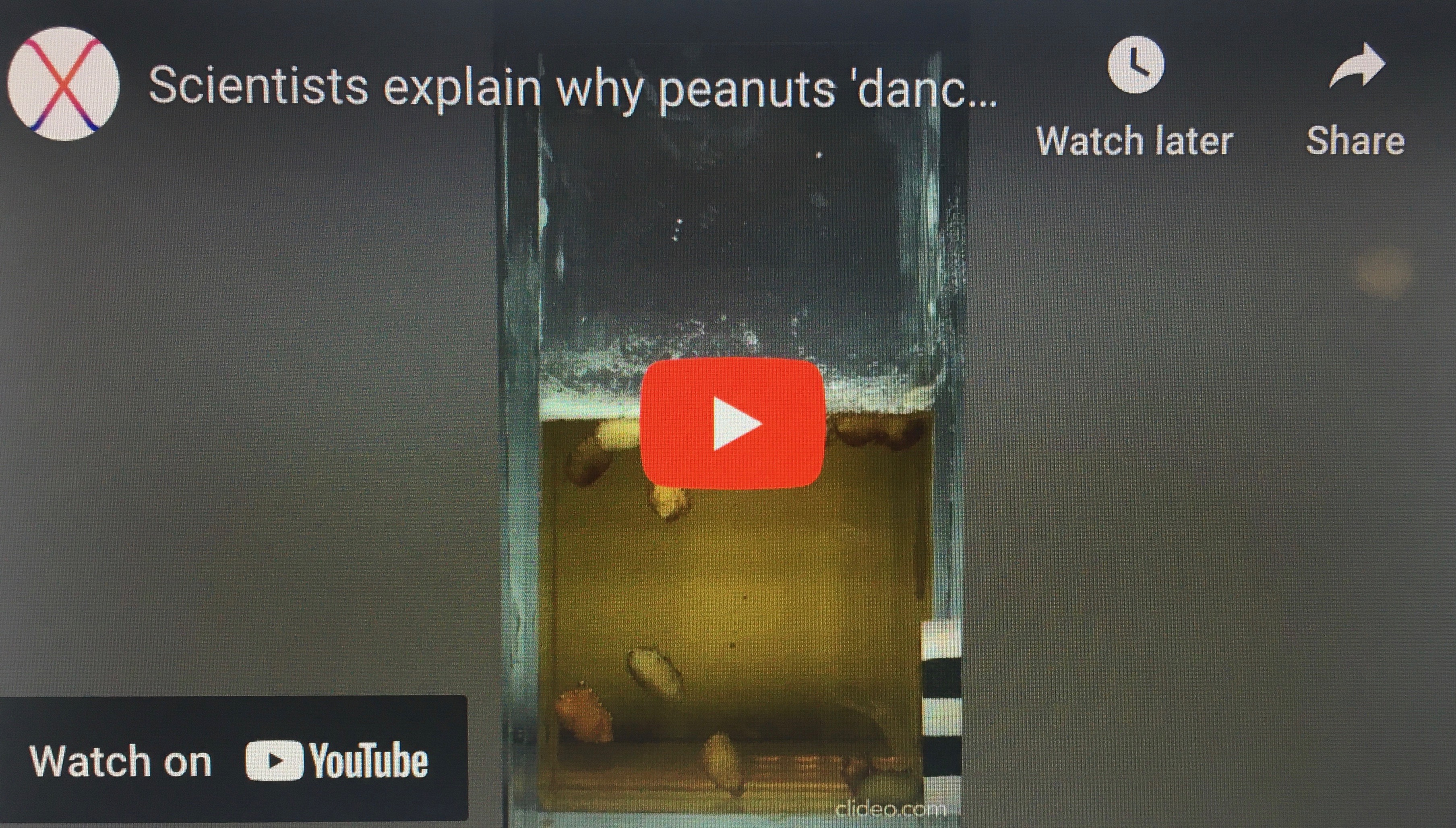
The process continues: “The peanuts then dive down before being propelled up again by freshly formed bubbles, in a dance that continues until the carbon dioxide runs out—or someone interrupts by drinking the beer.”
And How Come? In their Abstract, Pereira and his colleagues describe the dynamics of it all: “Phenomenologically, when roasted, shelled and unbroken peanuts are first introduced to a glass of lager-style beer, they sink. During the initial sinking phase, they act as a nucleation site for bubbles (a), because only a few seconds after immersion, the surface of the peanut is covered with bubbles. It can be observed that those bubbles covering the peanut do not originate from rising bubbles from below. The nucleated bubbles remain attached to the peanut surfaces and start to grow; at a certain point, the bubble-coated peanut reverses direction and starts to float (b).”
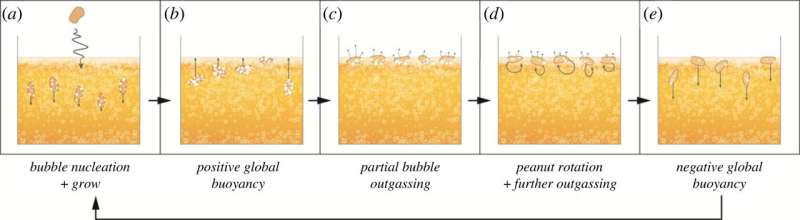
The process continues: Once the bubble-coated peanut reaches the beer top surface, some (but not all) of the bubbles attached to the top part of the peanut and proximal to the atmosphere or beer foam are released by bubble bursting (c). After some time at the top surface, the peanut rolls and rotates, which allows bubbles on the underside to also detach and pop at the beer top surface (d).”
A Repeated Process: “The peanut–gas assembly then sinks into the body of the beer, and the cycle can repeat via new preferential nucleation on the peanut surfaces as well as by growth of any remaining attached bubbles (e).
Bubble Analysis. Researchers analyzed this nucleation of bubbles. VOA reports, “They found that the larger the ‘contact angle’ between the curve of an individual bubble and the surface of the peanut was, the more likely it was to form and grow. But it cannot grow too much—a radius of less than 1.3 millimeters is ideal, the study said.”
Note, bubbles are more likely to form on the peanuts than on inner surfaces of the glass or in the beer itself.

The paper discusses bubble nucleation and cyclicity in great detail. Its analyses are not for the faint of heart.
Implications. Researchers note, “Like any good bar-side conversation starter, the peanut dance is a vehicle for discussions about particle floatation in general.” They cite applications in water purification, nuclear waste vitrification, iron extraction from ore, and magma behavior in the Earth’s crust.
“Therefore,” they say, “we close by proposing that this study has heritage and that the observation of bubble dynamics in beer is a rich topic, worth repeated investigation.”
I say “Here’s to ya. With peanuts, please.” ds
© Dennis Simanaitis, SimanaitisSays.com, 2023
 Simanaitis Says
Of course the reliability of research observations will be inversely related to the sample size taken by individual experimenters.
And how many mugs of beer (and days of work) were consumed in pursuit of this marvelous scientific discovery?
I love it!
>
The question is still unanswered. Why do bars in Argentina put peanuts into the beer they serve?