
Simanaitis Says
On cars, old, new and future; science & technology; vintage airplanes, computer flight simulation of them; Sherlockiana; our English language; travel; and other stuff
HARVESTING ELECTRICITY FROM THE AIR—BEN FRANKLIN, NICOLA TESLA, THE EUROPEAN COMMUNITY, AND THE UNIVERSITY OF MASSACHUSETTS, AMHERST PART 1
RESEARCHERS AT THE UNIVERSITY of Massachusetts, Amherst, and, independently, at the European Commission’s CATCHER project have been transforming atmospheric humidity into renewable power. This is in line with Benjamin Franklin’s famous kite-in-a-thunderstorm tale and also early 20th-century Nicola Tesla’s experiments attempting to capture electrical charges from the atmosphere.
Here, in Parts 1 and 2 today and tomorrow, are tidbits gleaned from each of these research efforts.
Ben and the Kite. Nancy Gupton describes this founding father/polymath’s experiment in her article in The Franklin Institute, June 12, 2017.

“Despite a common misconception,” Gupton writes, “Benjamin Franklin did not discover electricity during this experiment—or at all, for that matter. Electrical forces had been recognized for more than a thousand years, and scientists had worked extensively with static electricity. Franklin’s experiment demonstrated the connection between lightning and electricity.… To dispel another myth, Franklin’s kite was not struck by lightning. If it had been , he probably would have been electrocuted, experts say. Instead, the kite picked up the ambient electrical charge from the storm.”
“After his successful work,” Gupton says, “Franklin continued his work with electricity, going on to perfect his lightning rod invention. In 1753, he received the prestigious Copley Medal from the Royal Society, in recognition of his ‘curious experiments and observations on electricity.’ ”
My Own (Inadvertent) Experiments. I’ve already described my youthful hobby of flying control-line airplanes on a vacant field along the Cleveland waterfront of Lake Erie. Quite apart from my confusion of the summer sun setting in the north, I too occasionally felt the effect of static electrical charges buzzing my hand on the metal control handle (wrapping it in cloth mitigated this).
Tesla’s Dream. As I noted back in 2013, “The tale of Nicola Tesla is one of advanced technology, high drama, eccentricity bordering on the barmy—and even modern crowdfunding. It’s almost incidental that Tesla has a car named after him.”
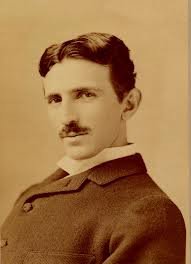
Consider, for example, his work with wireless transmission of electric waves (i.e., radio telegraphy). In “Realising a Century-old Dream to Make Electricity from Air,” December 22, 2022, Michael Allen writes in Horizon, the EU Research & Innovation Magazine, “In the early 1900s, Serbian-American inventor Nikola Tesla dreamed of harnessing energy from the air. He ran a series of experiments trying to capture electrical charges from the atmosphere and transform them into an electric current.”


Electricity from the Air. “The technique,” Allen says, “involves harvesting the tiny charges of static electricity contained in gaseous water molecules, which are ubiquitous in the atmosphere. The process is known as hygroelectricity or humidity electricity.”
Aha, I suspect it was hygroelectricity making my hand tingle while flying those control-line aircraft.
Tomorrow in Part 2, we’ll learn of progress made by researchers in the European Community as well as at the University of Massachusetts, Amherst. In time, hygroelectricity may offer options in renewable energy. ds
© Dennis Simanaitis, SimanaitisSays.com, 2023
 Simanaitis Says