
Simanaitis Says
On cars, old, new and future; science & technology; vintage airplanes, computer flight simulation of them; Sherlockiana; our English language; travel; and other stuff
SCIENTIFIC METAPHORS
ADVANCEMENTS IN SCIENCE PROFIT from explanatory metaphors. For instance, hydrogen’s promiscuity explains why its universal abundance doesn’t promote its being the slam-dunk of energy production. There’s lots of hydrogen, but its affinity for other elements complicates matters. It also explains the energy available, albeit sometimes complex to exploit, when hydrogen interacts with its elemental pals.
I encountered other scientific metaphors recently involving quantum computing. Here are tidbits on this tantalizing topic.
Quantum Entanglements. Einstein called this property “spooky action at a distance,” wherein two electrons can be entangled: That is, their spins, with 50/50 probability of being up or down, are correlated. And if one is measured as spinning up, the other, regardless of its distance away, spins downward.
Let’s Compute. As noted here at SimanaitisSays, “Stripped to its basics, a digital computer counts on two fingers, albeit very quickly. Its basic units are 1 and 0, on or off. By contrast, the basic unit of a quantum computer is a quantum bit, or qubit, a two-state system of physical properties occurring on the atomic level.”

What’s more, this illustrative metaphor suggests added complexity: “A qubit’s two states aren’t simply on or off; they can be any combination or superposition of these at the same time. For instance, a subatomic particle like an electron possesses a range of energy levels simultaneously.”
The matter of energy levels will recur here before long.

Quantum Potential. Quantum computer researchers C. Monroe and J. Kim were quoted back in 2013, “In a sense, entanglement between qubits acts as an invisible wiring that can be potentially exploited to solve certain problems that are intractable otherwise.”
SimanaitisSays noted back then, “To put the capability of quantum computing in perspective, today’s gold standard for computer memory, the terabyte, stores 243 on/off values. Even a mere 100-qubit quantum machine could handle 2100 complex values.”
Accountants and Hotel Rooms: Quantum researcher Michio Kaku has a new book on the topic, reviewed by Dov Greenbaum and Mark Gernstein in AAAS Science, May 12, 2023.
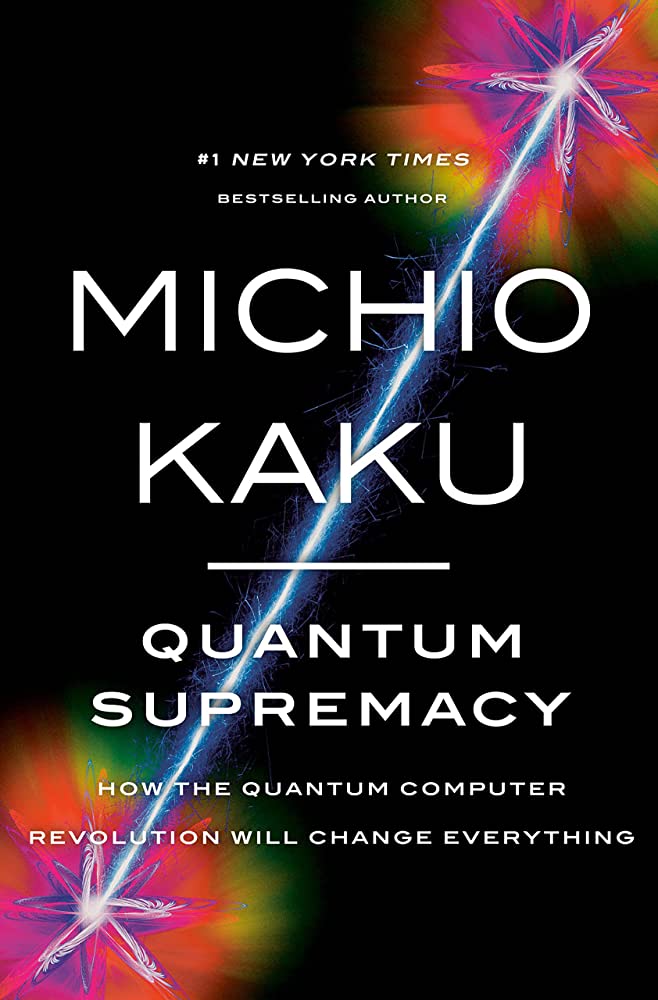
Michio Kaku is a professor of physics at the City University of New York, cofounder of string field theory, author of Hyperspace, Beyond Einstein, Physics of the Impossible, and Physics of the Future. He is the science correspondent for CBS’s This Morning and host of the radio programs Science Fantastic and Explorations in Science.
Greenbaum and Gernstein write, “Kaku excels at developing understandable metaphors for the complexities of quantum mechanics and computing. Consider the distinction he draws between classical and quantum computing: ‘An ordinary digital computer…is like several accountants toiling away independently in an office…But a quantum computer is like a roomful of interacting accountants, each one simultaneously computing, and, importantly, communicating with each other via entanglement.’ In another metaphor, he likens electron orbits to a hotel in which different types of rooms fill up in a particular order.”
Build Your Own Electron Hotel. As described in StoryboardThat, “Perhaps the most difficult part of atomic structure to grasp is the current understanding of how electrons are arranged outside the nucleus. Students generally come to chemistry comfortable with the idea of electrons orbiting the nucleus like planets around a sun. Though this idea has been known to be incorrect for nearly 100 years, it persists due to the ease at which people can relate to it.”
That is, less than perfect metaphors sometimes persist.
“It’s helpful,” StoryboardThat continues, “to use an analogy to help students understand that electrons move about in three-dimensional space, arranged by increasing potential energy and described by clouds of probability.”
The education resource says, “This is a great way to shift students away from the imperfect solar system model into something complicated but more accurate.… Though not a perfect analogy, this can be likened to an electron hotel. The floors of the hotel would represent energy levels, each one farther away from the ground floor, or nucleus. Each floor would have wings that are sublevels and within the wings are rooms, or orbitals. A room may contain 0, 1, or 2 electrons. The hotel would populate the rooms, wings, and floors in order of increasing energy, just as the Aufbau Principle describes the build-up of electrons according to energy.”
Kaku’s book would tell us more about how these energy levels relate to qubit superpositions. ds
© Dennis Simanaitis, SimanaitisSays.com, 2023
 Simanaitis Says