
Simanaitis Says
On cars, old, new and future; science & technology; vintage airplanes, computer flight simulation of them; Sherlockiana; our English language; travel; and other stuff
ROCKING WALLS MAY SURVIVE THE BIG ONE
AS REPORTED IN The San Diego Union-Tribune, May 9, 2023, Gary Robbins writes, “10-story Tower Survives Fake Earthquake in Possible Boon for Tall Wood Structures.”
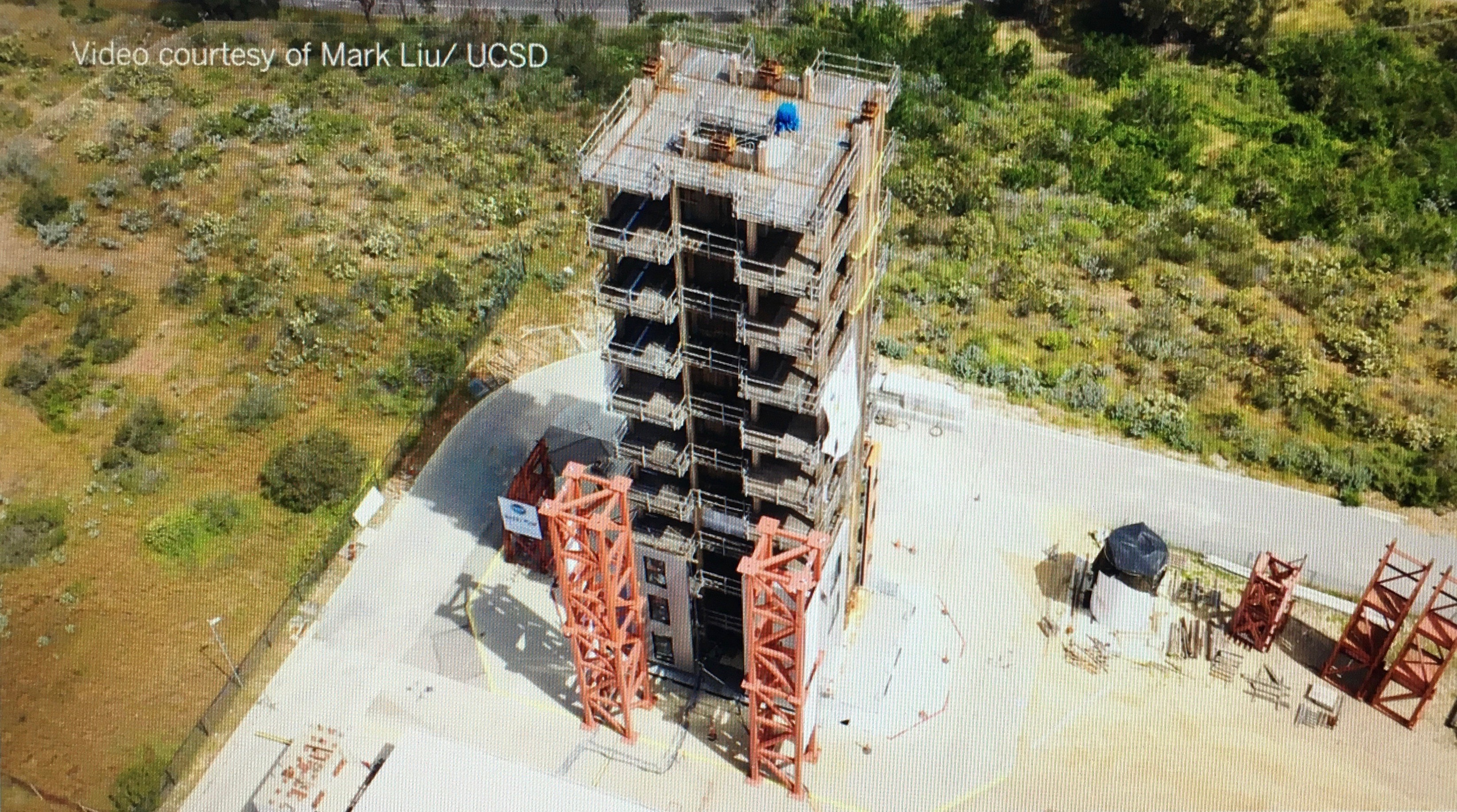
UCSD’s Large-scale Shaker Table. The University of California San Diego gives details of its outdoor shake table: Ioana Patringenaru writes, “The shake table can carry and shake structures weighing up to 2000 metric tons, or 4.5 million pounds–roughly the weight of 1300 sedan cars. This makes it the earthquake simulator capable of carrying the largest payload in the world. It’s also the only large-scale earthquake table in the world located outdoors.”
Patringenaru continues, “The table was recently upgraded thanks to $17 million in NSF funding and is now able to reproduce the full 3D ground motions that occur during earthquakes, when the ground is moving in all six degrees of freedom—longitudinal, lateral, vertical, roll, pitch and yaw. It is part of NSF’s Natural Hazards Engineering Research Infrastructure network, or NHERI–eight experimental facilities support innovative research for mitigating damage caused by hazards such as earthquakes, tsunamis, landslides, wind storms, storm surge, and flooding.”
Patringenaru says that the shake table simulates “earthquake motions recorded during prior earthquakes covering a range of earthquake magnitudes on the Richter scale, from magnitude 4 to magnitude 8, including various iterations of the 6.7 magnitude Northridge earthquake which struck Los Angeles in 1994. This will be done by accelerating the table to at least 1g, which could accelerate the top of the building to as much as 3gs.”
Shaken, But Not Scathed. AAAS Science reports how a “Tall Wood Building is Shaken, but Not Scathed.”

The magazine describes the Tallwood project: “A 10-story wooden building survived two severe, simulated earthquakes intact this week as scientists sought to show that wood can rival steel and concrete to safely support tall buildings. The structure is the tallest ever tested at the University of California, San Diego’s earthquake simulator. As part of a project funded by the U.S. National Science Foundation, the machine subjected the building to the equivalent of the 1994 6.7 magnitude Northridge, California, quake. A few minutes later it re-created a 1999 7.7 magnitude temblor that struck Taiwan.”
Construction Techniques. Science continues, “The building is reinforced by narrow wooden panels running from the ground to the top of each of its four sides. These ‘rocking walls’ are pinned in place by metal rods anchored to the ground and running through the panels to the top. They enable the walls to sway during a quake, then return to vertical.”

Patringenaru writes, “Due to this seismic movement induced by the rocking system, resilience-critical nonstructural components within and covering the building, such as the exterior facade, interior walls and stairways, are in for a big ride…. The building features four exterior façade assemblies, a number of interior walls, and a 10-story stair tower.”
“The exterior envelope must protect the building from temperature extremes and weather events,” Patringenaru notes, “while stairs must remain functional to allow occupants to safely exit and first responders to continually access all floors of the building.”
Hitherto, modern constructions of tall structures have depended upon steel and concrete. Scientists say using wood to construct tall buildings could lower their environmental footprint, yet be designed to be “shaken, but not scathed.” ds
© Dennis Simanaitis, SimanaitisSays.com, 2023
 Simanaitis Says
Brilliant!
Thank you,
>
Thank the multiple sources.
Hello Dennis,
A fascinating story on Shaken, not Scathed. I toured the Philippine island of Bohol right after a strong earthquake several years ago. Many of the recently built concrete houses were destroyed or heavily damaged. Concrete roofs were flipped off. The traditional houses of the well off strata of the population are wood-framed and clapboard sheathed. The windows are large arrays of small mother-of-pearl tiles. I saw no damage to any of these 100 year old plus structures.
Concrete failed badly though, in its defense, it was likely of pretty poor quality due to general lack of money for enough cement in the mix and too light-gauge rebar.
But the tour was sure eye opening!
Thank you, Dennis,
Van Baehr
Fascinating is the word. Thank you. Add to the above that according to recent articles in the New Yorker and elsewhere, the Pacific Northwest is overdue for a mega quake far greater than is the Bay Area, a “game changing” event. An article in the January, 2020 National Geographic, “Will the skyscrapers of the future be made out of wood?” holds still greater promise.
Never cease to be amazed by the range and scope of topics on SimanaitisSays.
Oh, the inadequacy of acronyms and initialisms! The 17,576 possible three-letter permutations are used multiple times. “NSF (National Science Foundation) funding” sounds strange to these Canadian ears. “NSF” is one of the reasons Canadian banks may give for bouncing a cheque (check): “Not Sufficient Funds”.