
Simanaitis Says
On cars, old, new and future; science & technology; vintage airplanes, computer flight simulation of them; Sherlockiana; our English language; travel; and other stuff
PITY THE AUSTIN A-30
AN ASTOUNDING DESIGN LEAP in automobile design occurred in Britain between the 1954 Austin A-30 and the 1959 Morris 850, aka the Mini. Whereas the Mini was innovative in so many ways, back in August 1954 R&T said, “While the A-30 may meet the needs and desires of the British marginal motorist, it seems ill-suited to American requirements.”

This completes our look at three of the four cars tested in that R&T issue. (Yesterday, the Moretti; the day before, the Nash Metropolitan; and see here at SimanaitisSays for an earlier evaluation of the VW.
Lord Austin’s Prodigy. R&T, August 1954, recounted, “The smallest Austin was first designed as the famous ‘Seven.’ His drafting board was a pool table and if someone had forgotten to remove the eight ball before Austin set to work, its influence has shown up—in the ‘reborn’ Seven, the Austin A-30.”
Design Goals. “The A-30,” R&T wrote, “is designed to hold four passengers (in either the two or four door models) and designers attempted to (1) keep the family ‘line’ in appearance and (2) give this particular model the big car look.”

Their goals, said R&T, were “to produce, within that body, an automobile which will offer good gasoline mileage, take up small garage or parking space and not be a sitting duck for those tax authorities who eye the motoring public as the deathless Goose of Golden Egg fame.”
I’m reminded of the Morgan Trike, another encouragement of His Majesty’s Inland Revenue. Seemingly more successful, though, as Trikes persisted at Malvern Link from 1911 to 1952 (and have been recently resurrected).
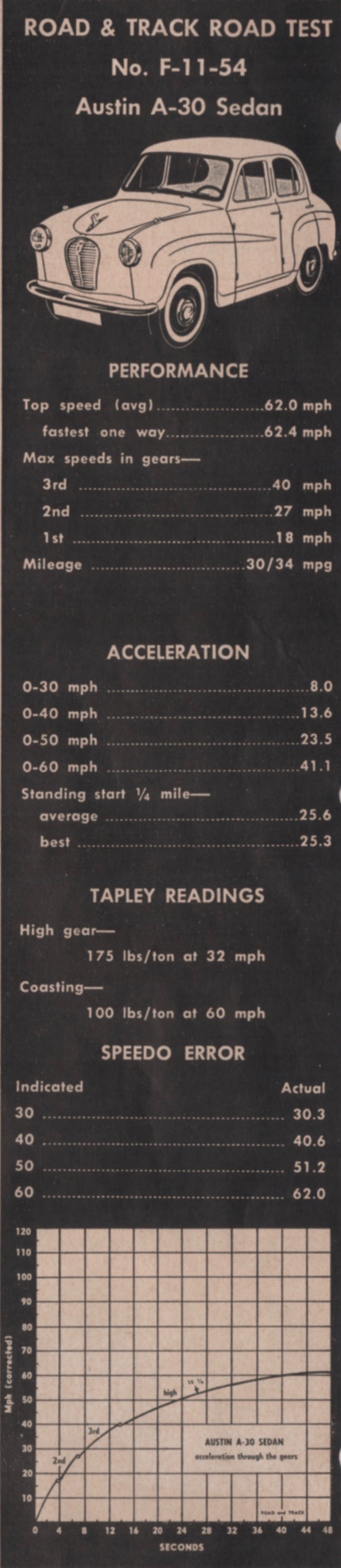
Performance—Or Lack Thereof. R&T reported, “Barely able to keep up with normal ‘easy-going’ traffic, the tiny engine [800 cc/28 hp] must be revved unmercifully. Our total mileage with this car included an 800 mile trip and it was an unhappy experience.”
“The comfortable cruising speed,” R&T continued, “is no more than 50 mph and above that, the engine is neither quiet or vibrationless.”
Recall, this was five years before England got its first motorway.
“In traffic,” R&T said, “the transmission gears are noisy and make a definite clashing sound when shifted even faster than normal. There is rear axle noise, engine noise and even suspension noise—all blended into a cacaphonous highway harmony. When the wind noise joined in with the others there were those who indicated they thought they’d walk instead.”
Newsboy Bike Drags. R&T observed, “While the British motoring journals call the performance of this car ‘brisk,’ our test crew did not concur and were of the opinion that the A-30 might lose a stop light ‘drag’ race to the newspaper boy on his bicycle. Even more to the point, we wondered what state of repair the engine would be in after a full year of struggling to stay up with traffic.”
Versus the Beetle. Not that the Volkswagen’s acceleration (39.2 seconds to 60 mph) was all that quicker than the A-30’s 41.1. Indeed, a Letter to the Editor in November 1954, “In Defense of the Austin A-30,” compared R&T’s figures showing the A-30 to be quicker than the VW in the newsboy range.
Back in 1952, though, R&T noted the sturdy understressed nature of the Beetle’s flat-four: “The car was pounded unmercifully thru traffic and absolutely floor-boarded on the open road. At no time was there any sign of distress…. In open country a 60 mph average was possible to maintain.”
And in these August 1954 road tests, it can be noted that John Bond and two other pals, Jack Parkhurst and Disney Imagineer Henry “Bob” Gurr, each owned a VW. ds
© Dennis Simanaitis, SimanaitisSays.com, 2023
 Simanaitis Says
Looks like my decision to avoid one of these was correct .
I think they’re cute beyond belief and understand the care and tending old L.B.C.’s require having used a Metropolitan Nash FHC for daily driving, road rallying and long distance touring for two + decades .
The British had a different way ot viewing transportation .
-Nate