
Simanaitis Says
On cars, old, new and future; science & technology; vintage airplanes, computer flight simulation of them; Sherlockiana; our English language; travel; and other stuff
AMERICA WANTED A SMALL CAR? THE 1954 NASH METROPOLITAN DELIVERED
“THIS, THE NASH COMPANY ASSURES US,” R&T WROTE IN MAY 1954, “is what the public asked for…. Well, let’s see what the public wanted.”
“First,” R&T said, “the public wanted an inexpensive car; basically, a second car with social acceptance, low operating costs, good performance, attractive appearance.”

Here are tidbits on the Metro, with reflective comments touching on the others.
Anglo-American. R&T wrote, “The Metro employs the Austin A-40 power plant and rear axle. The famous Nash unitized frame [recall, most cars then were body-on-chassis] is built for the car by Fisher & Ludlow Ltd. of England and the assembly work on the car is done at the Longbridge works of Austin.”
“The car,” R&T recounted, “is being manufactured in two models, a convertible and the American phenomenon known as the ‘hardtop convertible’ which converts only to a hardtop.”

Fifties’ Italian Appearance. The Moretti had Ghia styling, but the Metro was Farina-influenced: R&T analyzed, “The exterior of the car resembles a slightly squashed stock-sized Nash, and perhaps the main distinction from what once was a Farina design are the extremely small 13-inch wheels fitted with ‘kiddy car’ tires of 5.20 x 13 size. There is a continental tire kit as standard equipment on the car, complete with a Vynide plastic cover—but the small wheel and tire tend to distract rather than to add.”
By contrast, the soon-to-be-ubiquitous Volkswagen Beetle rolled on 15-inch tires. It wasn’t until 1961 that the Austin Mini legitimized the appearance of even smaller 10-inchers.
Simple Accommodations. R&T noted, “The front seat is of the bench type, split in the middle with access to a back seat (for pets and very small children only) available from either side. Trunk space is roomy for the car’s overall size, but to save money [and, no doubt, to enhance torsional stiffness], no exterior lid had been cut into the car and access to the trunk is through the upright portion of the back seat, which comes complete with lock and key.”

“Visibility in both models,” R&T reported, “is excellent because of the high windshield and roll up windows (which lower the dropped portion for convenient elbow resting ala sports car), and the view over the hood with raised fenders and fake air scoop give one the impression that the car underneath is something big and potent like a Lancia.”

Surprising Performance. “The Metro, for its size,” R&T said, “screams out from lights, and shifts into second and into third require a great deal of practice before one can eliminate the sudden squat in the rear when the higher gears take hold. The speedometer needle flickers upwards fast and it’s quite easy to be hitting 50 mph within a long city block, police and weather conditions allowing.”
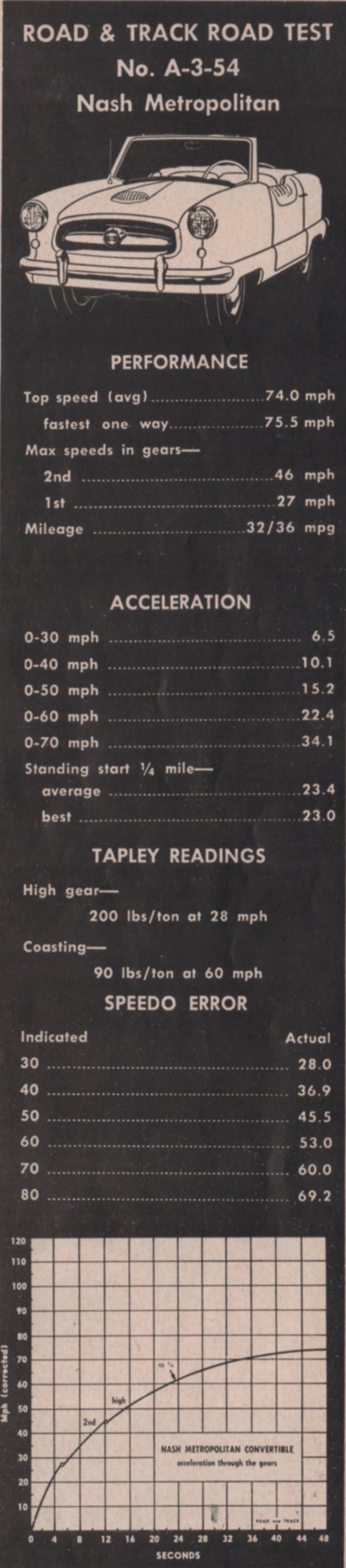
Before getting snarky about 0-60 in 22.4 seconds, be aware that the Volkswagen Beetle tested in the same issue took 39.2 seconds; the Austin A-30, 41.1.
No wonder Wife Dottie’s brother Willard proudly drove a Metro. ds
© Dennis Simanaitis, SimanaitisSays.com, 2023
 Simanaitis Says
I had no idea that it was so sporty in performance! How was it to drive? The track looks quite narrow, but then, so did the original XKE. Thanks for the flashback.
I never drove one, but never heard Willard complain later about it.
When new they drove very nicely .
As they aged out and few bothered to grease the king pin and threaded trunnion front suspension they got worse .
They were geared rather low as designed for in town use .
I had a few, my favorite was my ’59 FHC, because BMC is like GMC I was able to mix and match various parts to make my little red Met a seriously speedy little car, I often out ran the local LBC Club’s Sports Cars in the twisty bits .
Good and clever engineering let down my BMC’s usual lack of any initial quality control made these “Watch Charm Rolls Royce” runabouts into jokes for the average American buyer but the cute factor means many were saved in back yards and garages etc. instead of being crushed in the 1960’s, they’re simple and easy to maintain and make good daily drivers .
My FHC was my rally and long distance touring rig as well as a daily driver for over ten years…….
-Nate