
Simanaitis Says
On cars, old, new and future; science & technology; vintage airplanes, computer flight simulation of them; Sherlockiana; our English language; travel; and other stuff
ENGLISH, EH?
LIBBY NELSON’S “25 Maps That Explain the English Language” at vox.com is an exemplary concise history of the English language. Nelson has collected wonderful maps on everything from the Old World Language Family Tree to You Guys vs. Y’All. The story is well worth reading. Here are three samples:

No. 1: Where English Comes From. Map by Minna Sundberg. This and the following images from “25 Maps That Explain the English Language.”
I could lose myself for hours in climbing the branches of Minna Sundberg’s Old World Language Families Tree. It’s pretty well known, for example, that Finnish, Estonian and Hungarian are unrelated to the rest of Indo-European tongues. I like to image that three proto-European brothers parted company at the Danube, two heading north, one heading south.
It’s new to me, though, that the Celtic branch, including modern Gaelic and Welsh, is so low on the tree. Notice as well how separated Venetian, Piemontese, Emiliano, Ligurian and Lombard are from modern Italian. ”You Say ‘Anguria.’ I Say ‘Cocomero’: Italy’s Many Dialects” by Gaia Poanigiani gives examples of this in The New York Times, October 7, 2016.
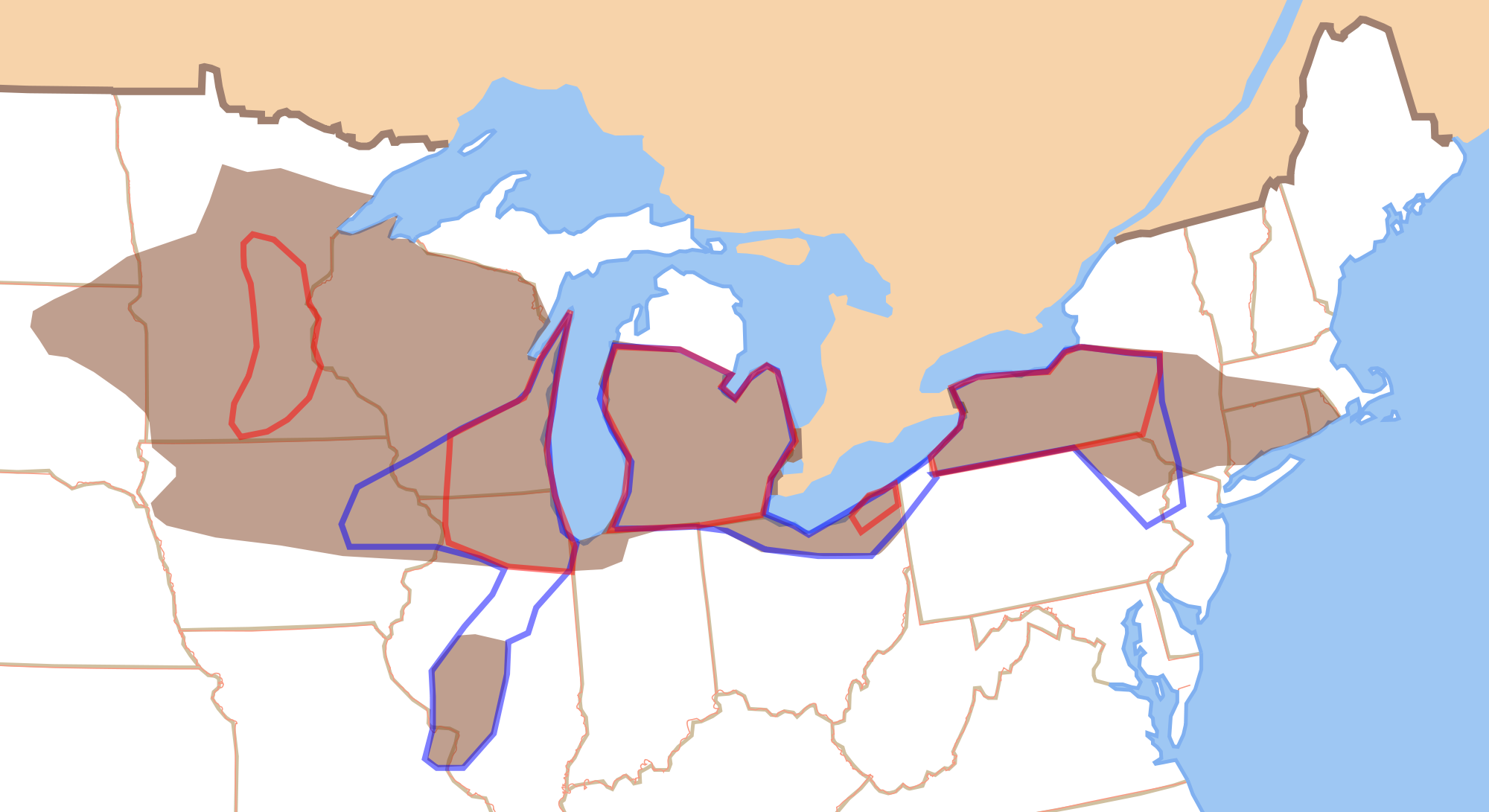
No. 23: North American Vowel Shift. Map by Angr.
Nelson notes that the North American Vowel Shift is taking place in the U.S. Great Lakes region, where I was born and raised. The phenomenon is “remarkable because short vowel sounds (think of the short “a” in “cat,” rather than the long “a” in “Kate”) actually survived the Great Vowel Shift in the 17th Century.” This earlier one, No. 6 in Nelson’s list, describes when “meese” became our “mice.”
With this new trend, people in Milwaukee, Chicago, my native Cleveland and other Great Lakes locales are pronouncing “buses” more like “bosses” and “block” is becoming “black.”
Though this shift appears to have begun in the 1930s, it seems to have missed me. However, I confess it wasn’t until I did educational radio work with WBOE, Cleveland’s Board of Education station, that I realized “are” and “our” weren’t pronounced the same. (“Hour” was different.)
I recall a high school teacher gently asking me, “When did you come to this country, Dennis?” And, yes, sarcasm has often been wasted on me.

No. 22: Dialects and Accents in Britain, as spoken by Siobhan Thompson.
Especial fun at the vox.com website is Siobhan Thompson’s 17-stop tour of the British Isles. Here’s a direct link to the funny ways they talk over there.
Ha. Look who’s talking. ds
© Dennis Simanaitis, SimanaitisSays.com, 2016
 Simanaitis Says