
Simanaitis Says
On cars, old, new and future; science & technology; vintage airplanes, computer flight simulation of them; Sherlockiana; our English language; travel; and other stuff
THIRD PERSON SINGULAR
THE LINGUISTIC gender war in English has been raging over the third person pronoun, particularly in its singular personal form: he/him, masculine, and she/her, feminine. There are those, macho, feminist, LGBT, whatever, who wish not to specify gender with a third person singular.
Fine. But I see no reason proposing oddities such as xe and xim to replace he/she and him/her, respectively. Also, I grant that “he and/or she” and “him and/or her” have legalistic overtones akin to “the party of the first part” and “the party of the second part.”
Hardly love letter syntax.
It has also been suggested that the third person plurals “they” and “their” be employed. The latter has already entered English in wincingly nonparallel, albeit genderless, constructions such as “Alice arranges their hair” or “Bob blows their nose.”
The Washington Post already has the singular “they” in its stylebook. The American Dialect Society voted the singular “they” as its 2015 Word of the Year. The group noted its use “as a conscious choice by a person rejecting the traditional gender binary of he and she.”
Honest.
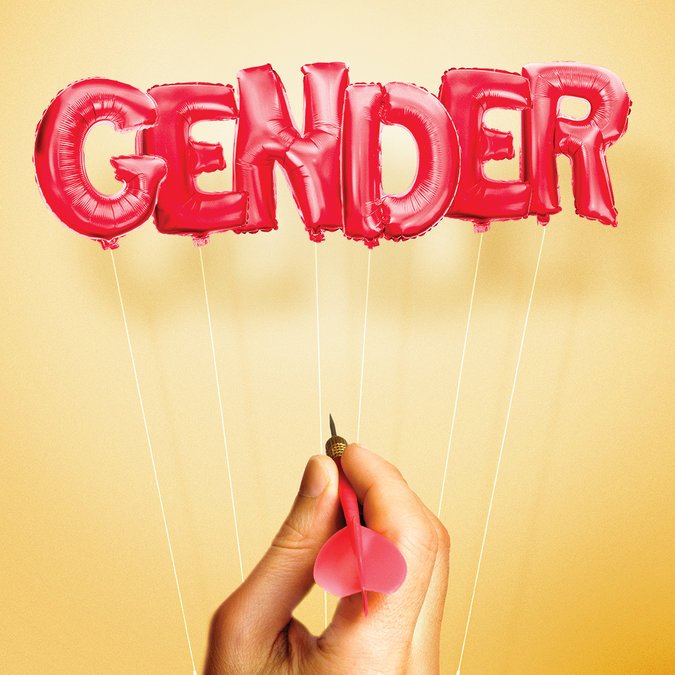
Image from The New York Times magazine, April 3, 2016.
See “Who’s ‘They’?” by Amanda Hess, The New York Times, March 29, 2016, for a spirited analysis of xe, xim, they, their and the evolution of English.
I’ve thought about this a bit too. And I offer an obvious solution. It’s already an accepted part of the English language, not to say other tongues as well: the use of “one” and “one’s” as personal pronouns for the third person singular.
This usage is more common in French; for instance, ici, on parle anglais, literally, “here, one speaks English,” loosely, “English spoken here.”
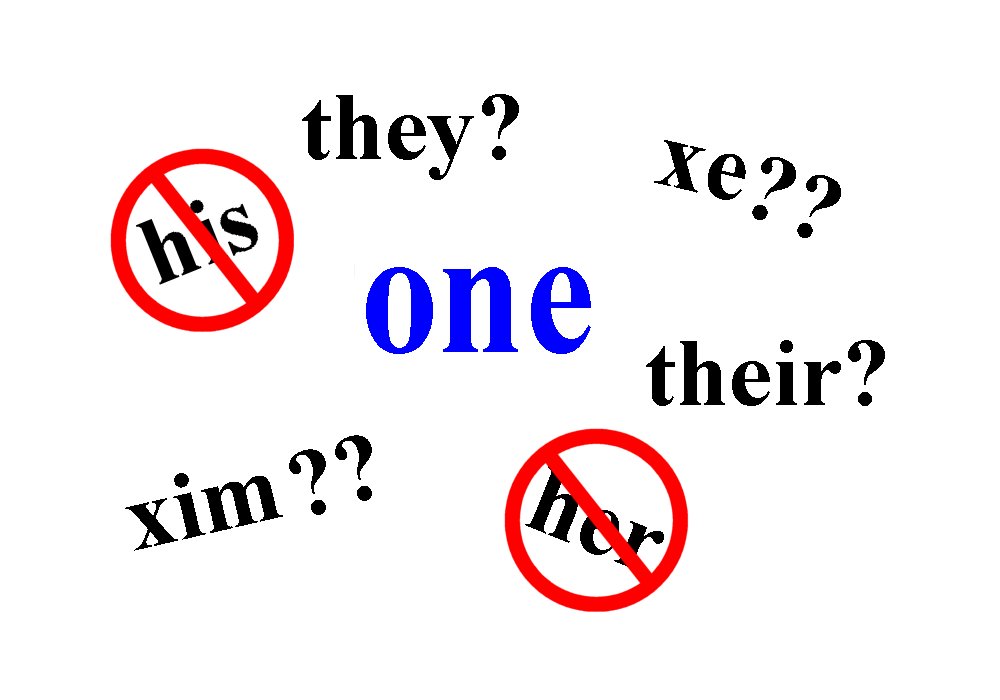
One uses it in English as well, though Merriam-Webster says, “used to refer to a single person or thing.” I confess, the “or thing” rankles me a little. English already has a pronoun for things: “it.” And “one” as a personal pronoun, third person singular, already exists too. It’s familiar to everyone. And, apart from not appeasing to language Nazis, I sense nothing wrong with its use.
It would take some getting used to. Nevertheless, I’d prefer “Alice arranges one’s hair” and “Bob blows one’s nose” to the jarring garble of singular and plural. Full disclosure: Nor do I see anything particularly damaging, genderwise, to her arranging her own hair and his blowing his own nose. Or vice versa; her nose and his hair.
What do you think of this matter of English evolution? ds
© Dennis Simanaitis, SimanaitisSays.com, 2016in
 Simanaitis Says
Stuff like this — the basic argument for such substitutes — gives me a headache. Are we that self absorbed that he/she or ‘them’ is no longer sufficient? Glad I no longer need to keep a style book (The AP Bible of the Universe) handy so as not to offend anyone.
Not so much evolution as genetic engineering.
Reminds me of something that I heard years ago. It was either from a stand up comic or one of several perverse individuals that I have met through the years.
Here goes the progression of changes:
1. Chairman is too masculine for a woman to use, so “Chairwoman”
2. To make the title gender neutral “Chairperson”
3. But then there is that pesky male “son” in the word, so more correctly it should be “Chairperchild”
In all seriousness, I regard the position of Chairman as a position, not a person, and so take the substitutes Chairwoman/Chairperson as a devaluation of the role.
Then take the word “woman”. There’s that pesky “man” again, so make it “woperson”. But then there’s that pesky “son” again, so make it “woperchild”.
All the reengineering of the language is not going to make the world a more equal place. Only actions will, actions that respect individuals, irrespective of their race or gender.
I am reminded of an interview many years ago of a senior female executive who was asked about how she had managed to penetrate the “glass” ceiling in her organization. Her response was “what glass ceiling?”. There is no doubt that there are still many “glass” ceilings/walls erected by individuals/groups wanting to bar access to their “club”, but often these glass barriers are illusory, working effectively not because they exist, but because individuals believe that they exist and can’t be penetrated. And if an organization really does erect hard barriers, there are plenty of others that will willing accept individuals based on their talent, expertise and ability to earn respect.
The quite proper female chairperson of a commission I once worked for insisted on being referred to as “Madam Chairman.”
Ha. I find this less jarring than simply “the chair.” I speak to furniture only rarely.
I still like Bart Simpson’s term for the FeMailMan, delivering letters.