
Simanaitis Says
On cars, old, new and future; science & technology; vintage airplanes, computer flight simulation of them; Sherlockiana; our English language; travel; and other stuff
NOËL COWARD’S JAMAICA
A COMPELLING image of Noël Coward is one of elegance at a theater in London’s West End or maybe in glittering Las Vegas. Yet one of the most urbane of 20th-century personalities loved the rustic settings of Jamaica in the Caribbean. What’s more, this playwright, composer, actor, singer and wit had a lesser known, but no less evident, talent as an artist in oils. The book Out in the Midday Sun displays this, as well as Coward’s interactions with Winston Churchill and James Bond’s creator Ian Fleming.

Out in the Midday Sun: The Paintings of Noel Coward, assembled and with commentary by Sheridan Morley, Philosophical Library, 1988.
Coward’s paintings were largely a personal thing, only occasionally gifted to friends or associates. His first paintings were watercolors of English country scenes, often centered at Goldenhurst, his 16th-century farmhouse in Aldington, Kent, 60 miles southeast of London, near Canterbury.

The Pond at Goldenhurst Farm, Kent. This and the following images from Out in the Midday Sun.
Morley relates the tale that Coward spent a Sunday chatting with friend and fellow artist Winston Churchill. Coward’s secretary and friend Cole Lesley noted, “… by the end of that Sunday, Sir Winston had commanded him to stop painting in watercolours and work only in oils. Noël came back converted.”
Another bit of gold, Ian Fleming’s Goldeneye, is on Oracabessa bay, on Jamaica’s northern coast about 45 miles north of Kingston, the capital. Goldeneye was named, perhaps, for a World War II operation to protect Gibraltar, its plans drawn up in 1941 by Lieutenant Commander Fleming. Fleming himself offered this as one of several inspirations for naming his Caribbean home. He wrote the James Bond adventures there, beginning with Casino Royale in 1952 and continuing for 12 years.
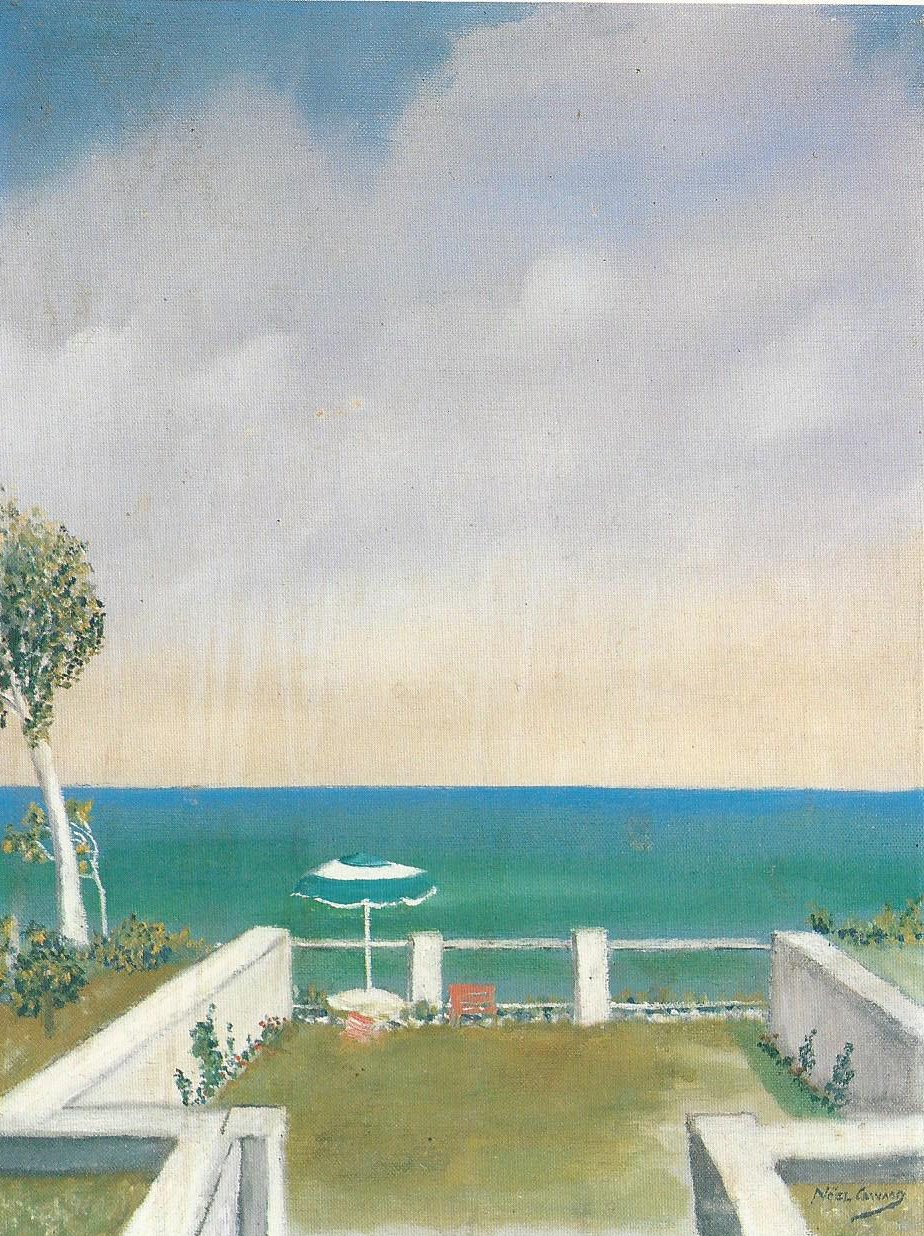
The Sunken Garden, Goldeneye, Jamaica.
Coward rented Goldeneye from Fleming in 1948, eventually calling the estate “Golden Eye, Nose and Throat.” However, he liked Jamaica enough to build his own home there at Port Maria, a few miles along the coast. Coward named his estate Blue Harbour, with Firefly his special retreat built high on the property.

The Terrace, Firefly, Port Maria, Jamaica.
The sun, sea and solitude contrasted with entertainment aspects of Coward’s life. (He referred to his Las Vegas gigs as “NesCafé Society.”) In his book, Morley likens Coward’s painting style to that of David Hockney in vibrancy of image and its use of bright colors. Of his compositions, Coward wrote, “You have to imagine that you are seeing them through a telescope, as that is the only way I can ever manage to paint people.”

Red Roof and Tropical Coastline.
Morley notes, “Many of Noël’s landscapes look like stage sets for some sun-baked operetta, and his vivid colouring is highly theatrical.” In fact, though, Coward left design of his theater sets to a lifelong friend, artist Gladys Calthorp. Morley’s book contains one rare poster that Coward did for his 1961 musical Sail Away.

Poster for Sail Away, 1961.
Morley came upon the cache of oils in 1968 when he visited while researching Coward’s biography. “What I didn’t expect to find,” Morley writes, “… was a room off the hall entirely filled from floor to ceiling with twenty years of his paintings.”
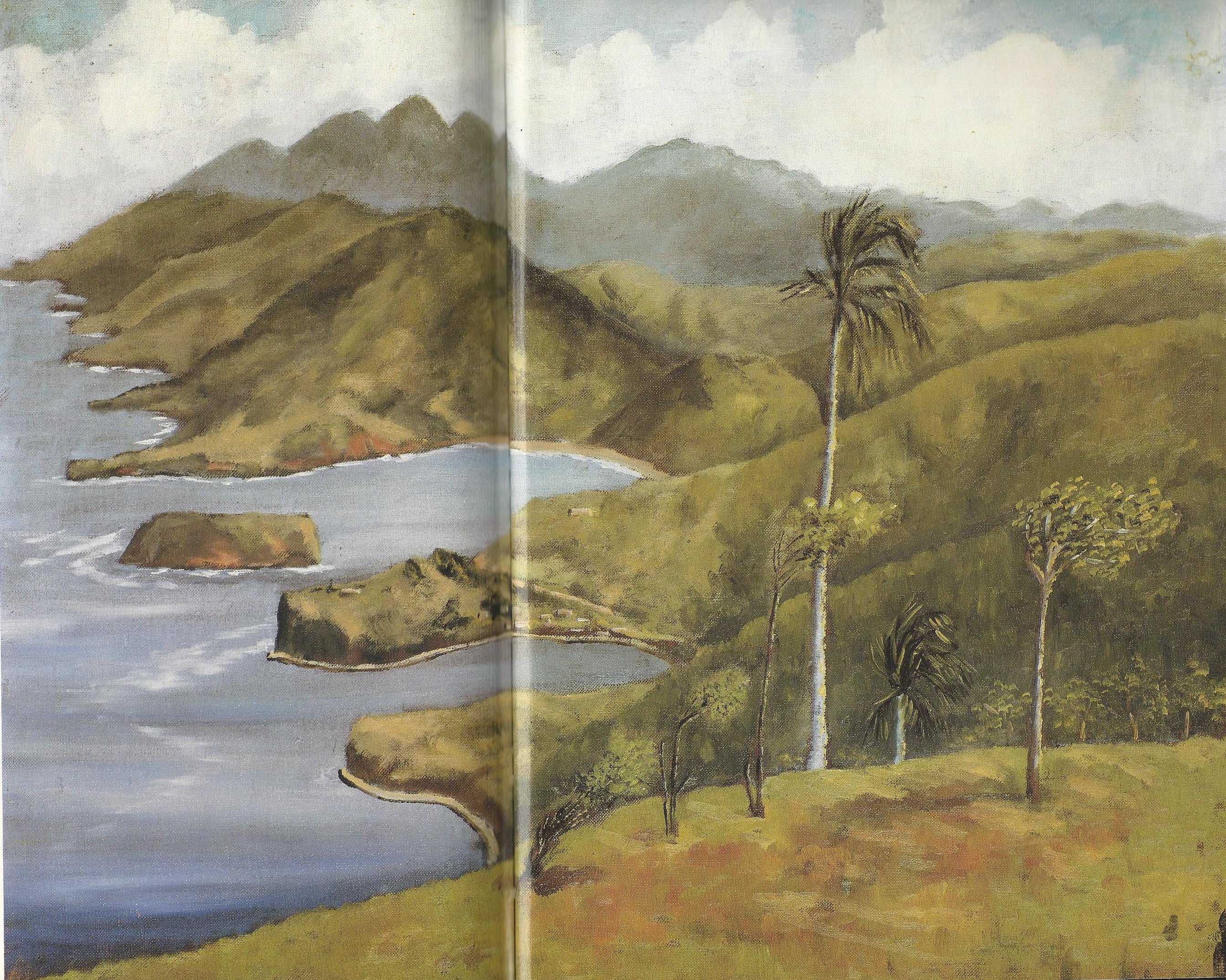
View from Firefly.
Coward died at Firefly in 1973, at age 73 of heart failure. He was buried on the brow of Firefly Hill. It wasn’t until 1988 that Coward’s executors put the paintings up for auction, the proceeds going to theatrical charities. As Morley notes, “In fact, they went for a grand total of £786,000 [$1,415,000 at the time; perhaps $2,800,000 in today’s dollar] in one short sale, thereby happily vindicating Noel’s own diary estimate that ‘compared to the pretentious muck in some London galleries, my amateur efforts appear brilliant.’ ”
As Coward also mused, “… the most I’ve had is just a talent to amuse.” And a great deal more. ds
© Dennis Simanaitis, SimanaitisSays.com, 2016
 Simanaitis Says
I recall reading that Sir Winston explained his preference for landscapes as opposed to portraits this way . . . trees and palms can’t complain.