
Simanaitis Says
On cars, old, new and future; science & technology; vintage airplanes, computer flight simulation of them; Sherlockiana; our English language; travel; and other stuff
DIFFERENT HORSES—BUT FOR DIFFERENT ERAS?
A COLLEAGUE asked about horsepower measurement, specifically for classic cars like the Duesenberg Model J built between 1928 and 1937. As I happen not to have a Model J in my garage at the moment, I cannot simply call up a local dyno shop and have it tested. But I have dug around and understand a bit more about automotive horsepower, these days as well as back in the Duesenberg’s era and before.

Let’s start with absolute basics. An automobile moves by rotation of its drive wheels, this rotational force originating in its engine. Thus, the heart of automotive propulsion is the twisting force of its engine’s output, be it the crankshaft of a conventional reciprocating powerplant or output shaft of an electric motor.
An English unit of this twisting force, of torque, is the lb.-ft. Alas, it’s doomed to be confused with the ft.-lb., an English unit of work. Grasp a 1-ft. ruler at one end with a 1-lb. weight on it at the other, and the twisting force is 1 lb.-ft. By contrast, 1 ft.-lb. is the work exerted in raising a 1-lb. weight a vertical distance of 1 ft.

At left, a force of 1 lb.-ft. At right, the work of 1 ft.-lb. Images by Tim Barker in R&T, November 2003.
In the late 18th century, Scottish inventor and mechanical engineer (long before this term became current) James Watt wanted to compare the power of his steam engine with those of established Newcomen designs. (Both were used to evacuate water out of mines.) He began his figuring with a horse being able to turn a mill wheel 144 times/hour and calculated one horsepower to be 32,572 ft.-lb./minute, which rounded to 33,000 ft.-lb./min. (the official definition of “mechanical horsepower”), whence the familiar 550 ft.-lb./sec.
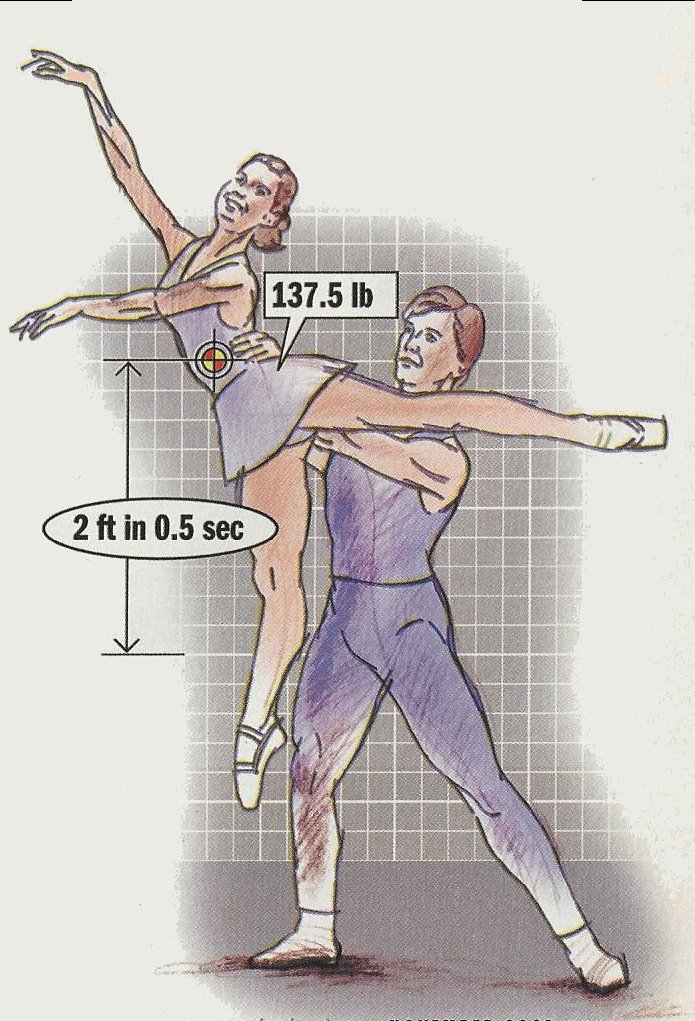
Image by Tim Barker from R&T, November 2003.
As I once calculated, a ballet dancer lifting an admittedly BBW 137.5-lb. ballerina a distance of 2 ft. in 0.5 second exerts 1 hp. I believe she helps a bit with a little jump on liftoff.
Measuring the output of an engine requires a calibrated means of absorbing its power. Over the years, dynamometers have used weights, water, hydraulic fluids and electricity to measure horsepower, the earliest electrical devices dating from the 19th century. Essentially motor/generators, their electrical output is directly related to the power of the test engine driving their input shaft. Other dynamometers resist the engine’s rotational output through flow dissipation of water or other fluid, akin to spinning a paddle wheel. For example, Jay Leno’s garage includes a Superflow SF-902 water brake engine dyno.

Jay Leno’s Superflow SF-902 engine dyno. A video shows dyno testing of a Mercedes-Benz 300SL engine.
The term “brake horsepower,” bhp, comes from engine dyno measurements taken at the engine’s crankshaft. At the other extreme, a chassis dyno records its measurement at the drive wheels, thus accounting for frictional losses of gearbox and final drive.
Just to confuse matters, governments got involved with taxation schemes based on automotive power. RAC Horsepower, for example, was based on nothing more than the number of cylinders and their bore. Ignoring as it did the engine’s stroke, RAC Horsepower was only vaguely related to an engine’s actual output, giving rise to names such as the Talbot 14/45 (14 RAC Taxable, 45 hp).

SAE International, formerly the Society of Automotive Engineers, originally the Society of Automobile Engineers founded in 1905, published a paper in 1913 titled “The Measurement of Horsepower” (now catalogued as SAE 130027). That same year, SAE 130023 discussed “Garland’s Magnetic Absorption Dynamometer.” By the late 1920s, matters had evolved to discussing corrections for humidity and the like (SAE 290034).
Carmakers report bhp of their engines, but the complexity is far from resolved. Different conditions of testing affect engine dyno results. SAE Standards J245 and later J1995 set test conditions for what’s now known as SAE gross horsepower. In 1971 – 1972, prompted by government worries about an on-going horsepower race, SAE promulgated J1349 and its change to net horsepower.
The difference lies in engine auxiliaries. An SAE-gross-tested engine does not operate its own water pump, radiator fan or generator. Its intake and exhaust needn’t be stock either. By contrast, SAE net requires the engine to run these power-consuming components, along with air cleaner, emissions controls and other production fitments.

A Horiba Titan engine test stand. Image by Mikelantis.
There’s also something called SAE Certified Horsepower, J2723, dating from 2005. It contains no major changes in test methodology; rather, it’s a way for third-party protocol to give consumer confidence in automakers’ SAE net and gross ratings.
There’s no precise conversion factor between SAE gross and SAE net hp because engine elements react differently to these differing test conditions. Generally, though, SAE net figures are 8 to 15 percent lower than those obtained in SAE gross conditions.
Last, there’s “horsepower measured at the brochure,” product hype in the interest of enhanced sales. It’s part of this website’s analysis of Duesenberg power coming tomorrow. ds
© Dennis Simanaitis, SimanaitisSays.com, 2015
 Simanaitis Says
Paraphrasing Milton Friedman, another take on different horses for different eras: if we had actual horses producing all the automotive horsepower we now utilize, we’d have a serious emissions problem of an entirely different sort.