
Simanaitis Says
On cars, old, new and future; science & technology; vintage airplanes, computer flight simulation of them; Sherlockiana; our English language; travel; and other stuff
A FOGGY DAY/IN LONDON TOWN…
IRA GERSHWIN wrote the lyrics, his brother George composed the melody, and Fred Astaire introduced the song in the 1937 movie A Damsel in Distress. Old-time movie buffs may recall this flick. Along with Astaire, it also starred Joan Fontaine, George Burns and Gracie Allen (three years before her presidential run against Franklin Delano Roosevelt). I suspect most of us could hum along with A foggy day/In London town/Had me low/Had me down….

The October 8, 2015, issue of London Review of Books has a most enlightening article on this atmospheric condition to which London has been subject. Indeed, the worst of London fog is a thing of the past. How and why make for an interesting tale in the LRB: “Brown Goo Like Marmite,” by Neal Ascherson, reviews a new book, London Fog: The Biography, by Christine Corton.

London Fog: The Biography, by Christine Corton, Belknap Press, 2015.
Christine Corton’s book and, obviously to an abbreviated extent, Ascherson’s review are more than meteorological, they’re cultural, literary and metaphorical. Among other authors, Charles Dickens is offered as an example of these last two aspects.

Bleak House, by Charles Dickens, originally published as a serial between March 1852 and September 1853.
In the Chapter 1 introduction to Bleak House (an ominous title if ever there was one), Dickens wrote “Fog everywhere. Fog up the river where it flows among green aits and meadows; fog down the river, where it rolls defiled among the tiers of shipping and the waterside pollutions of a great (and dirty) city…. Fog in the eyes and throats of ancient Greenwich pensioners, wheezing by the firesides of their wards; fog in the stem and bowl of the afternoon pipe of the wrathful skipper, down in his close cabin; fog cruelly pinching the toes and fingers of his shivering little ‘prentice boy on deck.”
Ascherson, with tongue in cheek, adds, “To say that Dickens multi-tasks his metaphor is a hopeless understatement.”
By the late 1800s, three and a half million fireplaces in London were burning cheap coal with serious detriment to health. An 1879 fog brought about a 200-percent increase in mortality. In 1886 it was estimated that, during periods of fog, bronchitis deaths soared to 700 a week.
“Fog came to symbolize social breakdown…” Ascherson writes, “The 1886 fog coincided with an orgy of looting, the stoning of West End Clubs and rioting in Trafalgar Square…. The ‘link boys,’ who had always guided coaches and pedestrians through fog behind flaming torches, were now suspected of leading their clients into footpad ambushes.”
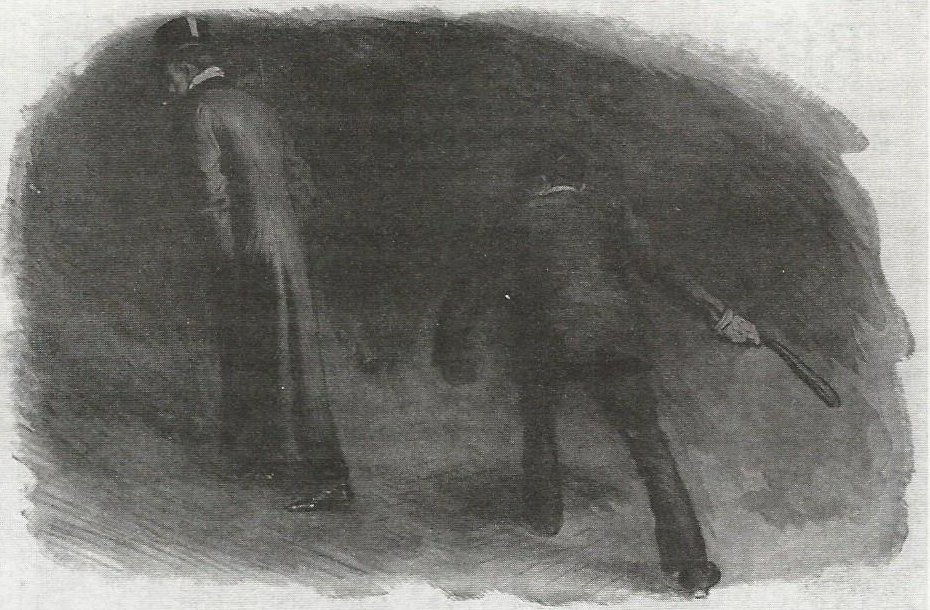
Sandbagging in the Fog, by George Sims, c. 1900. This and the following image from London Review of Books, October 8, 2015.
American author Nathaniel Hawthorne thought of fog as “the ghost of mud, the spiritualized medium of departed mud, through which the departed citizens of London probably tread in the Hades whither they are translated.”
The term “pea-souper” is traceable to Herman Melville who, in 1850, encountered “the old-fashioned pea soup London fog—of a gamboge colour.” Gamboge (not the first Melville bit I needed to look up) is a yellow pigment, used to dye the robes of Buddhist monks.
Ascherson notes that the term “smog,” as in smoky fog, was invented in a 1904 Smoke Abatement Campaign. It was only later that smog came to describe the eye-burning chemical reaction of motor vehicle pollutants, specifically hydrocarbons and oxides of nitrogen, in the presence of sunlight.
In the 1800s, there were debates about culpability: Was fog to be blamed on family hearths burning coal? Or did responsibility lie with factories fueling the Industrial Revolution? Briefly, both; though Parliament dragged its heels on smoke abatement well into the 20th century. As many as 6000 people perished from The Great Fog of December 1952; it caused the “Brown Goo like Marmite” of Ascherson’s title.
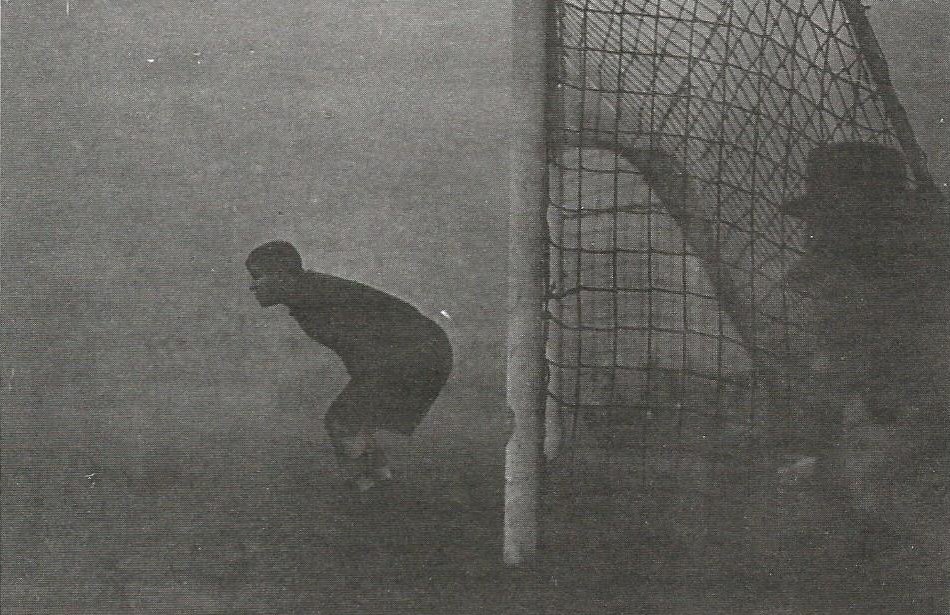
Photo of a foggy match between Moscow Dynamo and Tottenham Hotspur, 1945.
All this also got me thinking about the fog’s effect on my favorite Londoners, Sherlock Holmes and his chronicler Dr. John H. Watson. In “A Study in Scarlet,” 1887, Watson notes that “a dun-colored veil hung over the house-tops.” House-top high seems hardly enough to complain about.
But matters got worse: In chronicling “The Adventure of the Bruce-Partington Plans,” 1908, Watson describes “a greasy, heavy brown swirl still drifting past us and condensing in oily drops on the windowpane.”

A dense London fog sets the scene for “The Adventure of the Bruce-Partington Plans,” 1908. Image by Frederic Dorr Steele from stanford.edu.
Now that’s London fog. ds
© Dennis Simanaitis, SimanaitisSays.com, 2015
 Simanaitis Says