
Simanaitis Says
On cars, old, new and future; science & technology; vintage airplanes, computer flight simulation of them; Sherlockiana; our English language; travel; and other stuff
RACING ON THE BOARDS
JUST AS roads of wood planks had their heyday, so it was with race tracks surfaced in this same material. In fact, the first board track in the U.S. was the Los Angeles Motordrome. It held its first race on April 8, 1910, more than a year ahead of the Indianapolis brickyard’s inaugural Memorial Day event. (Indy’s events in 1909 were on a mixture of dirt and asphalt.)
Playa del Rey, California, became the speed capital of the world, albeit for only three and a half years, 1910 to 1913. Like the British Brooklands, Playa del Rey hosted cars as well as aeroplanes—and some of the hardiest of race drivers.

The Los Angeles Motordrome, 1910, in Playa del Rey, as depicted in a postcard of the era. This and other images from Southern California Architectural History.
Three men were instrumental in development of the Los Angeles board track. Jack Prince, pioneer bicycle racer, was its designer and construction overseer. Fred Moskovics, later to lead Stutz, headed the syndicate. Frank A. Garbutt, second-generation Los Angeles entrepreneur, wore the deep pockets. Their chosen location was in the Ballona Wetlands southwest of Los Angeles, near the present-day intersection of Jefferson and Culver Blvds.
Playa del Rey had a 1.0-mile circular track with a pine racing surface, its traction enhanced by a coating of crushed sea shells. The 25-ft.-wide track was banked at a 1:3 ratio, about 18 degrees. By contrast, Indy’s corners are relatively flat at 9 degrees 12 minutes; the Brooklands Banking, around 17 degrees.
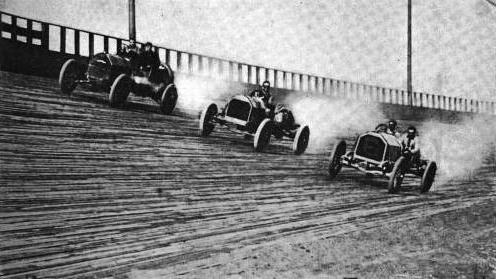
A Buick, a Cole and an Apperson contest on the Playa del Rey’s banked boards, 1910.
On its first anniversary, April 8-9, 1911, Playa del Rey held a 24-hour race. Its $25,000 of lighting was tried out the night before, with the Los Angeles Times reporting “… the lights glowed like an aurora borealis and attracted a large crowd from the beach resorts.” The race had fourteen cars co-driven by 28 drivers. A Fiat Forty-Five won, travelling 1491 miles averaging 62.125 mph.
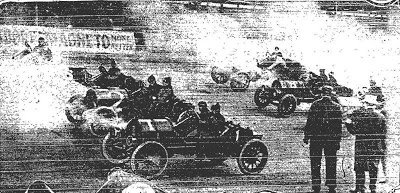
The start of the Playa del Rey 24-hour race, April 8-9, 1911. The Fiat in the center of the front row finished first.
A year later, attendance at a Playa del Rey event was 10,000; this, only one day after a major Santa Monica Road Race nearby. According to the Los Angeles Times, May 8, 1912, there was aerial excitement as well: “Two daring aeroplanists came hurtling through the air over the boards of the pie-pan and gave the throng a new thrill yesterday.”

Playa del Rey was home to the Aero Club of California, 1910.
Throughout the country, board tracks caught on big time. Of the 123 championship events sanctioned by AAA from 1920 through 1931, 82 were on wood, 12 on Indy bricks and the remaining 29 on dirt or road surfaces.
Because of their banking, some in excess of 45 degrees, board tracks had considerably higher speeds than Indy’s. In 1926, a car lapped a board track in Miami at 143 mph; it could manage only 112 at Indy. Banking increased to the point that cars were unstable at anything under 100 mph. Not that they were all that stable above it.
Deaths marred the sport. Events were filled with flying splinters and wooden shards. Cars had splinter-guards on their radiators. Drivers had no such protection. They were just tough.
In The Golden Age of the American Racing Car, Griff Borgeson relates, “You used to get hit with some terrific blocks and knots of wood. We all came in with pieces of wood bigger than kitchen matches driven into our face and foreheads. They’d go in, hit the bone and then spread out. Then you had to remove them, of course.”

Note what appears to be an airship tethered in the Playa del Rey infield.
Like plank roads, board tracks were expensive to maintain. Depending on climate, a new surface was required every five years. Patching from beneath the track—in the midst of a race!—was not unknown. There are tales of kids sneaking undertrack, popping their heads up through holes and ducking down when a car thundered by.
By the Great Depression of the 1930s, asphalt replaced wood at the nation’s tracks, with dirt remaining a fairgrounds option. Two New York board tracks persisted: Coney Island Velodrome had its last race in 1939, Castle Hill Speedway in the Bronx continued into the 1940s. Both ran cars in the midget class.
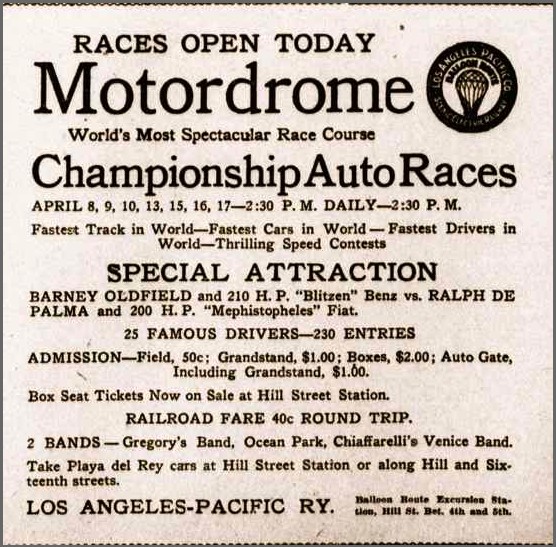
The Motordrome had its heyday.
Playa del Rey’s history was decidedly shorter, abruptly concluded because of a fire on August 11, 1913. Vagrants sleeping beneath the track were blamed, though Broadway raconteur/sports writer Damon Runyon had the best line: “Playa del Rey burned last night with a great saving of lives.” ds
© Dennis Simanaitis, SimanaitisSays.com, 2015
 Simanaitis Says
Remarkable story. Thank you. I’m writing a novel about a board track racer.
Thank you, Jeff. Weren’t those guys courageous racers! Good luck with your book. I hope the story of the kid poking his head through the track is true.