
Simanaitis Says
On cars, old, new and future; science & technology; vintage airplanes, computer flight simulation of them; Sherlockiana; our English language; travel; and other stuff
ROAD & TRACK, PLANK AND BOARD, RESPECTIVELY
IN THE infancy of automotive travel—and racing—California was the home of a road—and a track—made of wood. Today, I share tidbits of plank roads; tomorrow, of a board track.
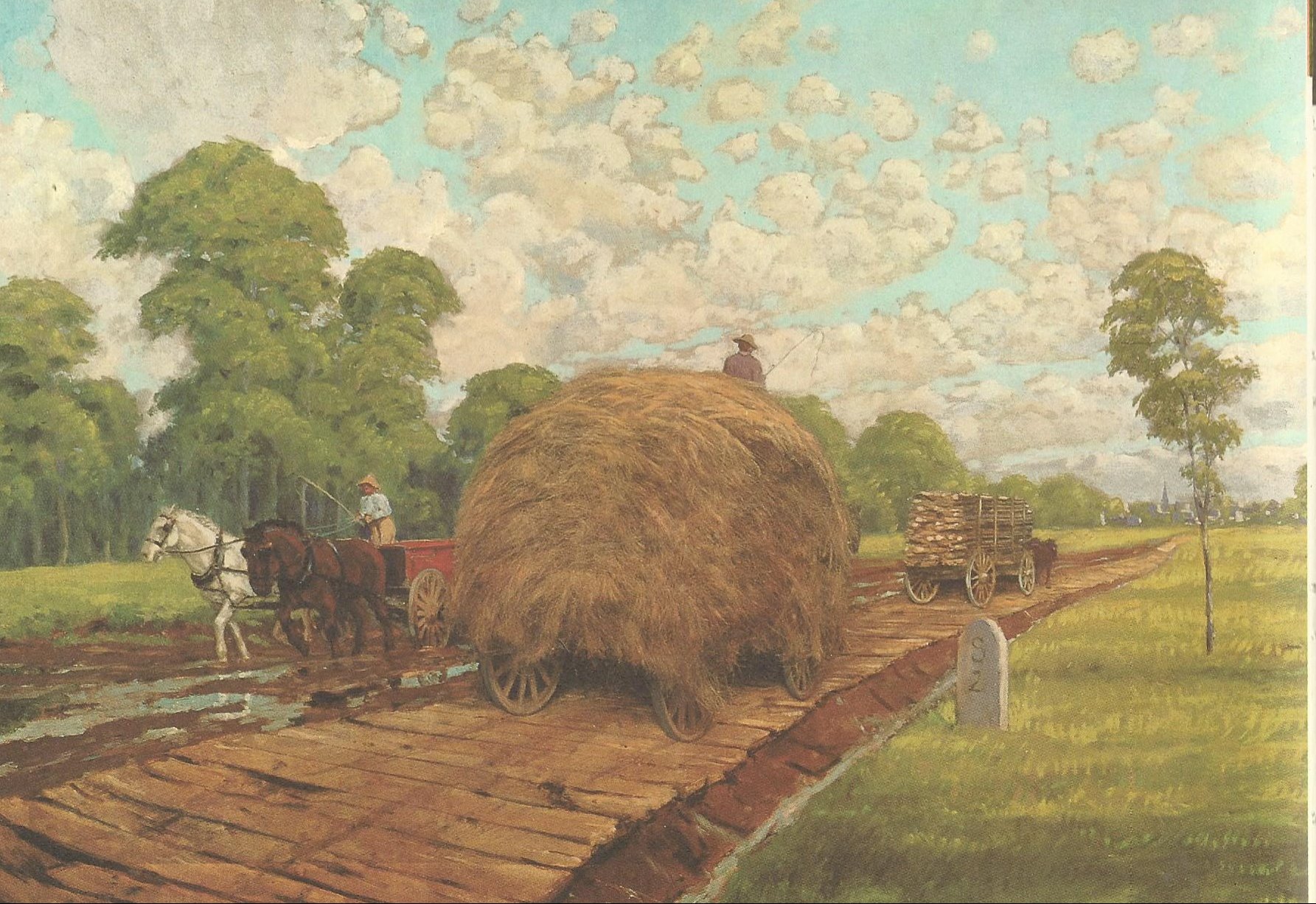
A plank-road craze began in the U.S. in 1846. This and the following image from American Roads: From Frontier Trails to Superhighways.
The idea of a wooden road surface wasn’t new. Between 1834 and 1850, Canadians were using timber for some 500 miles of plank roads through the wilderness. In 1846, in upstate New York the Salina and Central Square Plank Road was built between Syracuse and Central Square, near Oneida Lake. Hemlock was chosen for the road surface, and in time for its underlying supports as well. Today’s Interstate 80 follows the original 20-mile route.

The Salina and Central Square Plank Road, upstate New York, 1846. The offsets helped getting back on the surface.
For about 10 years, there was a plank-road craze in the U.S., just long enough to display the concept’s biggest shortcoming: Wood decomposes. Its use continued, but only in places where macadam or concrete roads were thought impractical. Like across the Algodones Dunes in the southeastern tip of California, to the east of Wife Dottie’s (and Cher’s) birthplace, El Centro, California.
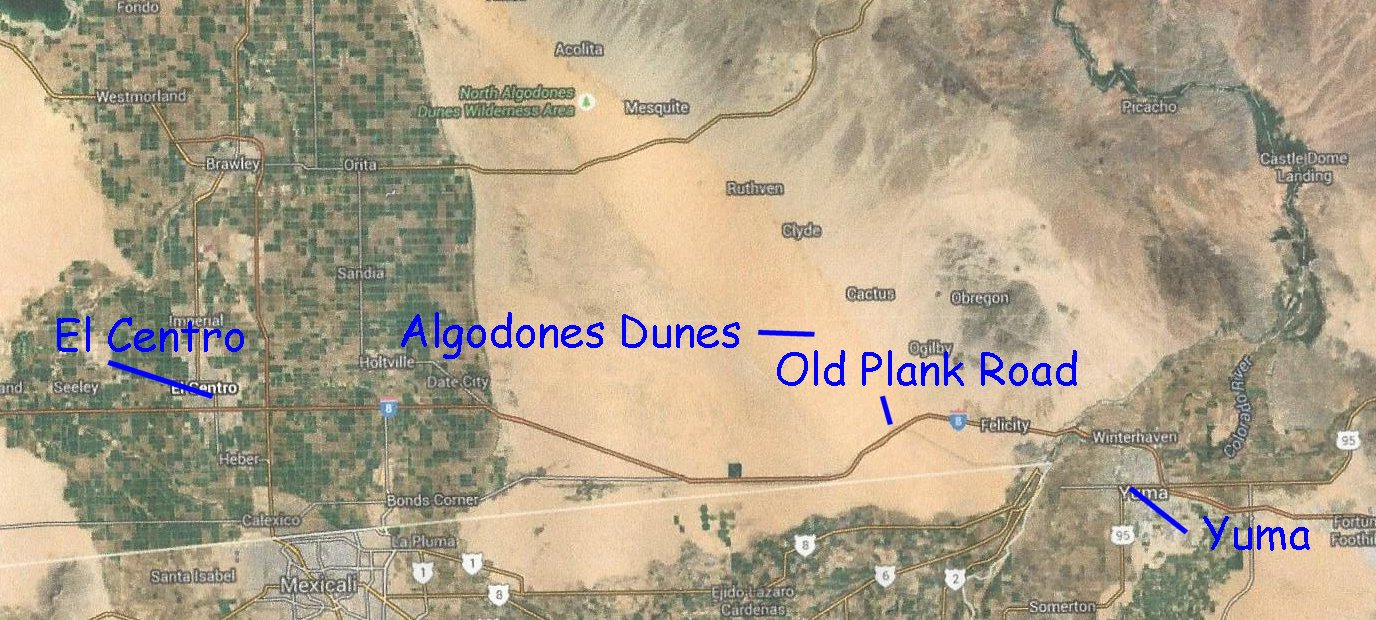
The Algodones Dunes, known locally as the Sand Hills, Google Satellite View. The dunes appear in Road to Morocco, Flight of the Phoenix and Return of the Jedi.
In 1915, San Diego entrepreneur Ed Fletcher promoted his city against rival Los Angeles by challenging a Los Angeles Examiner reporter to a California-to-Phoenix auto race. The reporter was even given a 24-hour headstart from Los Angeles (372 miles away), but Fletcher won out from San Diego (354 miles). It helped that he had a team of horses towing his car across the Algodones Dunes on the way to Yuma.

Two of Yuma’s attractions, c. 1913. Image from Arizona Good Roads Association Illustrated Road Maps and Tour Book, 1913, reprinted by Arizona Highways magazine, 1992.
Fletcher’s victory encouraged him to order up 13,000 planks of pine, enough for 6 1/2 miles of 25-in.-wide parallel tracks across the dunes. What became known as the Old Plank Road opened in April 4, 1915.

Two parallel tracks of the first Old Plank Road. Image from US80.
A second, wider, roadway built in 1916 used 8-ft.-wide prefab sections instead of the parallel tracks, with double-width turnouts every 1000 ft.

A display of the Old Plank Road at Yuma Quartermaster Depot State Historic Park. Image by Cbl62.
As with other plank roads, upkeep was reasonable for 10 years. By 1926, however, a concrete surface was laid atop the sand embankment. The route would later become U.S. Route 80 and, in time, Interstate 8.

Remnant of Old Plank Road. Image from desertusa.com.
Today, a remnant of Old Plank Road can be seen at the west end of Grays Wells Road, a frontage road paralleling I-8, near Winterhaven, California. A 1500-ft. replica lies at a monument and interpretive display three miles west of the Sand Hills exit.
Tomorrow, we travel north to Playa del Rey and its Los Angeles Motordrome board track. ds
© Dennis Simanaitis, SimanaitisSays.com, 2015
 Simanaitis Says
The ever wide and ever amazing breadth of Dennis’s interests never ceases to amaze me! Hoo-rah!
Many thanks, Mark. It’s the research opportunity that amazes me. Good fun.