
Simanaitis Says
On cars, old, new and future; science & technology; vintage airplanes, computer flight simulation of them; Sherlockiana; our English language; travel; and other stuff
ブリヂストン美術館—BRIDGESTONE MUSEUM OF ART
SHOJIRO ISHIBASHI chose the name Bridgestone for his company in 1931 for two reasons: His surname is literally ishi (stone) bashi (bridge); and he liked the British sound of its reversed rendering, Bridgestone. Long a lover of art, especially French Impressionist and Japanese, Ishibashi established a museum in 1952 as part of celebrating his company’s 20th anniversary and its new Tokyo headquarters.
Today, the Bridgestone Museum of Art is a 15-minute amble up Chuo-Dori from the center of Ginza, Tokyo’s high-style shopping district. It’s quite the neighborhood, with another cultural wonder, Kabukiza, just a few minutes’ walk on Harumi-Dori from Ginza’s landmark Waco Clock intersection.
Just as Kabukiza is in a fancy new building on the old site, the Bridgestone Museum of Art is also getting a new home at its original location; the museum being closed for several years from May 18, 2015. Fortunately, though, it maintains a well-executed website in a choice of Japanese or English, with a search function of its collection, textual and audio presentations of significant works and a museum shop .
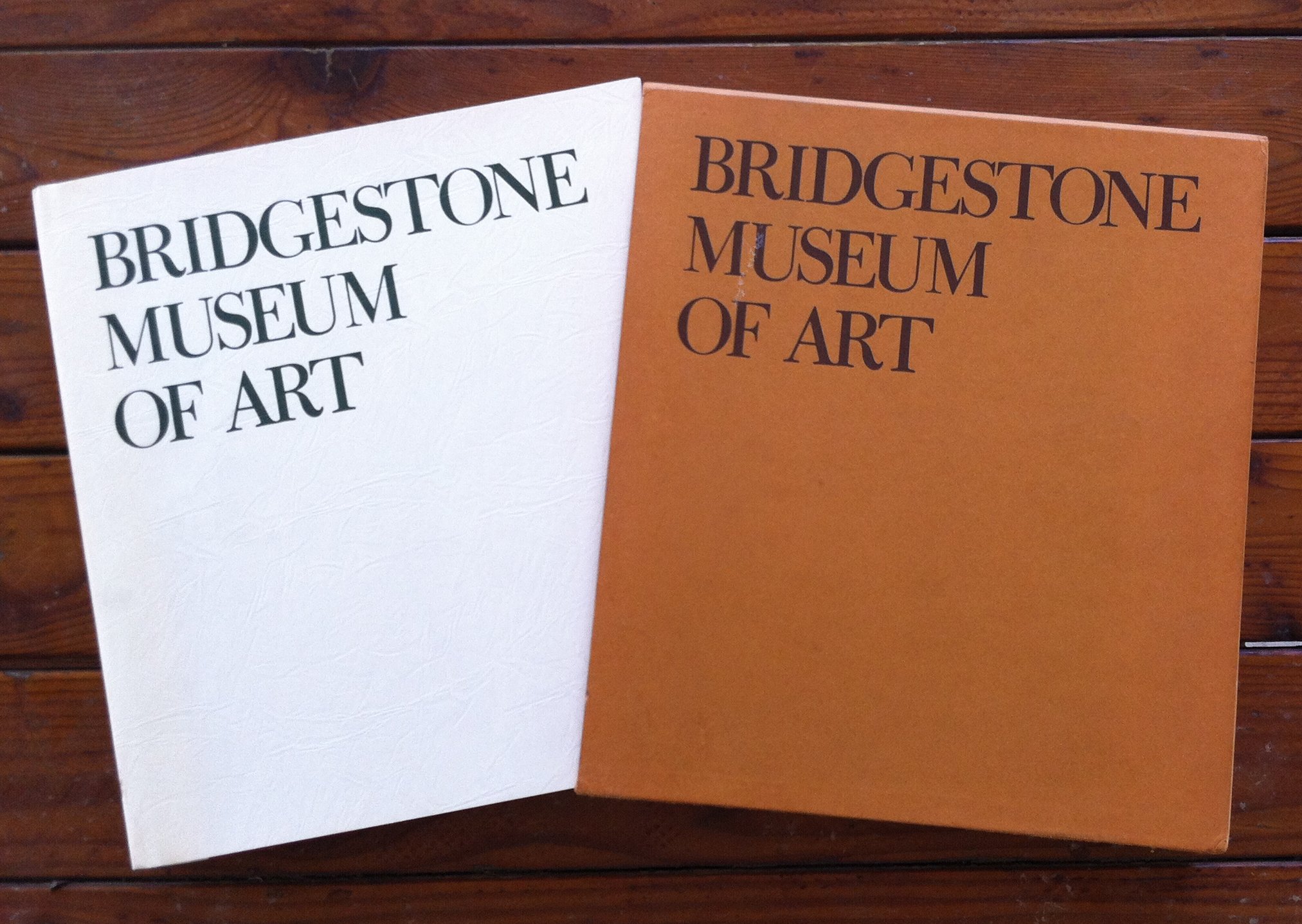
Bridgestone Museum of Art, published by the museum in 1977, updated periodically.
The museum has also published a large-format (10 x 11 in., 5.6-lb.) art book of its holdings. Here are several of my favorite works from the collection.
French Post-Impressionist Henri Rousseau, 1844 – 1910, initially worked as a Paris tax collector, only dabbling in art. Though he never left France, his best known works are paintings of jungles and wild animals.

Quay d’Ivry, by Henri Rousseau, oil on canvas, c. 1907.
The museum notes that Rousseau was also fascinated by modern mechanized civilization. For example, his painting Quay d’Ivry shows an early flying machine, likely the French airship La Patrie. There’s good detective work in assessing the date of the painting: La Patrie first flew across Paris skies in 1901. However, its stabilizers shown in the painting weren’t added until 1907. By the way, Rousseau incorporated another early flying machine, the Wright biplane, in Pêcheurs à la ligne avec aeroplane in 1908.
Danish-French Impressionist Camille Pissarro, 1830 – 1903, came by the Danish portion of his heritage through birth on St. Thomas, then part of the Danish West Indies. Regarded as the dean of the Impressionists, Pissarro studied in Paris in the 1840s, returned to St. Thomas for a time, then returned to Paris in 1855. Later he lived in Pontoise, on the River Oise, a Seine tributary, about 25 miles northwest of Paris.

Vegetable Garden, by Camille Pissarro, oil on canvas, 1878.
Pontoise had a dual character in the mid-19th century, factories on both sides of the Oise, yet it was also a major agricultural center. Including a cabbage field prominently in one of his Pontoise landscapes (Pissarro did more than 300) was considered something of an artistic vulgarity by critics of the first Impressionist exhibition in 1874.
Fernand Léger, 1881 – 1955, was a French painter, sculptor and filmmaker. His works evolved from cubism to a more figurative style of flat, geometric shapes. Léger’s works are also seen as forerunners of pop art.

Abstract Composition, by Fernand Léger, oil on canvas, 1919.
Léger also took an interest in theater set design. His scenery for Darius Milhaud’s La Création du Monde, 1923, has appeared at this website.
In his comments opening the museum in 1952, Bridgestone founder Ishibashi credited the works of Japanese artist Shigeru Aoki, 1882 – 1911, with awaking his interest in collecting art.
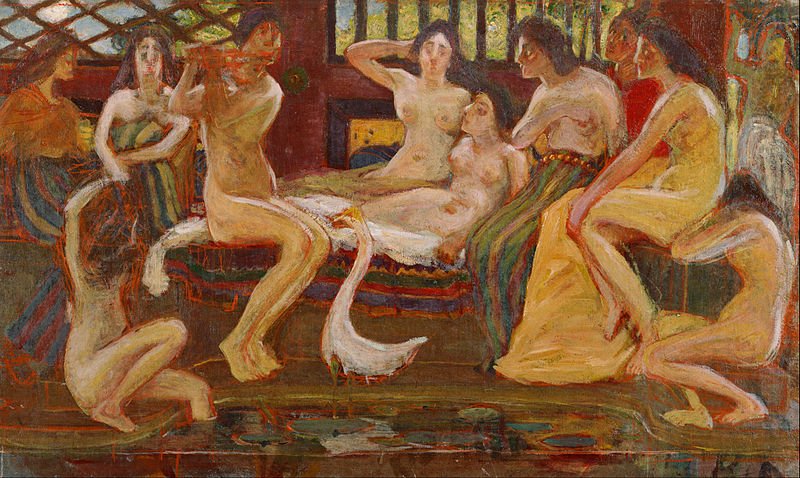
The Tempyo Era, by Shigeru Aoki, oil on canvas, 1904.
Aoki, the eldest son of a samurai, was caught up in the Meiji era of Japan’s westernization. Though he never ventured outside Japan, Aoki’s love of western art, literature and mythology was evident in his artistic output. He was heavily influenced by the English Romantic movement of the mid-19th century and its preference for classical themes. Aoki sensed a similarity with Japan’s Tempyo Era, named for emperor Shōmu-tennō, reigning 729 to 749.
Museum founder Ishibashi and artist Aoki shared a hometown, Kurume, Kyushu, 600 miles west of Tokyo. Ishibashi cited special pleasure in helping Aoki’s works gain recognition. More than this, the Bridgestone Museum of Art has provided these works with a good home. ds
© Dennis Simanaitis, SimanaitisSays.com, 2015
 Simanaitis Says