
Simanaitis Says
On cars, old, new and future; science & technology; vintage airplanes, computer flight simulation of them; Sherlockiana; our English language; travel; and other stuff
THE FUTURE AIN’T WHAT IT USED TO BE
FUTURISTS HAVE a real challenge: Aim too high, and people ridicule their “Tomorrow everyone will helicopter to work.” Aim too low, “Speaker phones will be all the rage!,” and their predictions look like last week’s newsreel.
What’s a newsreel, grandpa?
Either way, futurist thinking has generated fascinating art. The publisher Taschen has a neat book in its Icon series on this topic: Future Perfect: Vintage Futuristic Graphics (Icons Series)
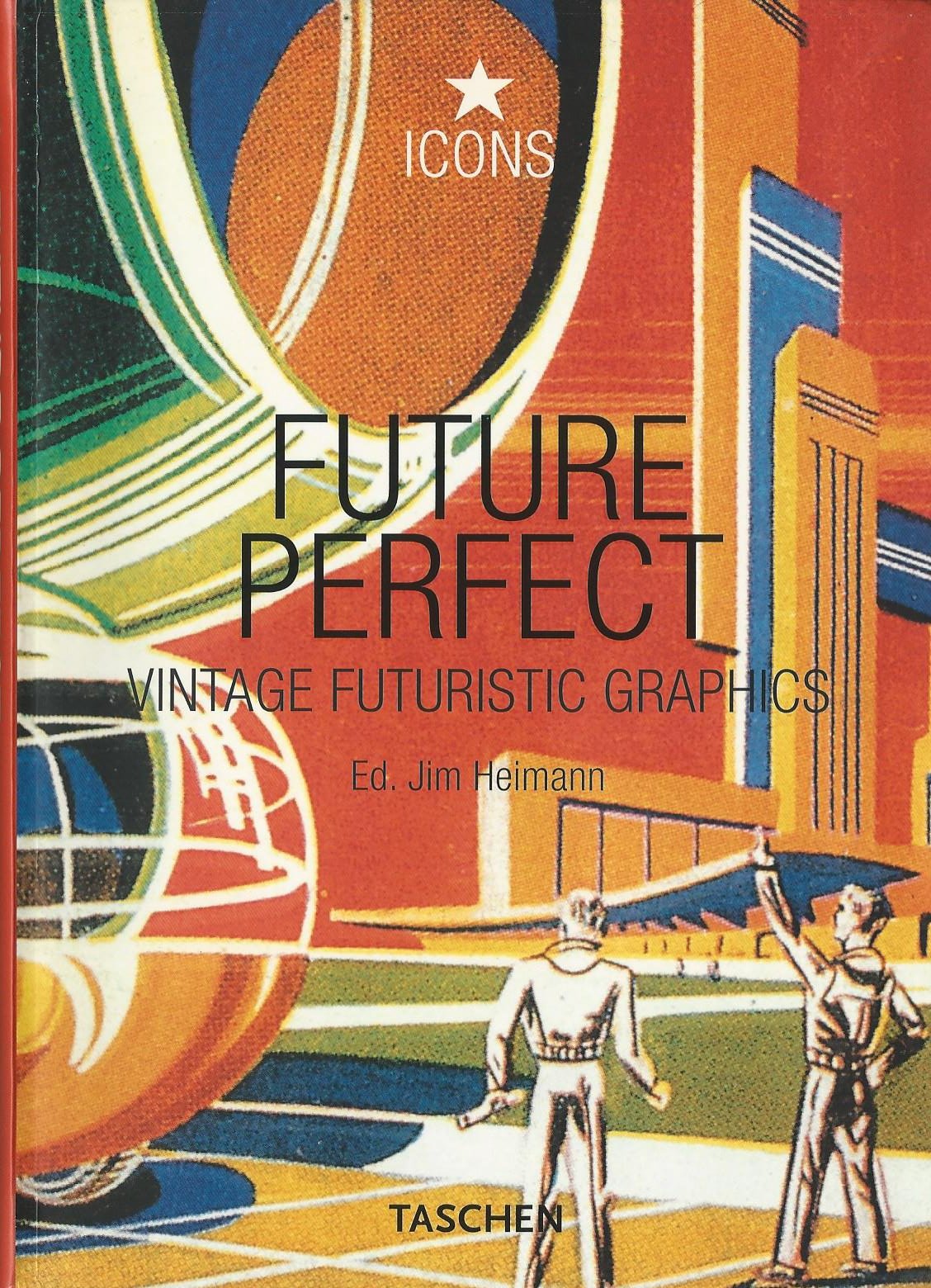
Author Bruce McCall contributes “Futures That Never Arrived,” an introduction to Future Perfect. He notes a roughly four-decade period [the 1920s through 1950s] that “was, in hindsight, a golden age of galloping optimism.” Technical exuberance of the 1920s got positively giddy (albeit less scientifically feasible) during the Great Depression. World War II and the post-war era evolved to include atomic visions in its Utopia.

Even a nuclear age had its positive marketing aspects. These and other images from Future Perfect.

We’d question today the blast survival of an all-concrete home, but it was a pitch in the late 1950s. Despite another ad promising a blooming desert through atomic power, I confess this is a view missing in my desert drives today.

Other predictions were technically feasible, but proved socially unacceptable. Sure, cell phones can connect airline passengers. But society has decided there are few annoyances quite as strong as having another person’s inane chatter interfering with one’s personal sphere. Forget interference with a plane’s avionics. This danger is far outweighed by human interference.
The world of aviation offered another post-war dream. Futurists predicted that pilots returning from military service would buy private planes for family travel. Four-passenger amphibian aircraft were seen as the perfect marketing fit.

Emphasized this Goodyear Aircraft ad, “… America must set the pace—must show the way—and only your whole-hearted acceptance of aircraft can bring that about.”
Actually, the vast majority of WWII pilots gratefully swapped their wartime cockpits for peacetime personal transportation of the land-borne variety. As an example, Republic Aircraft hoped for 5000 sales each year of its RC-3 Seebee. In the two years of its production, 1946 – 1947, only 1060 of these amphibians found homes.
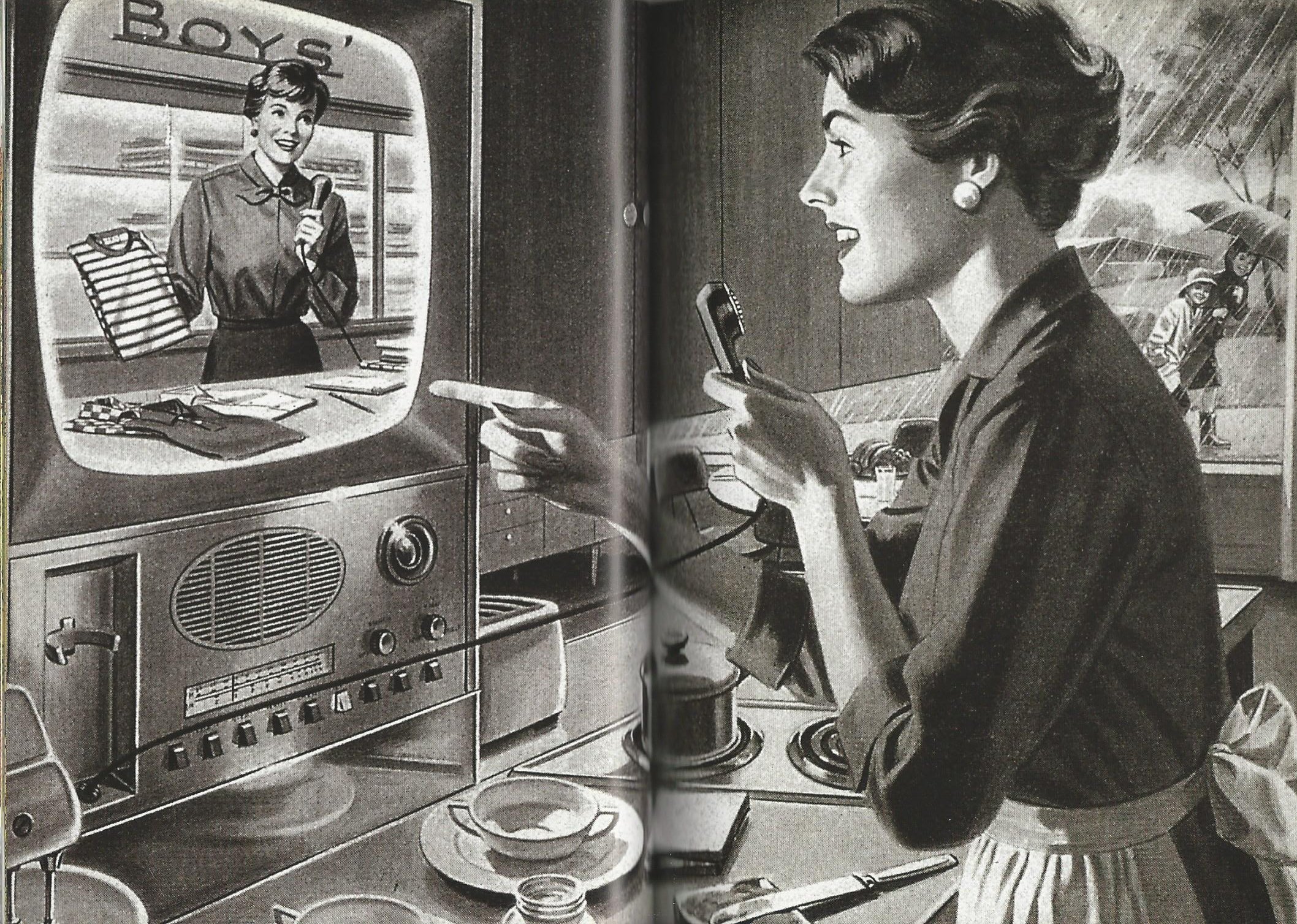
By contrast, the idea of home shopping has caught on big time, though its means are decidedly more compact than predicted. It would have taken a brave futurist in the 1940s to foresee a smart phone, a personal computer and, all the more, an Amazon.com.
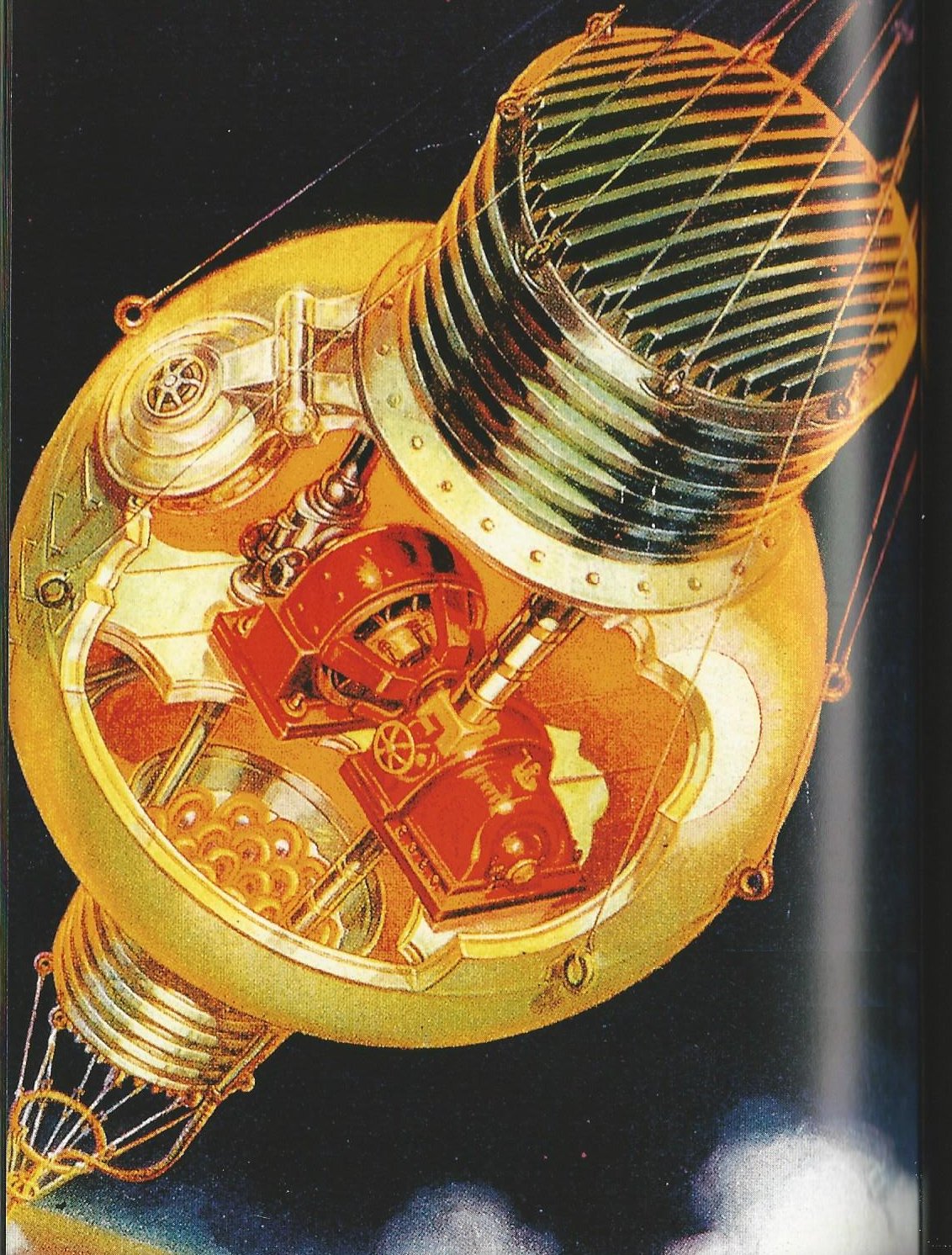
Some of my favorite futurist graphics are the ones of no known scientific merit; they’re just fun. This odd floating globe certainly contains sufficient gizmos to do something or other. I wonder what it does? ds
© Dennis Simanaitis, SimanaitisSays.com, 2015
 Simanaitis Says
It appears on-line shopping addiction was accurately predicted . . . her toast has gone cold. (Those kids outside will be addicted soon enough.)