
Simanaitis Says
On cars, old, new and future; science & technology; vintage airplanes, computer flight simulation of them; Sherlockiana; our English language; travel; and other stuff
LA PLUME DE MA TANTE’S
I HAVE long been puzzled by double possessives, also known as the double genitive case. “The feather of my aunt” versus “The feather of my aunt’s.” Which is correct?
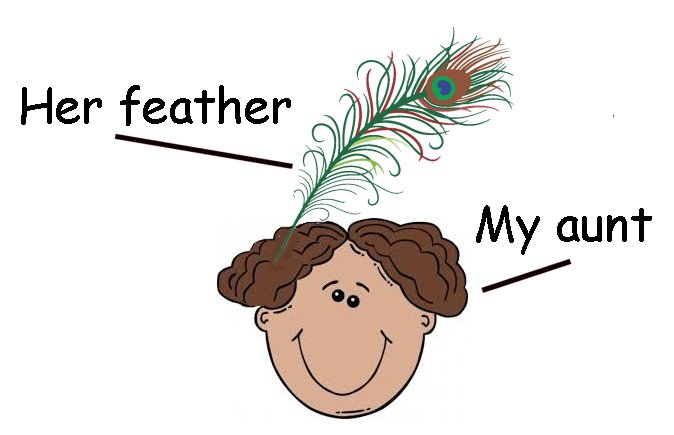
This hassle doesn’t exist in two other languages of my (faint) familiarity: “La plume de ma tante” is the only French choice, de being the preposition “of.” In Japanese, it’s 私の叔母の羽, watashi no oba no hane. I think of the post-positional character の as being equivalent to our apostrophe; literally, this Japanese sentence is “I’s aunt’s feather.”
But what about that added ’s in the feather of my aunt’s? Isn’t it redundant?
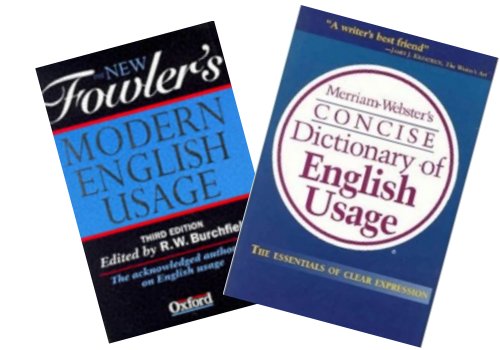
The New Fowler’s Modern English Usage, Oxford University Press, 1996, and Merriam-Webster’s Dictionary of English Usage, Merriam-Webster, 2002.
I consulted several grammatical sources, including The New Fowler’s Modern English Usage and Merriam-Webster’s Dictionary of English Usage. Here’s what I learned.
First, for those who just want to have a rule and get on with their lives: Avoid double possessives when the object is inanimate. However, they’re okay with humans.
Wrong: “the suspension of the car’s.” Okay, especially in informal use: “a pal of Dottie’s.”
For those who are more grammatically inquisitive, there are subtleties galore. As in any usage, clarity should be the goal. For example, “a portrait of the king” is wonderfully ambiguous: Does it portray the king’s image? Or does he own the portrait? Or both?
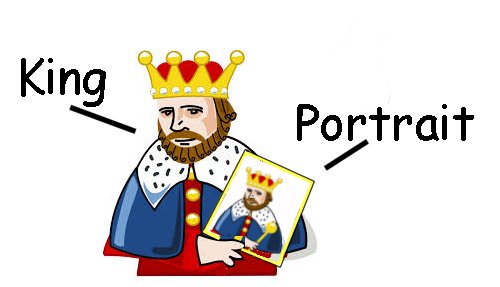
By contrast, “a portrait of the king’s” nails its ownership, although it still leaves the portrait’s subject up for grabs.
I suspect there’s even more ambiguity lurking in the word “subject” (as in “subject of the king/the king’s subject”), but let’s leave this undiscussed. It’s too close to a pun for my taste.
Another subtlety crops up if there’s also a possessive pronoun involved, his/her/its/their. “Dottie is a pal of his” sure sounds more natural than “Dottie is a pal of him.”
Double genitives go way back in the English language, even into Middle English. For a while there, they were utterly taboo. Merriam-Webster notes, “The 18th-century grammarians simply had a horror of anything double, because such constructions did not occur in Latin.”
As I have no Latin (other than a vague recollection of its Vulgate church vernacular), this rule doesn’t work for me.
There’s always a work-around with the apostrophe/s option: “Dottie’s pal” deftly sidesteps the quandary. However, that pesky king and his pic are still open to question in “the king’s portrait,” though I for one would be surprised if it turned out to be an image of anyone but His Highness.
What about you? ds
© Dennis Simanaitis, SimanaitisSays.com, 2015
 Simanaitis Says