
Simanaitis Says
On cars, old, new and future; science & technology; vintage airplanes, computer flight simulation of them; Sherlockiana; our English language; travel; and other stuff
LASERS OVER MAHWAH
IT’S NOT exactly Bullets Over Broadway, but Lasers Over Mahwah is the reality of High Frequency Trading of stocks, as practiced in one of the world’s major centers of such activities, Mahwah, New Jersey, just across the Hudson River from New York City.
I’ve been interested in HFT; to wit, the topic appeared in my website’s “Trading in Nanoseconds,” http://wp.me/p2ETap-2de.

This latest information comes from the same original source, the London Review of Books, in this case, its September 11, 2014 issue. The article “Be Grateful for Drizzle,” is by Donald MacKenzie. Here’s a collection of HFT tidbits gleaned from it.
As its name implies, High Frequency Trading is accomplished at amazingly high speed, these days approaching nanoseconds, billionths of a second. It’s all done by computers located near the primary servers, the mother computers supporting the New York Stock Exchange, the Nasdaq, the Chicago Mercantile Exchange and their equivalents in London, Frankfurt, Toyko and other world financial centers.

Banks of computers are at the heart of High Frequency Trading.
These primary servers are typically located in relatively low-rent areas near their respective cities. The NYSE server is in Mahwah, Nasdaq’s is down the road in Carteret, upstart BATS’ (the Better Alternative Trading System) is in Weehawken, all in northern New Jersey. The Chicago Mercantile Exchange server is in Aurora, Illinois, west of the city’s sprawl. One of the London centers is in Slough (original home of TV’s The Office), to the west just past Heathrow Airport.
High frequency traders locate their computers as near to these as possible. This proximity is because time, literally, is money.
HFT profits come primarily from two strategies: front running (identifying an incipient trade, buying the stock first, then selling it to the intended buyer at higher price) and market arbitrage (buying stock on one exchange, selling it higher on another before this second exchange has reacted). Each strategy requires identifying a buy/sell match and getting in between the two activities before consummation. Because of this, there’s a speed race among HFT firms.
Fiber-optics data travel at two-thirds the speed of light, around 125,000 mph. A round-trip HFT communication between Chicago and Mahwah now takes perhaps 13 milliseconds, 0.013 sec., quicker than an eye blink. Such is the speed that the paths of fiber-optic cable routing are important; a shorter cable length has become significant.
Wireless transmission is quicker still, microwaves traveling at essentially the speed of light. These require line of sight and, as distances increase, repeaters. There’s been talk of suspending relay gizmos in balloons.
Millimeter waves, at the high-frequency end of the invisible spectrum, are the next increment. Their extremely high frequency makes them efficient for transmission of large amounts of data.
The latest technology involves Free-Space Optics, lasers of even higher frequency, in the visible portion of the electromagnetic spectrum. Their advantage is enhanced bandwidth carrying even more data than millimeter waves. Just the thing for HFT.
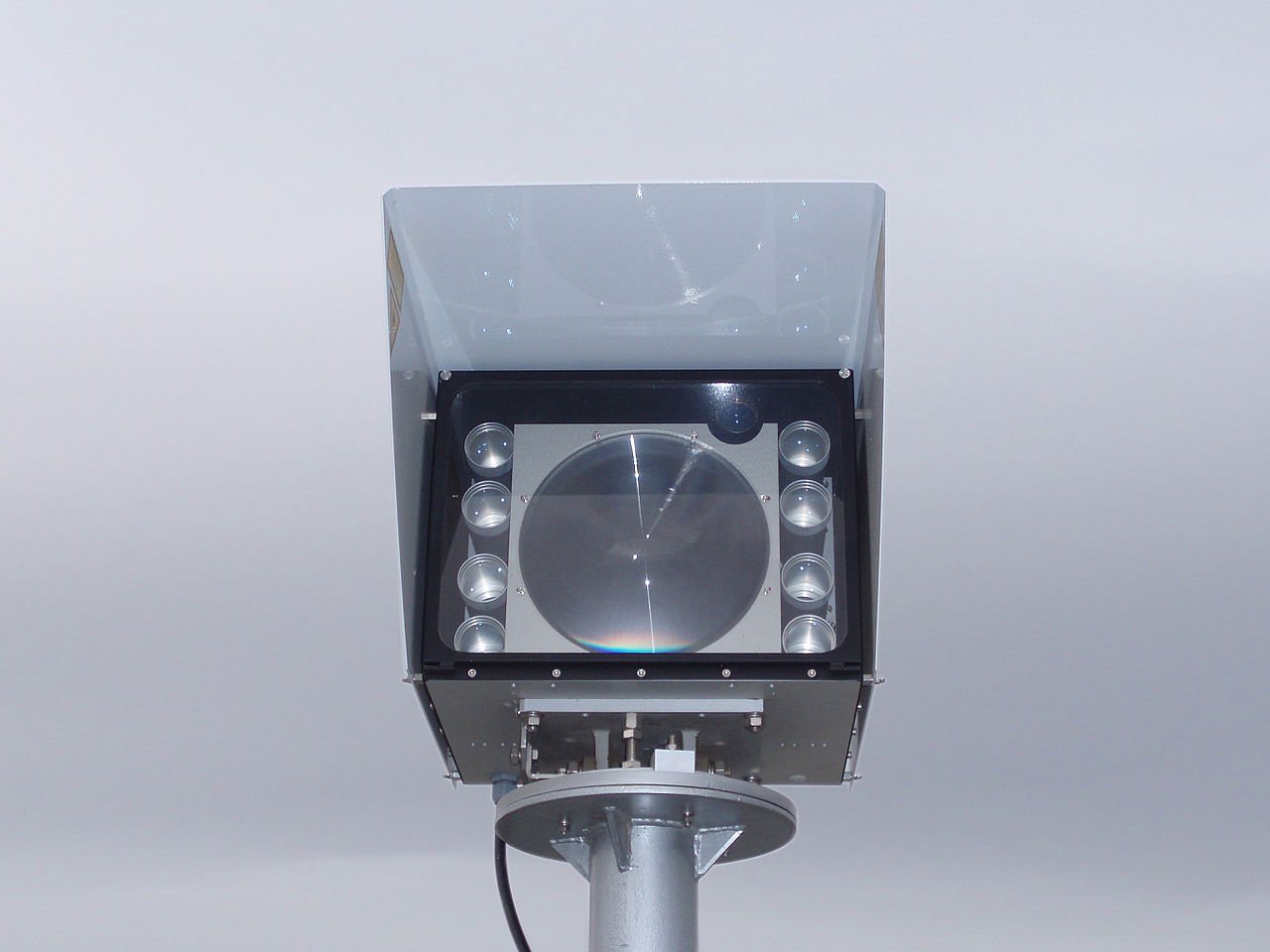
A Free-Space Optics laser link. The receptor is the large disc; transmitters surround it. Image by Adamantios.
Weather has an effect on these wireless technologies, with rain being potentially disruptive. Indeed, it turns out that London rain droplets are smaller than New Jersey’s, bad news for London lasers.
Computer banks are isolated and already kept colder than human operators would tolerate for an extended time. The extreme option of encasing computers in liquid nitrogen has been suggested. This would allow superclocking, running them at higher speed albeit generating more heat. However, HFT specialists say the rent abutting primary data centers is high enough already.
And with speed comes risk. Mistakes happen incredibly quickly.
One HFT programmer erroneously clicked on an obsolete trading program. In 45 minutes, on August 1, 2012, the company lost $440 million.
At another company, a programmer made a simple keystroke error of the ± sort. Within 53 seconds, $3 million was lost. Had it gone another 20 seconds before correcting, the firm would have gone bankrupt; another 50 seconds and its banker would have gone belly-up too.
Double-check those signs, kids! ds
© Dennis Simanaitis, SimanaitisSays.com, 2014
 Simanaitis Says
Technically fascinating … but it’s removed any remaining vestige of The Market’s relevance to human society.
Phillip,
The LRB author Donald MacKinzie makes an interesting comment about priorities of the world’s financial systems: “I’d say high on the list should be putting people’s savings to the socially most productive uses, while preventing too much of those savings being wasted along the way.”